This site uses cookies. View our Cookie Policy to learn more about how and why.

Regular hours: 9:30 am – 6 pm
Last entry at 5 pm

A white wave shape.

The Seattle Aquarium’s exciting research initiative focused on the ancient, elusive sixgill shark

Did you know one of the world’s largest shark species is not only found in the waters of Puget Sound—but that individuals have also been spotted directly under the Seattle Aquarium’s Pier 59?

Sixgill sharks (Hexanchus griseus) can grow to be up to 14 feet in length. They’re found worldwide, in tropical and temperate waters (such as those of the Pacific Northwest). And they’ve been around for literally millions of years—since before the dinosaurs, in fact.

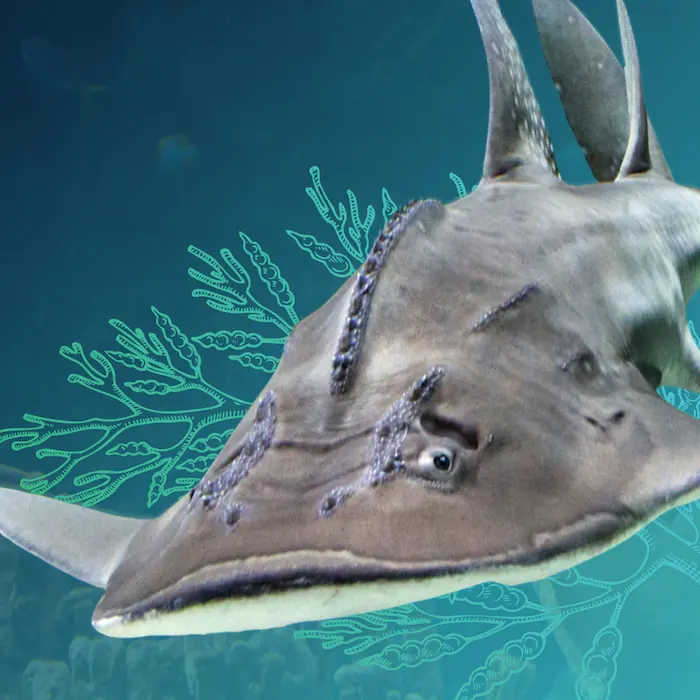
Look closely and you’ll see where sixgill sharks got their name!

However, beyond some of the basics, little is known about this species. Why? Because they tend to live deep in the ocean—up to 9,800 feet, or nearly two miles, below the surface!—and they’re elusive, typically preferring very low-light environments. For these reasons and others, it’s difficult for researchers to study them. But, fascinatingly, they’ve been sighted year-round in our local waters, at depths as shallow as 20 feet, which presents us with a unique opportunity to learn more about them.

Getting to know the sixgill shark

While most of the world’s 500+ shark species have five gill slits, aptly named sixgills have six slits along the sides of their heads. With their six gill slits and dimorphic teeth (which means the top teeth are different from the bottom), they bear a closer resemblance to extinct shark species than living ones—which is understandable, given how ancient they are.

Speaking of ancient: Sixgill sharks are presumed to have long life spans, and it’s thought that they reach sexual maturity later in life (20–25 years for males and 30–35 years for females). These two factors together make them vulnerable to overfishing—in other parts of the world, they’re often caught as bycatch or targeted for food and sport. They’re now classified as Near Threatened by the International Union for Conservation of Nature (IUCN) and included on the Washington state list of Species of Greatest Conservation Need.

Lastly, they’re carnivores, preying on bottom-dwelling fish and invertebrates (or animals without backbones).

Sixgills are hard to study because they spend most of their lives in deep water and prefer dark conditions—as seen in this photo.

A rare—and unique—opportunity to learn more

Much about the biology and life history of sixgill sharks is unknown. But, using the opportunity presented by their presence in our local waters, the Seattle Aquarium is launching an initiative to increase the body of knowledge about these mysterious creatures. (Or perhaps we should say re-launching. See our FAQ below to learn about our previous work with this species.)

Former Aquarium Dive Safety Officer Jeff Christiansen with a sixgill shark in the early 2000s.

You may be wondering: If these sharks are typically found deep in the ocean, what are they doing in the shallower waters of Puget Sound? Scientists believe females are using our local waters as a birthing area. New Seattle Aquarium research shows that females have birthing site fidelity—in other words, they return to the Salish Sea to give birth multiple times (the amount of time between pregnancies isn’t known). Once the pups are born, the Sound becomes their nursery for another unknown period of time—they remain, it’s believed, because of an abundance of prey.

These young sixgills are referred to as juveniles and subadults. They reside in more southern Salish Sea* sites in the summer and fall, and make small northward migrations in the winter and spring. Their daily movements are typically less than two miles per day: They often rise to shallow water at dusk and descend to deeper water at dawn—likely in search of prey. We think these patterns repeat until they eventually depart for the open ocean.

This consistency of movement and behavior reinforces the strength of our opportunity to study sixgill sharks in Puget Sound.

*Not sure about the difference between Puget Sound and the Salish Sea? Check out our webpage!

Gathering data to increase knowledge and inform management

Through our research, we hope to answer questions about the life history and ecology of sixgill sharks—including migration, growth rates and prey preferences. In addition, given the difficulty of studying these animals, we aim to investigate aspects of their physiology that have never been examined. We also want to understand human impacts, such as how baiting affects sixgill shark movement in Puget Sound.

We’ll share our data and results with the scientific community at large, as well as relevant partners and conservation agencies to help inform management of the species.

"When people think of Puget Sound, they usually picture orcas and other marine mammals. Many are surprised to discover that large sharks live right here in our backyard. I’m excited to seize the opportunity to learn more about these elusive predators thanks to advances in research methods and technology that allow us to further explore a species that remains largely understudied.

Our goal is to answer as many questions as possible—everything from human impacts to physiology to their potentially important ecological role in Puget Sound. We’re collaborating with agencies like the Washington Department of Fish & Wildlife, the Big Fish Lab at Oregon State University, Point Defiance Zoo & Aquarium and other researchers to fill gaps in expertise, all while keeping animal health and well-being our top priority."

Summer of discovery

Starting in May, Seattle Aquarium researchers will attempt to study sixgill sharks at three different Puget Sound locations: off Redondo Beach, in Elliott Bay (near the Aquarium) and in the waters off southeast Bainbridge Island. They’ll visit each site once per month through September.

Most research will take place on the Seattle Aquarium’s vessel. Sharks will be carefully brought to the surface, and depending on their size, will either be quickly lifted on board the vessel using a custom-made cradle or secured at its side and placed on their backs to enter a state of natural tonic immobility.*

Once secured, they’ll be examined by our team—which will always include a veterinarian with extensive shark experience. Sharks alongside the boat will be kept partially submerged to ensure proper aeration of their gills; those on deck will be ventilated using seawater passed over their gills.

We created a custom “cradle” to safely hold a shark while our team works quickly to examine it.

Working swiftly over five to 10 minutes, the team will collect measurements, obtain tissue samples and deploy tags that will provide valuable data about movement, feeding ecology and habitat use. They’ll also take photos to assess whether photo identification is a viable method to identify individuals of this species. With all data collected, sharks will be quickly returned to the open water, and we’ll continue to follow their movements from afar. (See our FAQ below for more details.)

"There are lots of questions we would like to try to answer so that we can help identify what these incredible sharks need and how their lives might be affected by the world around them. For example, we have new methods, such as stable isotope analysis, to understand what they’re feeding on using small blood and tissue samples. Those same samples can help us assess the composition and genetic health of this population relative to 10+ years ago. And we can use tags to better understand their ranges and behaviors at the different sites.

Our priority throughout is the health and wellbeing of each individual—our project design is based around their care—but this gives us the opportunity to better understand an elusive species that is heavily dependent on the waters of Puget Sound."

The work will be led by Research Scientist Dr. Dani Escontrela, Director of Animal Health Dr. Caitlin Hadfield, Senior Conservation Research Manager Dr. Shawn Larson, and others. See our FAQ to learn more about the team and why they’re uniquely qualified to lead this project.

From left to right: Research Scientist Dr. Dani Escontrela, Director of Animal Health Dr. Caitlin Hadfield, Senior Conservation Research Manager Dr. Shawn Larson, Director of Animal Operations Tim Carpenter, Dive Program Manager Joel Hollander.

*What’s tonic immobility? It’s a naturally occurring state that activates when sharks are on their backs—they become calm and motionless for a short period of time, creating the opportunity for safe and painless study before they resume normal activity.

Timing is everything

Although recreational divers are currently reporting frequent sightings of sixgill sharks, we don’t know how long they’ll be around—especially since we understand that both males and females eventually leave our local waters for the open ocean, but we don’t know when.

So there’s some urgency in our project, as well as optimism. We hope to encounter a good number of sharks across all three sites, and use what we learn to increase conservation of these fascinating and mysterious animals. We’re excited to discover more about this species and to share our findings with you, as well as the scientific community, as the project progresses!

"The Seattle Aquarium has been interested in sixgill biology, ecology and conservation for over 25 years. Our efforts in sixgill research in the early 2000s taught us that sixgills were once abundant in Elliott Bay and then were not—because they were growing up, reaching adult size and leaving the Sound for the open ocean. We also found that the sixgills were from one population, and related individuals were often found in the same area.

The new research will build on our earlier work and help answer many questions about sixgill biology and ecology that remain unanswered."

FAQs

Q: Can I see a sixgill shark at the Seattle Aquarium?

A: Well…kind of. You can see an illustration of a sixgill (and how you measure up to it!) near the Caring Cove play space on Pier 59. But, to thrive, this species needs plenty of room—far more than any aquarium habitat could provide. So, while you can’t see an actual sixgill at the Seattle Aquarium, your visit will help support the work we’re doing to increase understanding of these amazing, ancient creatures.

(You can, of course, see other shark species that thrive in smaller habitats when you visit us: blacktip reef sharks, Indo-Pacific leopard sharks and dogfish!)

Q: Didn’t the Aquarium study sixgill sharks in the early 2000s?

A: Yes! In the wake of increased local sightings in the early 2000s, we actively studied the species through a research program that ran from 2003 to 2015, with a brief pause between 2005 and 2008.

During that study, bait was placed under Pier 59, and when sharks were encountered, Aquarium divers collected skin biopsies and attached external tags for individual identification. Data collected during this period helped identify genetic relationships between individuals, estimate the abundance of sixgill sharks in Elliott Bay and analyze their feeding behavior. However, a decline in sightings (273 individuals between 2003 and 2005 versus 33 individuals between 2008 and 2015) led to the program’s end, as sixgills were believed to have left Elliott Bay.

Interested in learning more? Check out this video, which features our earlier work.

Q: What qualifies the Aquarium to conduct this research?

A: The Seattle Aquarium has 49 years of experience in shark husbandry and veterinary care*, and an 11-year history of conducting sixgill shark research. Additionally, this project has been collaboratively designed with partners from the Washington Department of Fish & Wildlife, Oregon State University Big Fish Lab and Point Defiance Zoo & Aquarium, who have significant experience with sharks in the region, including sixgills. Partners will join our research trips to help brainstorm, refine methods and share their expertise with our staff.

*Dogfish, small, bottom-dwelling sharks, have been in our care since we opened our doors in 1977. Learn more about them on our webpage!

Individual members of the team also bring a wealth of experience that will benefit this project:

  • Research Scientist Dr. Daniela Escontrela Dieguez completed her Ph.D. at the University of Hawaiʻi, studying coral predators. Her research was fieldwork-intensive, and as such she has familiarity and expertise conducting research on small boats and large ships. During her undergraduate studies, she served as an intern and trip leader with the University of Miami Shark Research and Conservation Program for four years. During her time there, she participated in at least 100 shark research expeditions, where she employed many of the methods that will be implemented in this project, including securing live sharks, collecting various types of data (measurements, tissue samples, tag deployments), and releasing sharks. She has worked with hundreds of sharks from a variety of species, including tiger, bull, hammerhead, sandbar, nurse, blacknose, blacktip, Caribbean reef and lemon sharks.

  • Director of Animal Health Dr. Caitlin Hadfield, MA VetMB DACZM DECZM MRCVS, completed veterinary school at Cambridge University, which was followed by a veterinary internship at the National Aquarium in Baltimore, where she became the senior veterinarian. She moved to Seattle in 2017. She is board-certified through the American and European Colleges of Zoological Medicine and has been working with elasmobranchs for 20 years, including sharks, skates, rays, guitarfish and sawfish. She has conducted clinical research and fieldwork on a wide variety of fish and invertebrate species. She is the primary author and editor for Clinical Guide to Fish Medicine and the head of the Veterinary Working Group and part of the steering committee for the multinational zebra shark recovery project (StAR: Stegostoma tigrinum augmentation and recovery) as well as the Association of Zoos and Aquariums’ Animal Welfare Committee.

  • Senior Conservation Research Manager Dr. Shawn Larson has been involved in sixgill shark research and conservation for 24 years. From 2002 to 2015, Shawn actively participated in the Seattle Aquarium’s sixgill shark research—baiting, filming, tagging and collecting skin biopsies from free-swimming sixgill sharks below Pier 59. She also led population genetics analyses on skin samples collected at the Aquarium and from longline operations of sixgill sharks conducted by various research partners. Shawn has published six peer-reviewed papers on sixgill sharks focusing on genetics, abundance and conservation, as well as edited four books: two on Northeast Pacific sharks, one on sharks in the United States and Canada, and one on sharks in Mexico. She has also led and organized shark community meetings since 2004, starting with the Cowshark Conservation Workshop (2004–2014), which eventually became the Northeast Pacific Shark Symposium (2014–present), held every two years. Lastly, she has been a member of the International Union for Conservation of Nature (IUCN) Species Survival Commission Shark Specialist Group since 2016 and has participated in shark conservation strategies and Red List assessments. 

  • Director of Animal Operations Tim Carpenter has cared for fish and invertebrates in an aquarium setting for over 30 years and has supervised animal care and field work for 25 years. During that time, he has been responsible for planning and conducting diving field work and boat-based trips every summer in coastal and inland Washington waters, while managing the Aquarium’s permitting process for all local collections and field activities. Tim was a key participant in the Seattle Aquarium’s earlier work with sixgill sharks, coordinating on-site and underwater diving and tagging operations, and he was a primary author of the resulting paper on the distribution of these sharks in Puget Sound. He has 30 years of experience using all kinds of collecting and sampling equipment, including longlines, seines, hand collection and other field capture methods for teleosts (ray-finned fishes) and elasmobranchs.

  • Dive Program Manager Joel Hollander is a marine biologist and dive operations leader and has been at the Aquarium since 1998. A key figure in field operations, Joel has been one of the Aquarium’s primary animal collectors for over two decades, specializing in both temperate and tropical species, and has served as primary boat operator since 2005. He was also co-principal investigator on the Aquarium’s earlier sixgill shark research project and has conducted longline surveys for skates, rays and spiny dogfish.

Q: What methods will the researchers use for this project?

A: At each site, the team will deploy fishing lines for short periods of time. While lines are in the water, the team will deploy a baited remote underwater video system (BRUVS), which will help document behavior if sharks are encountered.

If a shark is on the line when it’s pulled back in, the team will quickly either secure it alongside the boat or on the deck using a custom-made cradle (depending on the size of the individual). Sharks alongside the boat will be kept partially submerged to ensure proper aeration of their gills; those on deck will be ventilated using seawater passed over their gills.

In either location, once secured, our team will work as two teams to efficiently collect a variety of data, including:

  • Length and other measurements to help answer questions about growth rates, maturity and body condition.
  • Blood, muscle and fin samples to investigate trophic ecology (e.g., food preferences), blood hematology and biochemistry values, stress indicators, toxicology and genetics.

They’ll also deploy two types of tags:

  • Floy tags will be placed on all sharks and can help answer questions about movement if individuals are sighted by divers or caught by other people. They can also help estimate population abundance if an individual encounters our team again. The tags will have big, visible numbers to help divers and others report sightings using a reporting form.
  • Acoustic transmitters will be implanted in a selection of sharks by one of our veterinarians and will provide data on movement and habitat use.

Lastly, photographs will be taken to assess whether photo identification is a viable method to identify individual sixgills.

The entire data collection process will take five to 10 minutes. The team will prioritize animal health from start to finish—if an individual displays signs of stress, poor ventilation or poor health, it will be released immediately.

GiveBIG to conservation in action.

This year, we’ve set a GiveBIG goal of $70,000, and thanks to the generous support of Al & Pat Friedrich, Clint & Barb Bennett, Marshall & Janice Brumer, Michael Klein & Catherine Melfi, and an anonymous donor, every gift will be matched up to $30,000, doubling your impact.

Join us for After Hours: New Beginnings on Thursday, April 16, to celebrate spring and all the wonderful changes that come with it.

Today only, your gift will be matched dollar-for-dollar up to $25,000 thanks to the generosity of donors Betsy Cadwallader, J & Tim, and Jess & Andy Peet. Help us reach our $50,000 goal!

End the year with a gift to the ocean.