This site uses cookies. View our Cookie Policy to learn more about how and why.

Regular hours: 9:30 am – 6 pm
Last entry at 5 pm

Marine ink-spiration: Tattoos of the Seattle Aquarium, part 4—volunteer edition II

We recently introduced you to three amazing Seattle Aquarium volunteers who show their connection to the marine environment with meaningful tattoos. The story was so nice that we’re doing it twice—we’re back with three more fascinating folks who graciously agreed to share the stories behind their ink.

Without further ado, please meet Chelsea, Chris and Taylor! And if you haven’t already checked out earlier installments of this ongoing series, we invite you to explore part 1, part 2 and part 3.
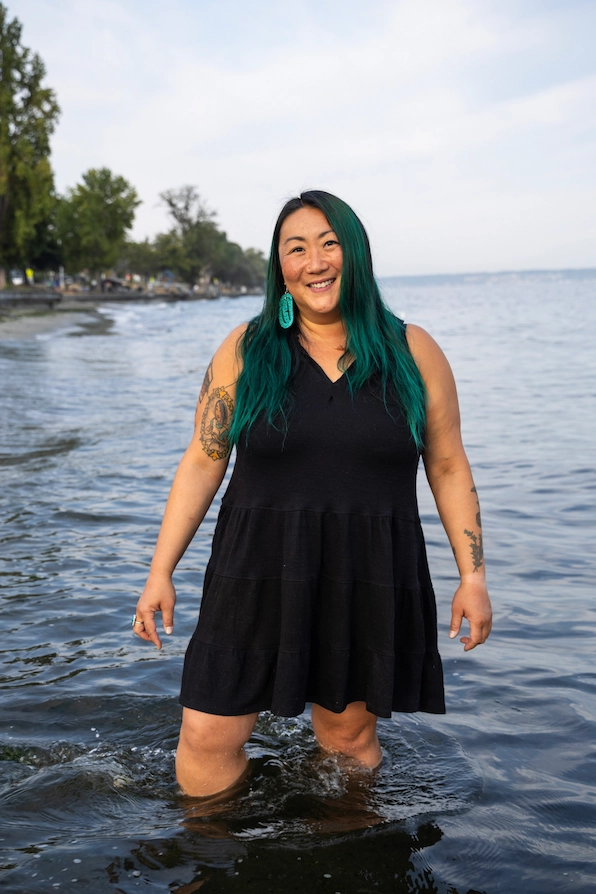
Chelsea wearing a black dress and standing in the water.

“I feel like I'm in the right place at the right time, doing the best I can with what I have. That applies to being at the Aquarium, being in my work and being in the sea. It's like a Venn diagram of those.”

I got my seal of approval last year. He’s positioned so that when I give a thumbs up, he gives one too.

I’m an open-water swimmer—unassisted, which means no wetsuit, flippers or paddles. Just a swimsuit. I train at Alki Beach and seals swim along with me all the time. I always introduce myself and let them know I’m here to respect their space, not cross any boundaries between wild animals and something I want to hug.

I did my first marathon swim in 2021, in Sitka, Alaska. There’s a doctor at that event and she was amazed because it had taken me almost four hours but I wasn’t cold at the end. She said, ‘How are you not freezing? I think you might be a seal person.’ She started calling me Chelseal and it kinda stuck.

Chealsea's tattoo of a cartoonish sea otter giving a thumbs up. the tattoo is located on Chelsea's left forearm.

It’s been such a beautiful journey to build a relationship with the Salish Sea. I was born on the south coast of South Korea, adopted by white people and raised in Minnesota—just about as far from the ocean as you could be. But I always felt like it was calling me back. The first time I went in, I thought, ‘Ohh, this is what home feels like.’

I work for a nonprofit doing policy and systems change advocacy around affordable housing, community spaces and equitable access to public transportation. One thing that I talk about with people at the Aquarium, my conservation message, is the ability to coexist.

If you look at the animals in The Reef at the Ocean Pavilion, everybody’s able to coexist because they’re all getting their needs met. And when I talk about that with visitors, I bring in my work life and say, ‘Imagine if we did that for people.’ I hope that I’m planting a seed with that.

—Chelsea “Chelseal” Lee (she/her)
Tattoo by Berger, @wizardcitytattoo
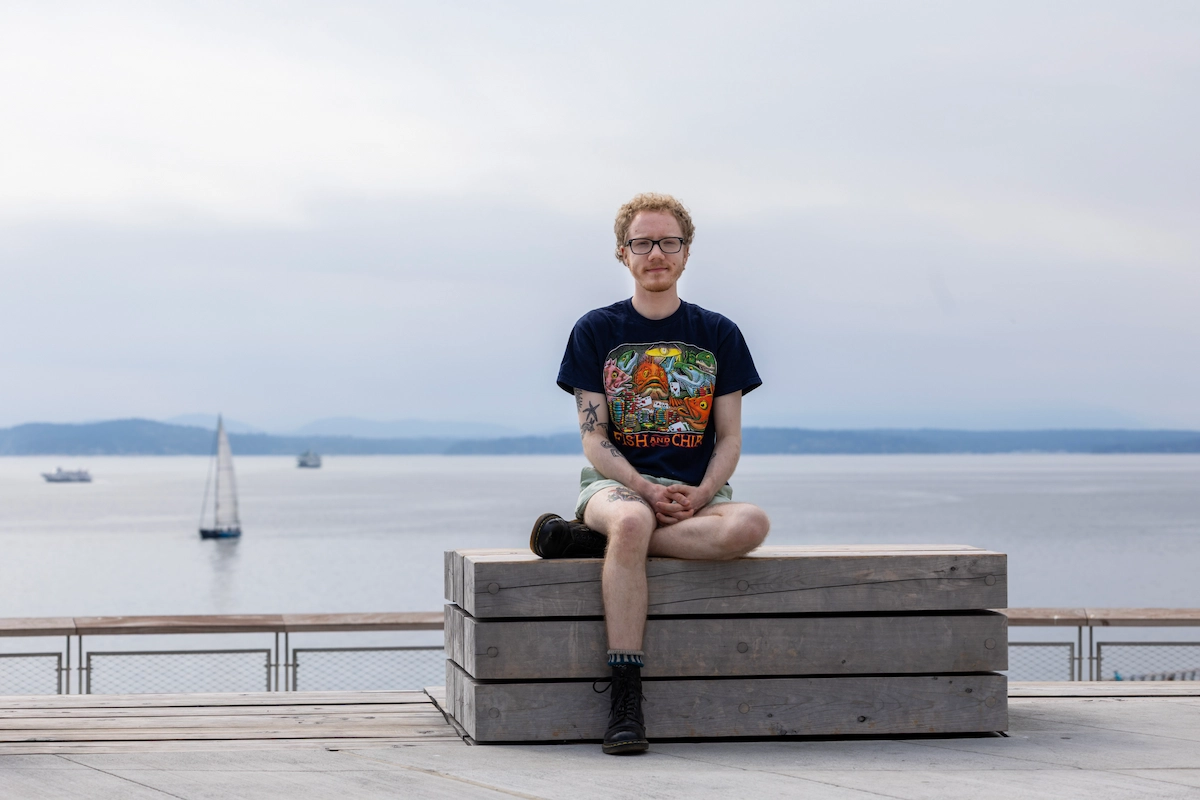
Chris wearing a black shirt and sitting in front of the water.

“I realized that you don't have to work in this field to still be at the Aquarium and be a valued member of the community.”

I’ve lived in Seattle, close to the water, my whole life. When I was a kid, we’d go to a cabin that my grandpa built on the Oregon coast every summer. That’s where I learned about tide pooling, one of my favorite pastimes.

Going into college, I wanted to be a marine biologist. I started taking chemistry but it just doesn’t work for me. Then I learned about the pastry program at Seattle Central. I’d always been a fan of baking, so I went for it. Now I work at a bakery and I’ve been volunteering at the Aquarium for over a year.

I mainly volunteer at the touch pools. I love all the animals. It’s like tide pooling, but indoors and a bit more static. Working with kids is the best, especially the occasional 6-year-old who knows more than I do. It’s fun to talk with them as their parent tries to follow along while we’re both having a great time.

The people on my shift are always looking for nudibranchs, and it’s amazing when we find them together. It’s also cool for guests to see that there are animals here that surprise us—that it’s a living environment and we’re not controlling every single thing.
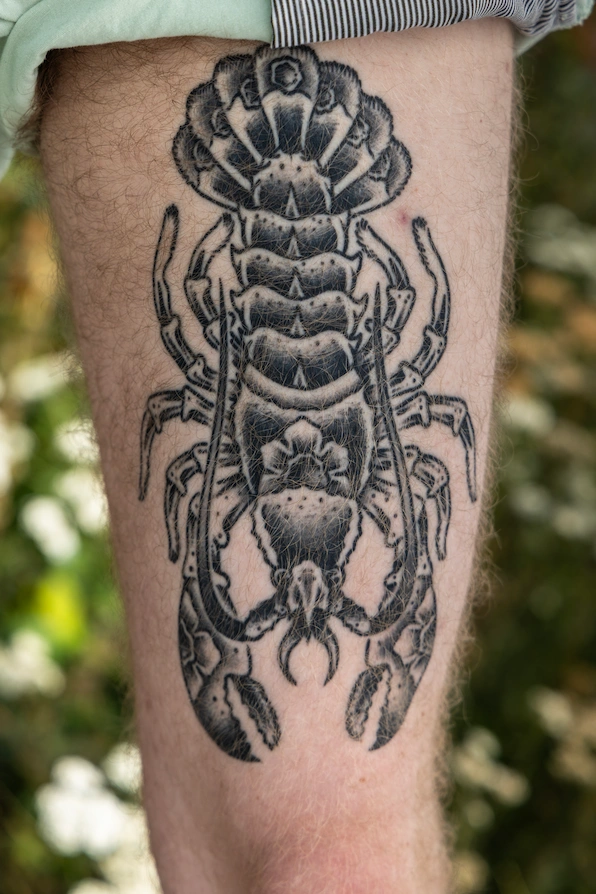
Christopher's tattoo of a spiny lobster located on his left thigh.

The lobster was my first unplanned tattoo. I went to L.A. to get a sandhill crane from an artist down there but she had to cancel. I was really bummed and went to Aquarium of the Pacific to make myself feel better. The lobsters made a big impression on me.

Later that day, an artist popped up on my feed who had done a spiny lobster* before. He was nearby and could get me in right away. It went from not working out to me having this great tattoo inspired by the lobsters at Aquarium of the Pacific. Lucky.

—Chris Fitch (he/him)
Tattoo by Noah Fox, Boartooth Tattoo, Culver City, CA, @noahfoxtattoo

*Editor’s note: Curious about what a Pacific spiny lobster looks like in real life? Visit our Ocean Pavilion!
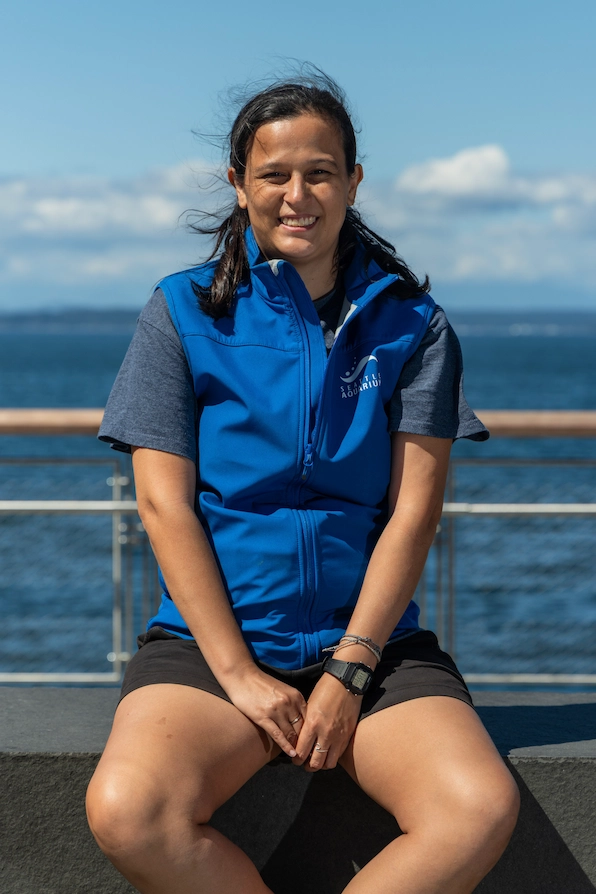
Taylor wearing a blue vest and sitting in front of the water.

“I stopped eating king and Chinook salmon when I learned about the low population of the southern resident orcas. I’ll still eat other kinds but not those. I want to save them for our residents.”

I’ve always been a huge animal person. I love orcas—just love how pretty they are. My grandma has a vacation home on Whidbey Island and every time there’s an orca sighting, she texts to tell me. It’s always the day after I leave. But I was actually here at the Aquarium for an orca sighting in Elliott Bay last spring. It was my first time seeing them in the wild after living in Seattle for 33 years.
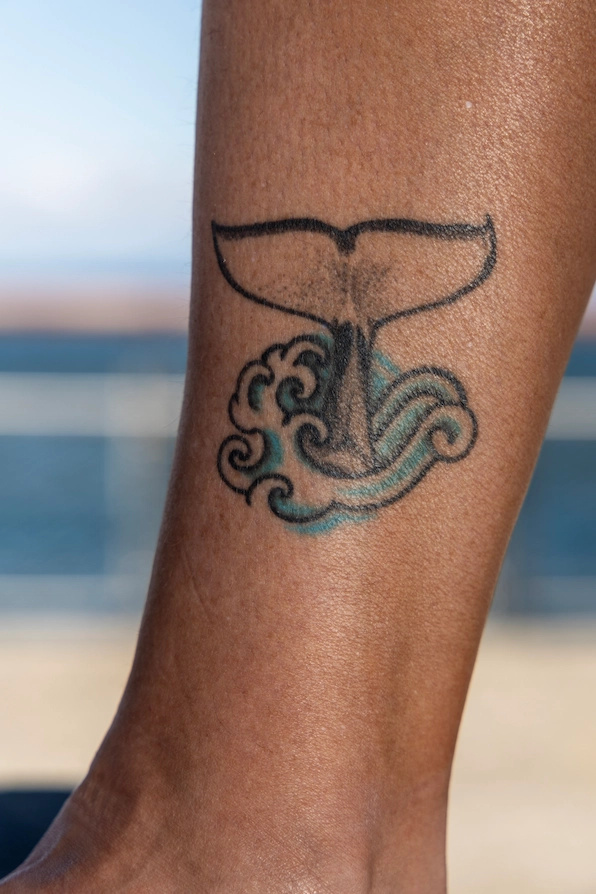
Taylor's tattoo of a whale's tail above the surface of a wave. The tattoo is located on her inner ankle.

I’ve been volunteering here for seven years and I’m still learning new things about some of the animals. I’m trying to do all the habitats, but I mostly like to be near the touch pools.

I love interacting with the guests. My favorite part is telling them about the sea cucumbers because they’re the vacuum cleaners of the ocean floor and they poop out clean sand, which kids love learning. I say, ‘Thank the sea cucumbers because this is their ecosystem and they’re doing us all a favor.’

I also assist with the volunteer program, doing interviews with potential new volunteers. I look for people with great energy. We talk about why they want to volunteer—some want to share their knowledge, others want to give back to the community, some just want to do something fun. We have a very unique ecosystem here and it’s cool when people want to get involved, help other people learn about it.

I graduated from UW two years ago, in environmental studies. I’ve been working part-time in the Gift Shop since then and I’m hoping to find a full-time job at the Aquarium. I’d love to do an outreach education program or be a marine interpreter supervisor here someday.

—Taylor Welch (she/her)
Tattoo by @dannychantattooseattle

We thank Chelsea, Chris and Taylor for sharing their stories with us—and all the volunteers who generously give their time in support of our conservation mission.

Seattle Aquarium volunteers share their knowledge and enthusiasm with our guests, help prepare meals of sustainable seafood for the animals in our care, dive in our habitats, meet members of the public on local shorelines and much more. Interested in learning about the program and potentially becoming a volunteer yourself? Check out our website!
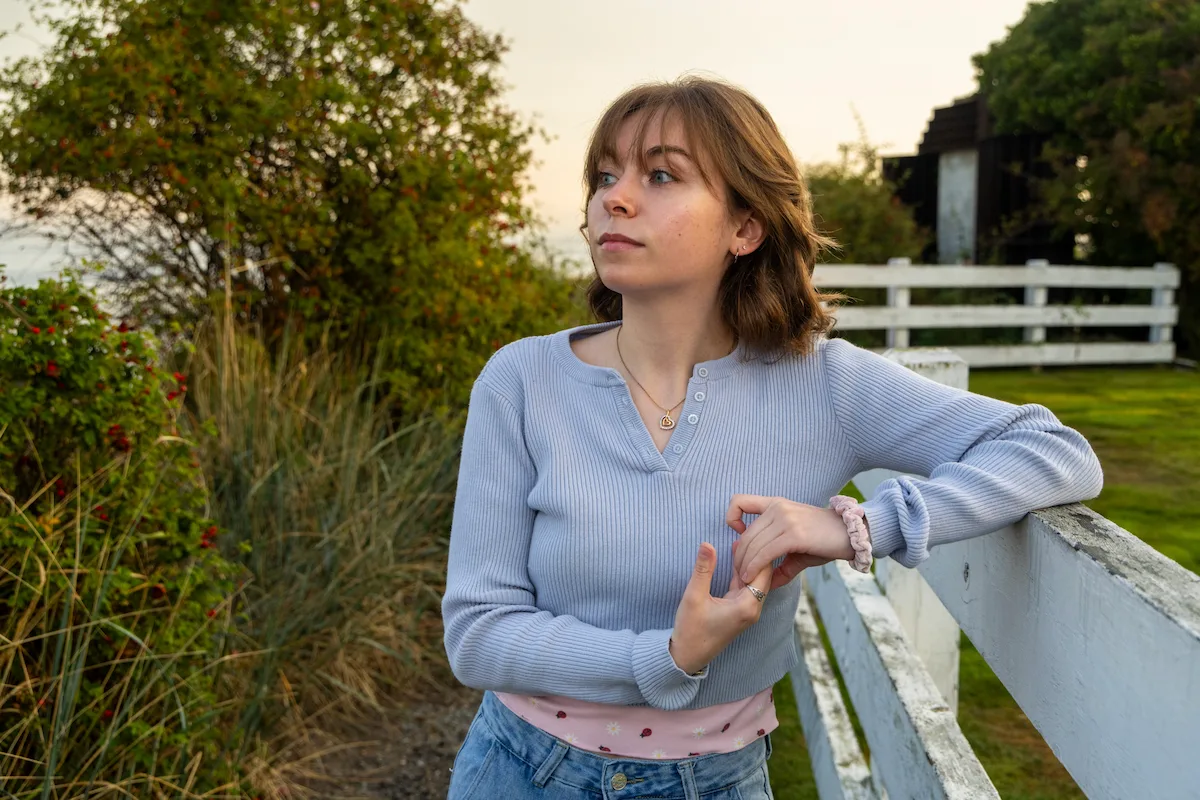
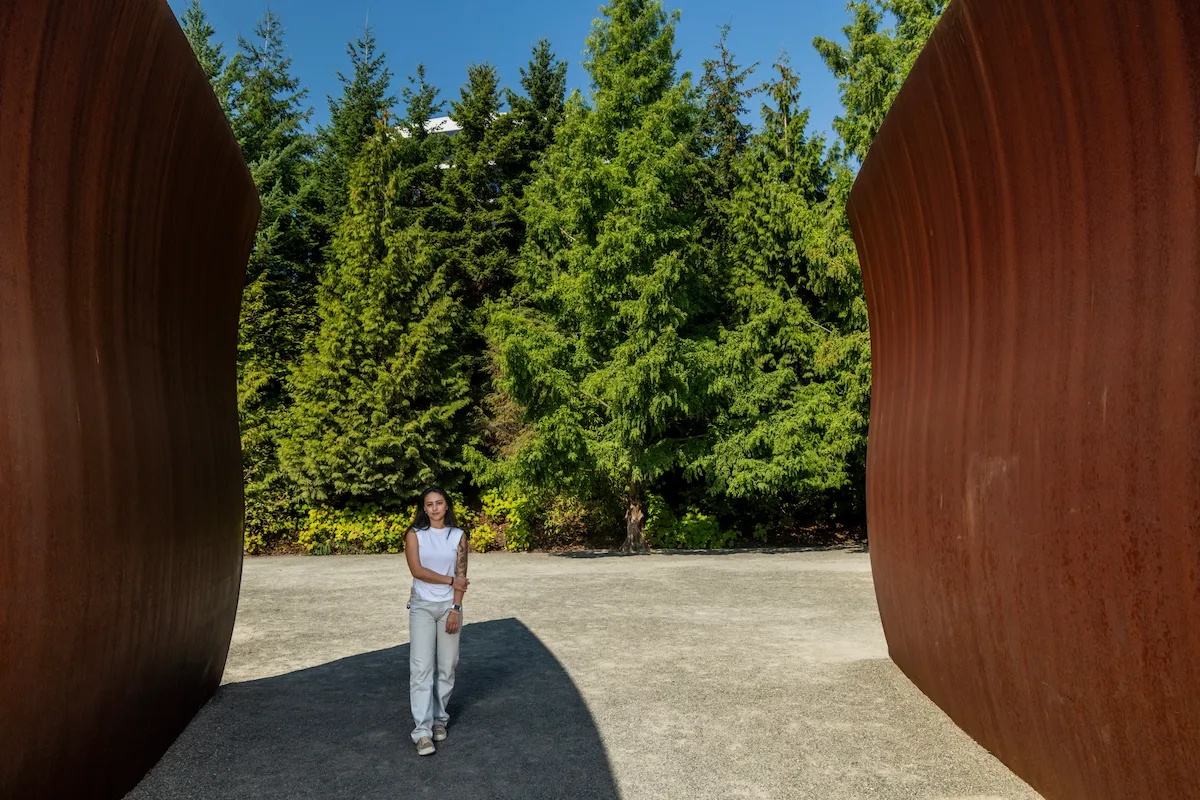
Marine ink-spiration: Tattoos of the Seattle Aquarium, part 4—volunteer edition

The Seattle Aquarium is incredibly fortunate to have an amazing team of talented, passionate volunteers who generously give their time in support of our conservation mission. They share their knowledge and enthusiasm with our guests, help prepare meals of sustainable seafood for the animals in our care, dive in our habitats, meet members of the public on local shorelines and so much more. As it turns out, some of them also show their love for the marine environment with fin-tastic tattoos!

So we’re adding to our ongoing series of web stories about folks at the Aquarium with marine-themed tattoos (check out part 1, part 2 and part 3 if you haven’t already) with this special installment, devoted to volunteers.

We hope you enjoy learning about these three outstanding volunteers and the stories behind their ink. Please be on the lookout for another installment devoted to volunteers later this fall!

“I love that I can bridge the gap and help people get comfortable interacting with the animals in the touch pools. I always tell them that this is something that they’ll probably never get to do again unless they’re at a tide pool or another aquarium.”

My mom is Japanese, and my dad’s American, from Washington state. He’s in the military and they met in Misawa, Japan. My mom gave me my middle name, Umi, which means ‘ocean’ in Japanese. Growing up, we traveled around the world, and I’m always drawn to a body of water, no matter where I go.

When I started college, I majored in art. But as I was taking classes, I realized that I wanted to use it more as an outlet to express myself—not something I wanted to get evaluated in.

And I thought, ‘What’s something impactful that I’m also really passionate about?’ I landed on marine biology and, through my studies, realized that it would be really cool to have tattoos that remind me of why I wanted to get that degree.

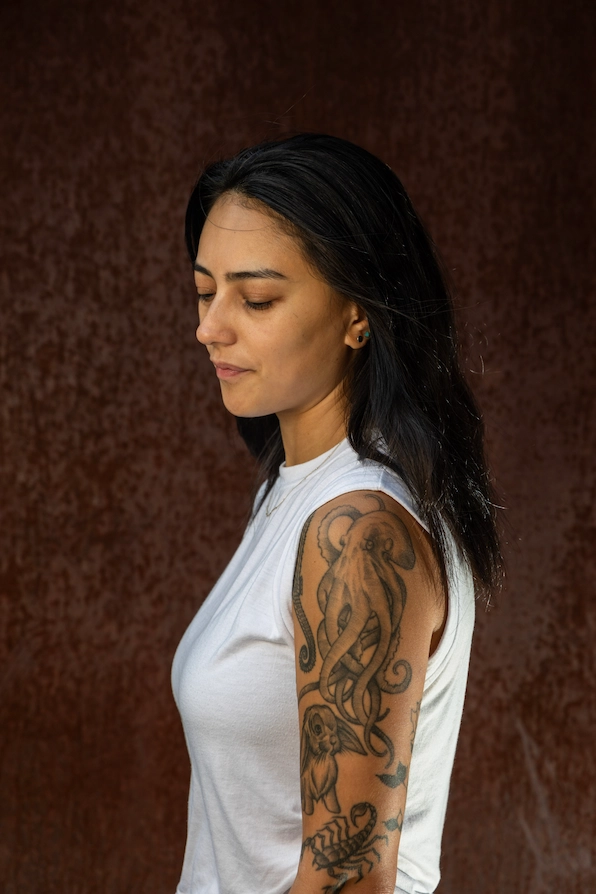
Mia's left arm is covered in black and white tattoos of a seahorse, octopus, rabbit and scorpion.

I’m living with my dad here in Seattle right now, saving to move to France and get my master’s. I came to the Aquarium as a kid, and when I went back as an adult, I thought it would be a cool place to volunteer—and wouldn’t make me feel like my degree was going to waste. I love the atmosphere and the people, just giving back to the community.

I believe that’s important because I grew up in a lifestyle where everyone accepted everyone. I traveled a lot as a military kid, getting to see so many different cultures and religions, and, through that, I realized that community is a really great way of making everyone feel welcomed.

I love people’s stories, and my tattoos have connected me a lot to other people. Sometimes they know facts about the animals, and other times, I tell them something that’s new to them. It’s great to connect with people like that.

—Mia Redfern (she/her)
Tattoo by @scorpionandroses

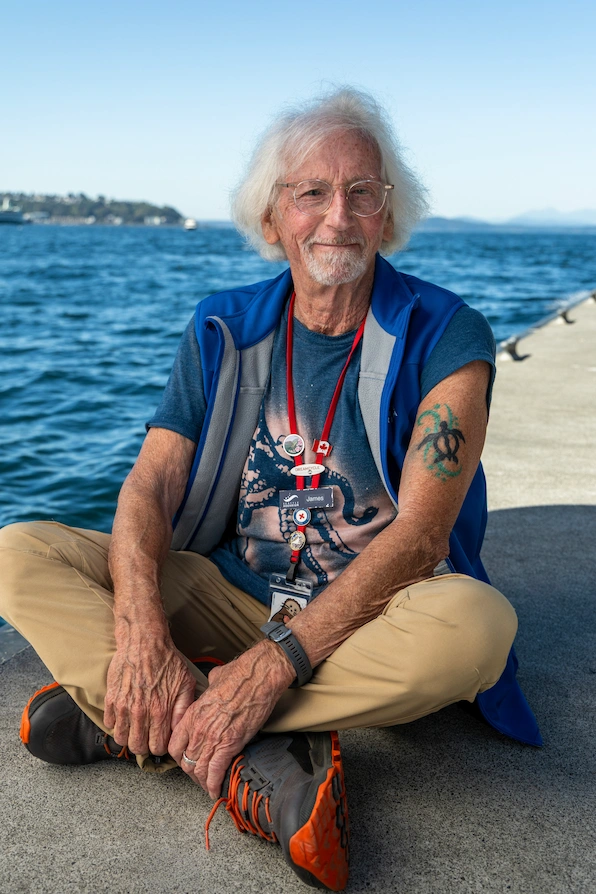
James sitting cross-legged next to the Salish Sea.

“I wish I’d found this place years ago. On a scale of 1 to 10, it’s a 400. Every time I come here for a shift, I spend the whole time smiling. It's just so fun.”

I started swimming when I was 4—I love being in the water. ‘Swim or die’ is my mantra, and I believe it’s a big part of why I’ve gotten to be this old and still have so much freedom of movement.

But, you know, I’ve learned more in the month that I’ve been volunteering at the Aquarium than the entire time I’ve spent in the water. Watching children—budding marine scientists—and people who have never experienced the ocean getting to touch these creatures, learn about them… it’s going to change how they see the ocean. My wife said, ‘You’ve found your home.’

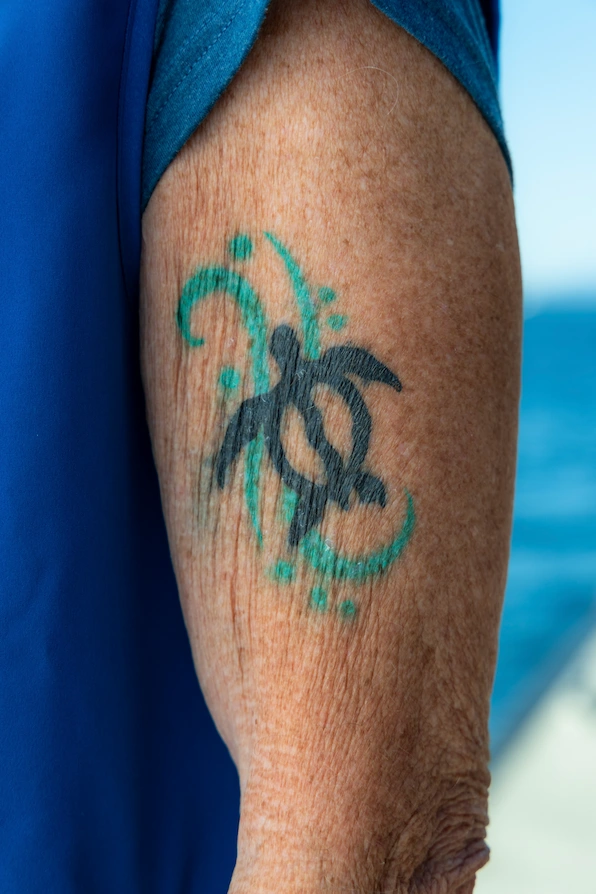
A blue and green tattoo of a turtle done in the style of a Honu petroglyph, located on James' upper left arm.

A few years ago, I was swimming across a crescent-shaped bay on the Big Island, a place I swim often. There was an onshore wind, so strong that sand was blowing across the ocean’s surface. I couldn’t look toward shore because I’d get a face full of it. When I lifted my arm, I’d get blown over sideways. The bottom was churned up so I couldn’t tell how deep the water was, and I couldn’t really see where I was because of the waves.

I got partly across the bay but couldn’t see my regular landmarks to know how much farther I had to go. And, suddenly, a great big honu—that’s Hawaiian for sea turtle—rose up out of the gloom below. It turned to look at me and made a sharp right.

I followed, and it led me all the way back into shore. When I could see better, I realized I’d gotten blown out of the mouth of the bay and into the open ocean. If I hadn’t seen the honu, I would have just kept swimming.

That’s why I got this tattoo, a honu petroglyph—an early present for my 80th birthday.

—James Smith (he/him)
Tattoo by @southseastattoohilo

Molly leaning against a fence, surrounded by trees.

“I’ve always loved animals—I came to the Aquarium all the time as a kid. Now, I call my mom after almost every volunteer shift to tell her what happened. I always have interesting stories to share!”

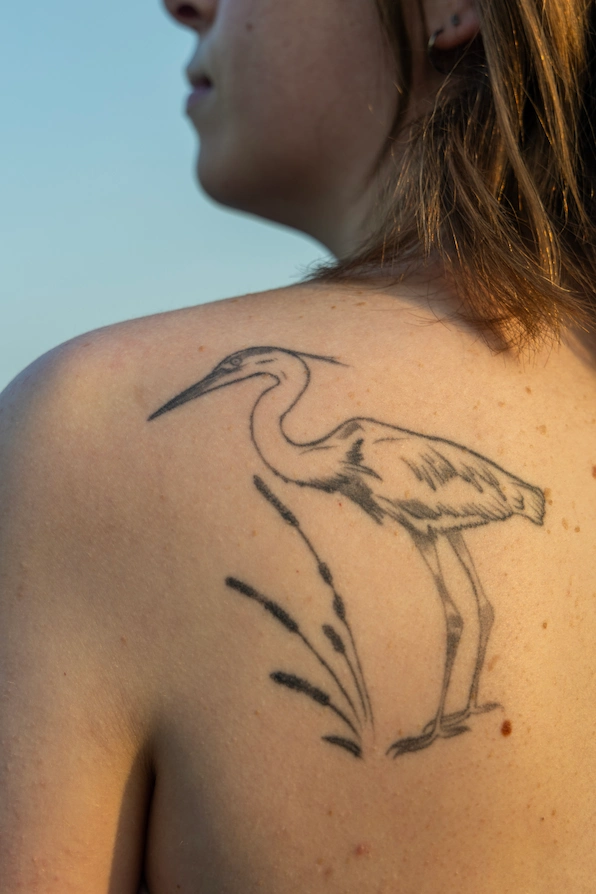
I grew up in Mukilteo, hearing that great blue herons were symbols of luck for fishermen and sailors. I like them because, even with their big bodies and skinny legs, they still hold themselves up, just being resilient creatures, even if it looks like the odds are against them.

High school was pretty hard for me. The beginning of college was okay, but then COVID happened. I was in my last quarter of freshman year— they said we’d do our finals online, then come back after spring break. You know what happened with that.

When we got back to campus, I tried to find ways to connect with people. I became president of the biology club and was a technical writer for a medical engineering lab. In my senior year, I thought, ‘I guess I’m doing pretty well.’ I never really saw myself making it that far, so it was a big achievement to get to that point! I got the tattoo to remind myself about being resilient when the odds are against you.

A tattoo of a great blue heron standing near cattails, located on Molly's left shoulder blade.

My degree is in biology. Right now I work in human medicine, as a pathology tech and, in addition to the Aquarium, I volunteer with PAWS and the Sno-King Marine Mammal Response team. I’m looking to enter a doctorate degree program to pursue research and medicine. I’d like to get into public health studies on animals and be able to relate that to human health.

I started volunteering at the Aquarium as a way to educate and connect with people, and to learn more myself. It makes me happy when I can help someone discover something. I like being able to show kids that it’s okay to touch the animals in the tide pools. If they’re scared, I say, ‘It’s okay, I’ll touch with you.’ It’s really cool to see people get inspired.

—Molly Biedscheid (she/her)
Tattoo by @a.ink.tattoo_lizzy

We thank Mia, James and Molly for sharing their stories with us—and all the volunteers who enhance every visit to the Aquarium. Interested in becoming a volunteer yourself? Learn more on our website!

Marine ink-spiration: Tattoos of the Seattle Aquarium, part 3—tropical edition

Last year, we shared two web stories about Seattle Aquarium team members who show their passion for marine life with a variety of incredible tattoos (check out part 1 and part 2 if you haven’t already!).

Now, to continue celebrating the recent opening of our Ocean Pavilion, we bring you our next installment, featuring some of the people who work with the tropical animals in our care—and their amazing tattoos.

We hope you enjoy hearing from these four outstanding folks and learning the stories behind their ink!

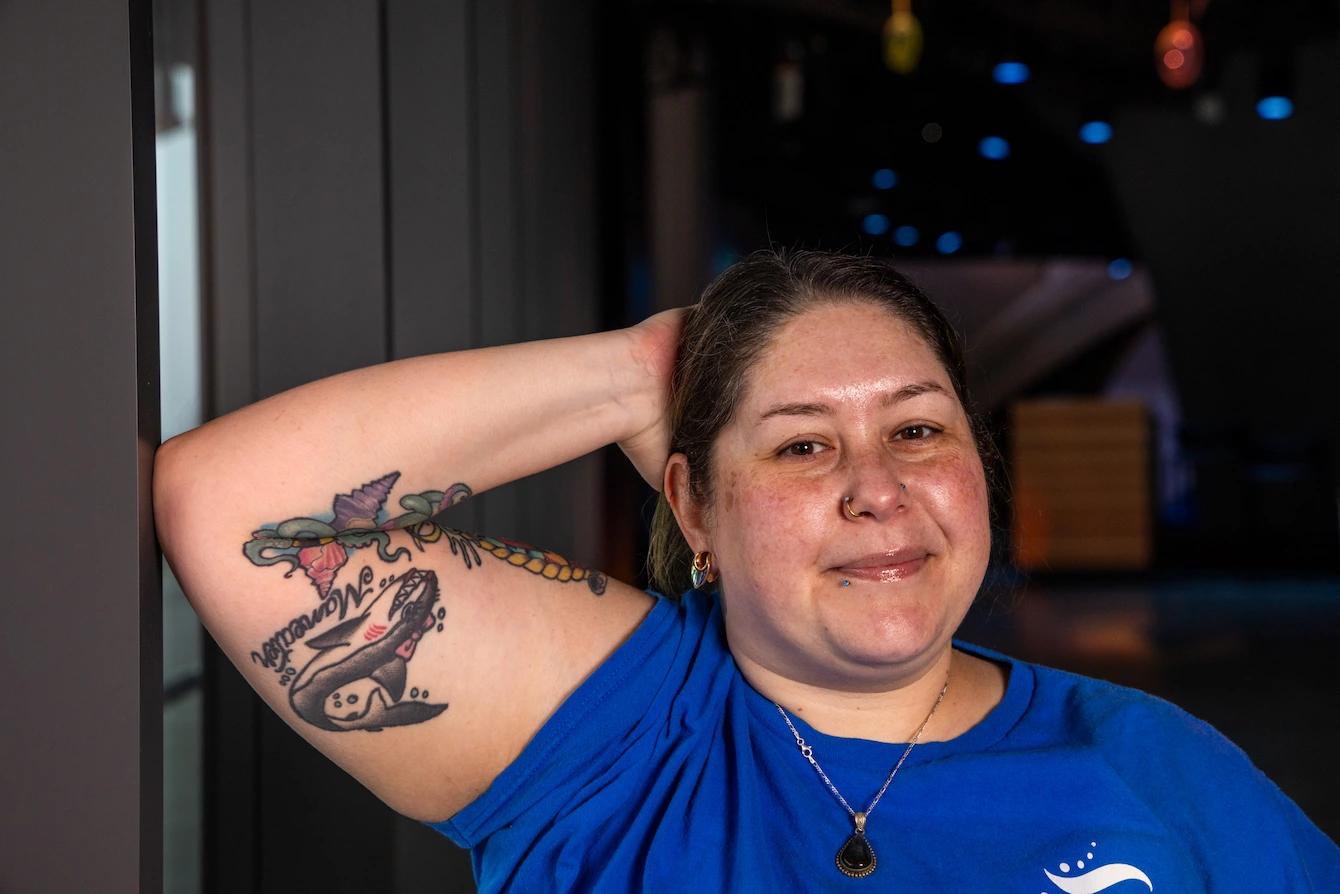
Amber, a woman with dark hair tied back in a ponytail, holding her right arm up to showcase a shark tattoo on her bicep.

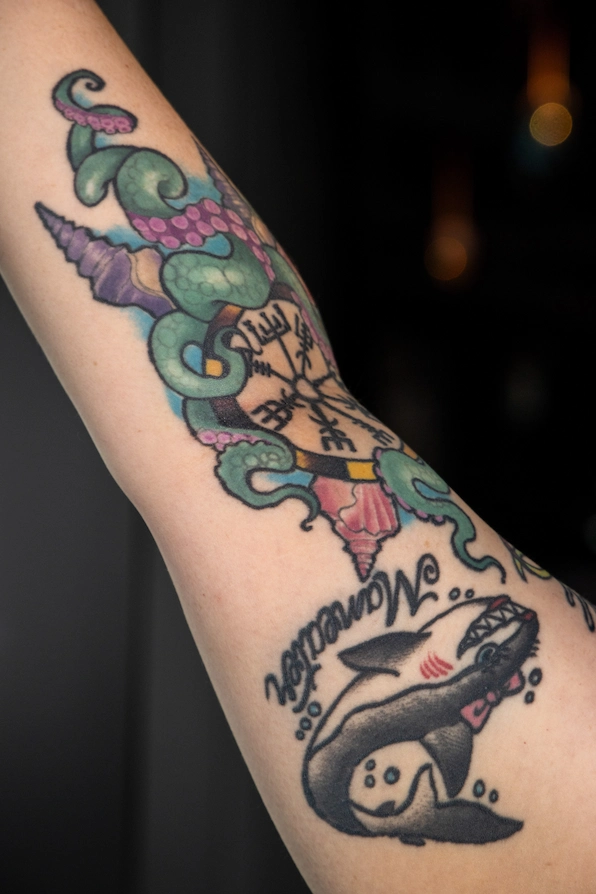
“When I got this tattoo, I just wanted to showcase the ridiculousness of the idea that sharks are man-eaters. It was foretelling my future and I didn't even know it.”

Working with sharks so closely, I get to see how great they are—just so majestic and inspiring. The love that I’ve developed for them is really understanding their gentle nature and that, like any other animal, they’re just trying to live life. To me, they have a really calming presence. The way they move through the water, how they’re alert to their surroundings. And their playfulness. I wish people knew how gentle they are. And that there’s really no reason to fear them.

Sharks, in some of their social systems—especially great hammerheads—are very matriarchal. The females hold the dominant role in the school. At least that’s what we’ve noticed with sharks in human care. Maybe the world should take note.

A close-up of Amber's tattoo: A shark with a pink bow on its head and the word "maneater" written under it in cursive.

I’m a descendant from the Southern Tewa tribe and Mescalero Apache tribe and recently did a project on Indigenous science, how it evolved, and how we can incorporate it to see things from an animal’s perspective. I think that’s the way we do better at animal care, through deep empathy. And part of Indigenous science is really conjuring that empathy.

As an Indigenous person, I connect personally with the Aquarium’s mission. A lot of Indigenous people are trying to keep their traditions alive, traditions that have disappeared over time because of colonization. I think that’s why conservation is so important to me—it’s more than just conserving an animal or land, it’s about conserving tradition and the traditional knowledge that has helped us manage lands since time immemorial.

We’re conserving these things not to conserve the past or the memory, but to help the future move forward without them completely disappearing. I feel very close with the mission at the Aquarium—in my own personal mission of recapturing traditional ways of being.

—Amber Ginther (she/her), supervisor of tropical fish and invertebrates

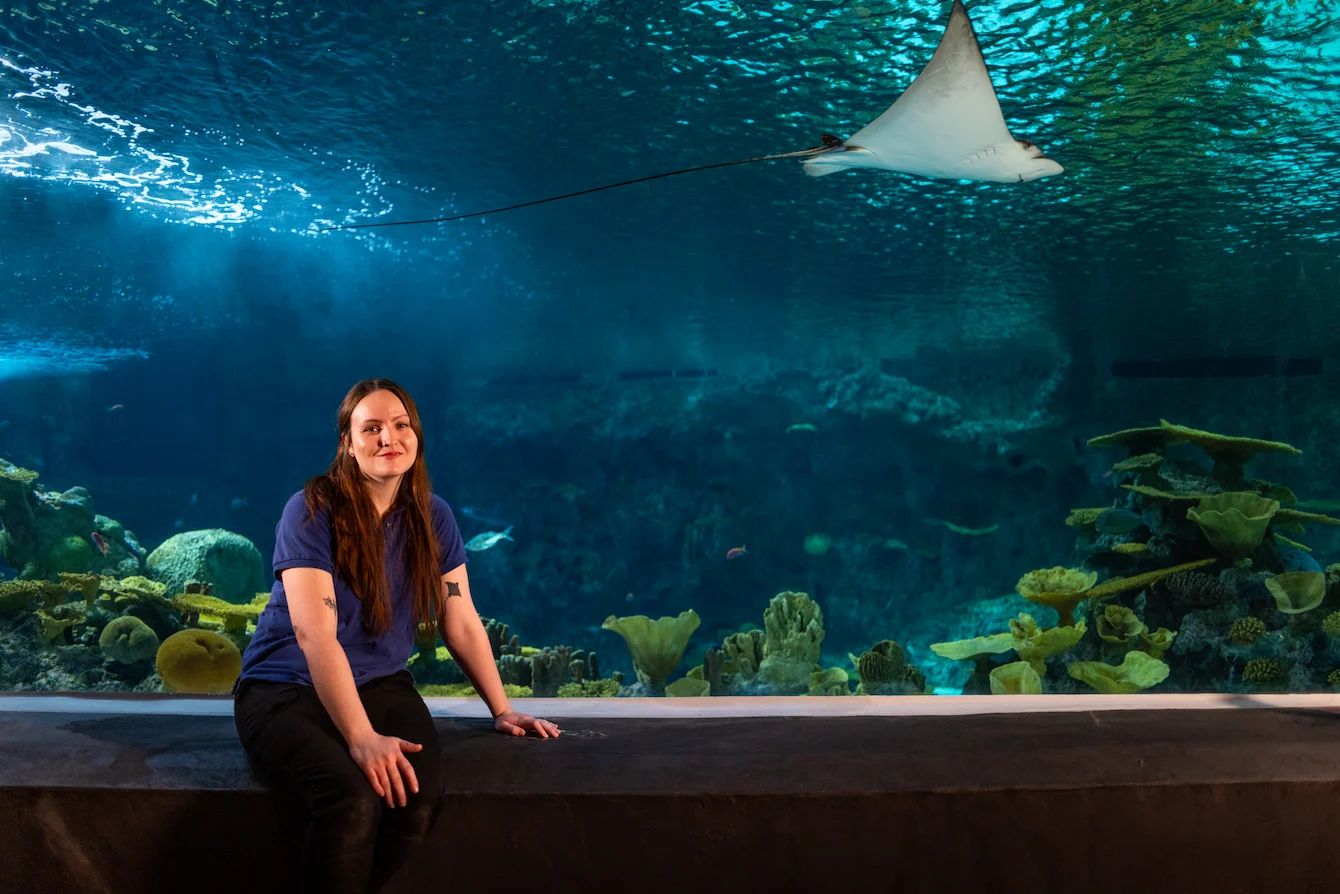
Makayla, a woman with long, brown hair, sitting on a ledge in front of The Reef habitat. Makayla is wearing a blue Seattle Aquarium shirt. Behind her, in the habitat, a spotted eagle ray is swimming by.

“I’ve always had a curiosity and love for the ocean. I grew up in a landlocked state so it wasn't something that I could just go and see.”

I remember going to an aquarium for the first time as a kid. I was enamored with everything—watching people feed the fish and the sharks and thinking, “Wow, I want to do that.”

I did an internship here at the Aquarium in 2020, then got a part-time job at Point Defiance Zoo & Aquarium. That’s where I first encountered spotted eagle rays—two of them are actually here now. It’s really cool that it worked out like that because I’ve known them for almost five years and gotten to work with them quite extensively.

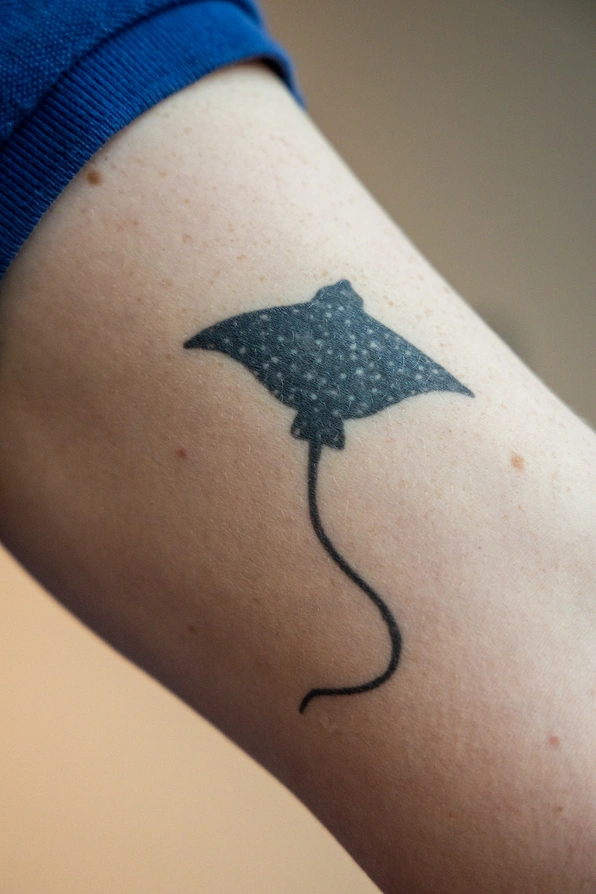
A lot of people don’t know that spotted eagle rays are identified by their head spots: Each pattern is unique. For my tattoo, I worked with the artist to make sure that the spots are in the same pattern as one of the eagle rays that I worked with closely at the Point Defiance Zoo & Aquarium.

A close-up of Makayla's tattoo: a simple, black illustration of a spotted eagle ray. The tattoo is on the inside of her upper left arm.

The best parts of my job are definitely feeding and training. Seeing the animals make those connections and feel more comfortable with us, building that relationship of trust. Because they’re so intelligent, training them for their feeds and different veterinary procedures has been an incredible journey. The three spotted eagle rays in our care have pretty different personalities. One of them is rambunctious. One is more even. And the juvenile is a healthy mix of the other two.

But they all love clams. We feed them the whole clam—shell and everything. They’ve got these crushing plates, kind of like a row of teeth, on the top and bottom. They use them like a nutcracker, basically, and just crunch up the clams. They need crunchy food to help them shed their teeth, so they crush the shells and eat the clam inside. They love it.

—Makayla Taylor (she/her), aquarist
Tattoo by Jasmine, @inkedbyjasmine

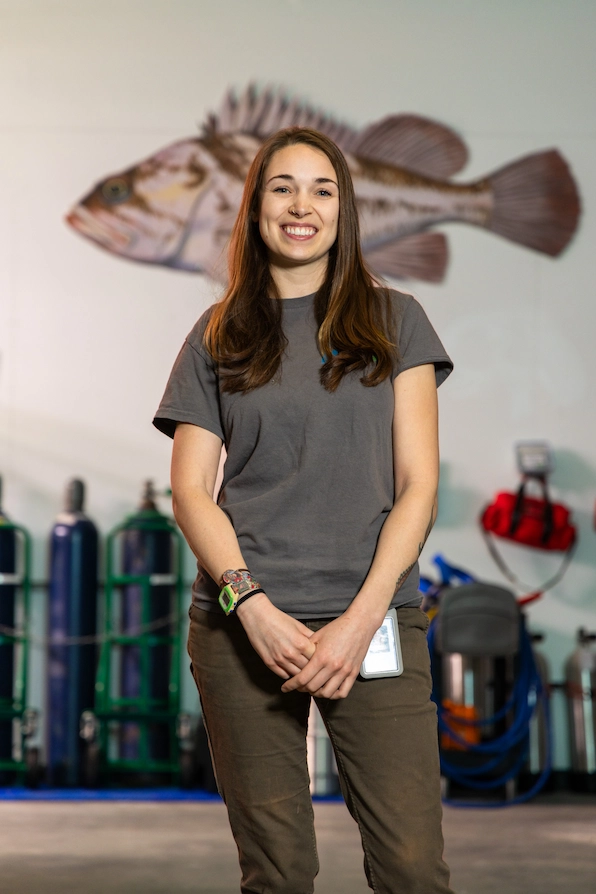
Casey, a woman with chest-length brown hair, standing in front of a row of SCUBA tanks. A rockfish is painted on the wall behind her.

“Just because we live here, it doesn't mean that animals on the other side of the ocean aren't affected by our actions. It's important to view it all as one system.”

My dad took me fishing when I was little and the first time I saw a bass, I thought it was the coolest thing ever. From there, I just got really into fish. Not even pretty, tropical ones—weird, ugly freshwater fish that you see in lakes and rivers. That’s why I was so into it when my first job was with freshwater biology even though I specialized in marine biology.

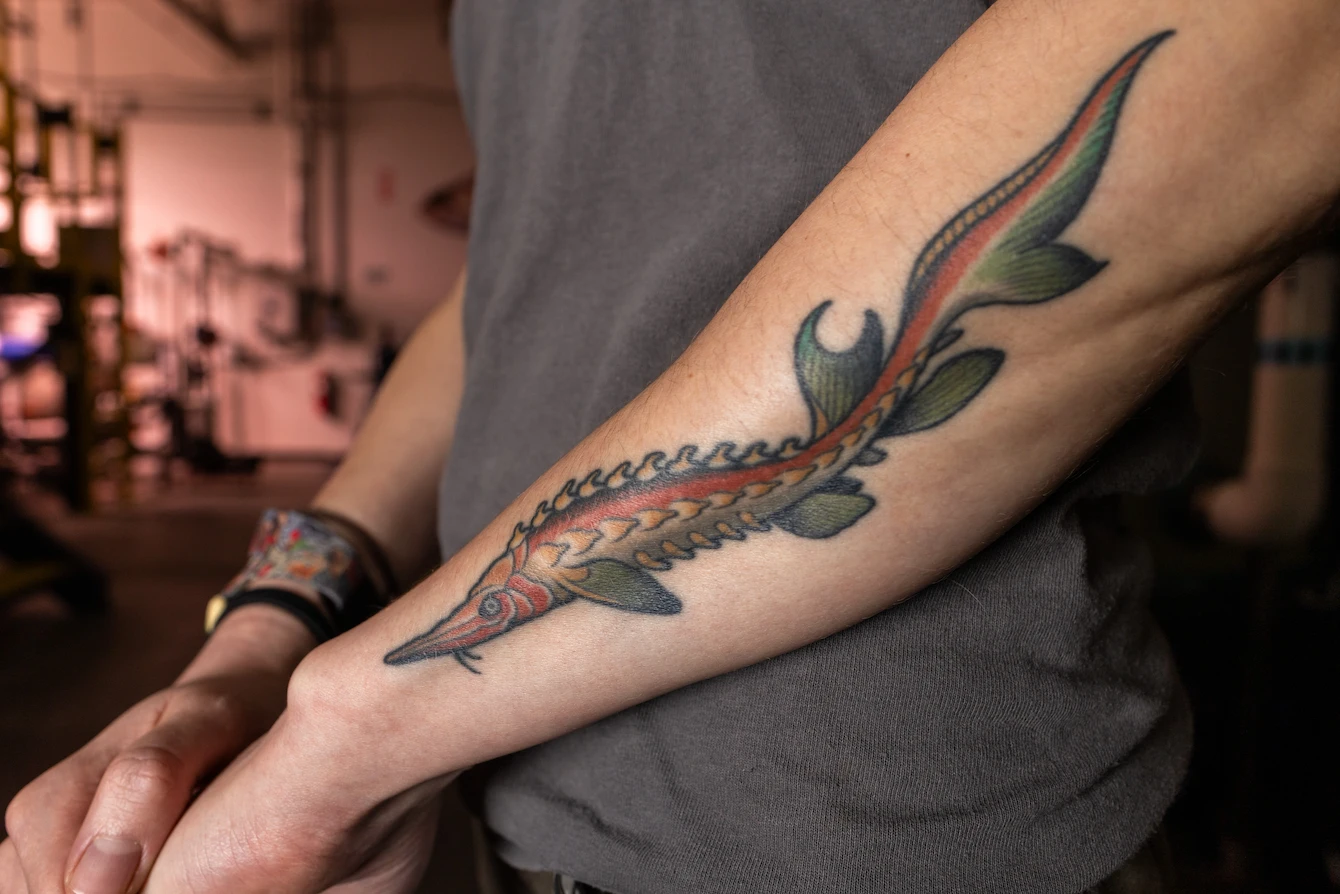
I was hired by the Missouri conservation department and they had a side project for critically endangered pallid sturgeon. Learning about them and then actually seeing them blew me away. They’re so weird and ancient-looking that you wouldn’t really expect them to have personalities, but they definitely do.

A close-up of the tattoo on Casey's outer left forearm: a stylized red-and-green illustration of a pallid sturgeon that stretches from her elbow to her wrist.

It’s not tropical versus temperate or freshwater versus marine: I’m equal opportunity—I love all fish. I work with tropical fish now but I’ll always have a special place in my heart for sturgeon.

The reason I started to care about these creatures was because my dad took me fishing when I was a kid and I understood that these animals are important. We need to take care of them. Maybe not everyone gets that opportunity or would be inspired by seeing a bass. But when you come to the Aquarium and see these amazing animals that you might never get to see in the wild, it really makes you appreciate them and want to protect them. And it’s my job to make sure they have the best life possible, so when people come to the Aquarium, they can be inspired by happy, healthy animals that are thriving.

—Casey Zinkievich (she/her), aquarist

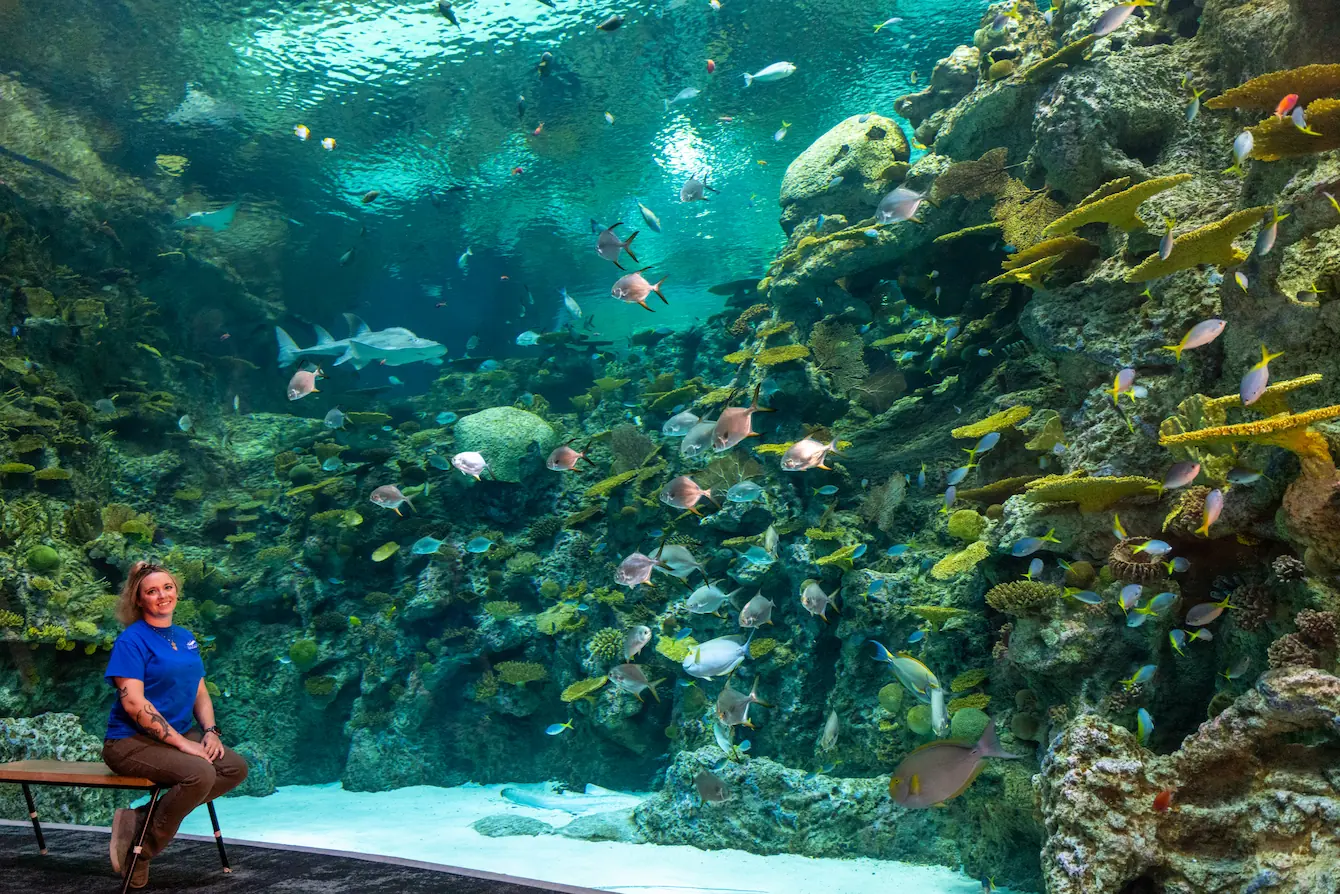
Charmaine, a woman with blonde hair tied back in a ponytail, sitting on a bench in front of The Reef habitat in the Ocean Pavilion. Charmaine is wearing a blue Seattle Aquarium shirt and brown pants. Schooling fish, rays and a bowmouth guitarfish are swimming in the habitat behind her.

“The biggest thing we can do is educate people. Showing them these animals and their habitats so they know it's not scary and dangerous. It's just this other world that we share a planet with.”

When I was little, we were watching an episode of Reading Rainbow where LeVar Burton talks to a marine biologist. I asked my mom, “What does that mean?” She told me and I said, “Great, I’m going to do that.” In college, I got a bachelor’s in biological sciences with a marine biology emphasis.

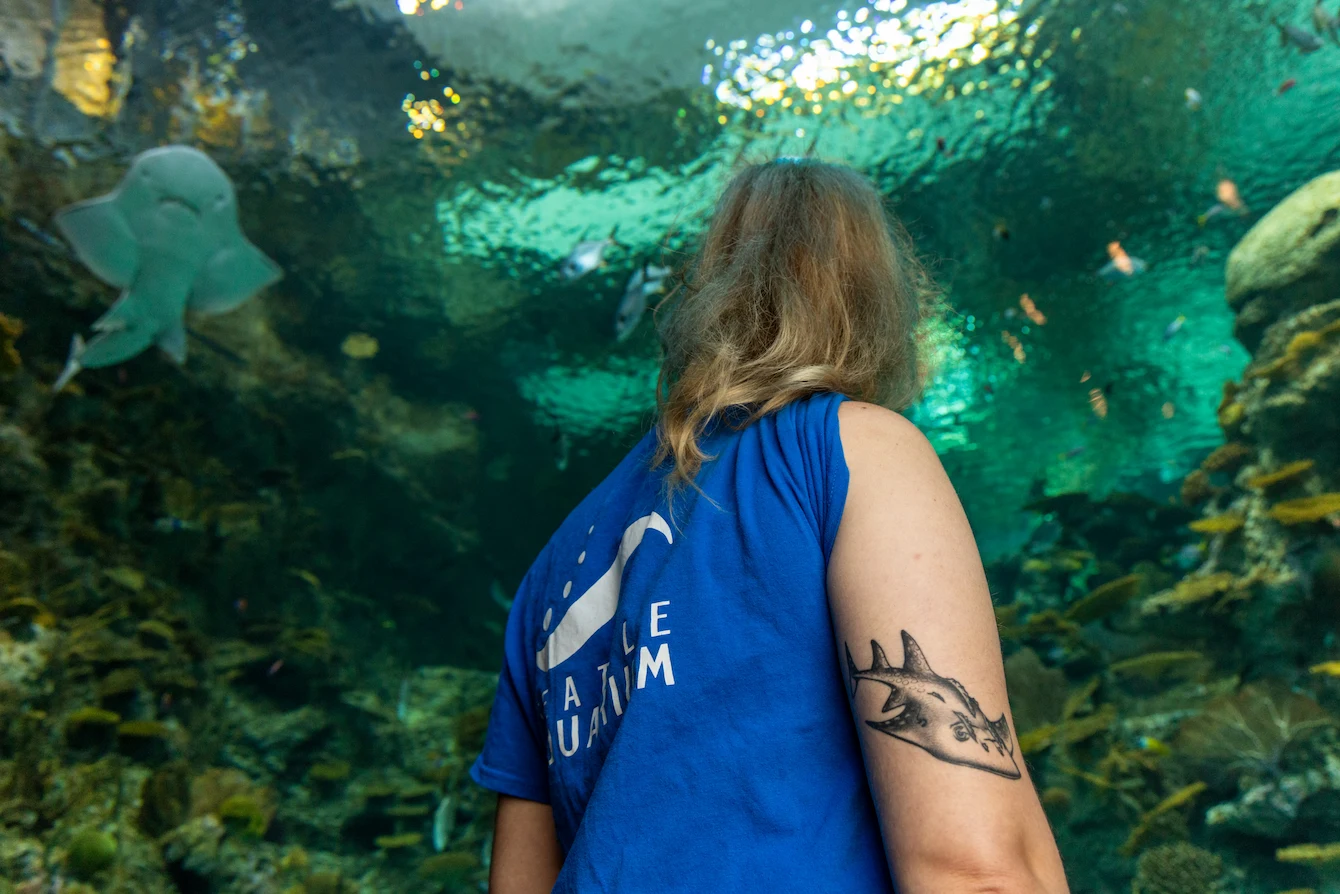
The bowmouth guitarfish on my arm is in honor of Rhina, the one we have here. I was her primary aquarist and developed her training plan—I just fell in love with her. It’s my first tattoo of an animal that I’ve worked with.

Charmaine, shot from behind, looking up at the bowmouth guitarfish in The Reef habitat. Charmaine's shirt sleeve has been rolled up to reveal the bowmouth guitarfish tattoo just above her right elbow.

Bowmouth guitarfish are unique animals and the first thing we learned was that they are incredibly messy. Their diet is 60 to 80% crustaceans—shrimp and Dungeness crab in the shell, Pacific spiny lobster with the carapace—and they can digest it, but a lot gets pooped out with big chunks of shell. Rhina also leaves a trail of shells in her wake while she’s eating. She’s just really messy.

The day she moved into the Ocean Pavilion, I was snorkeling and helped guide her out of the acclimation pool and into The Reef habitat. I was sobbing underwater, seeing her swim out. It was such an exciting moment and I was so proud of the team, how everyone worked together to accomplish it so smoothly.

I think giving our guests the opportunity to really connect with the animals in our care is the biggest impact we can make. Going to aquariums as a kid and getting the opportunity to see and learn about animals that I never would have seen otherwise is what made me love them. It’s why I wanted to get into this this field.

—Charmaine von Kriegenbergh (she/her), associate curator of tropical fish and invertebrates
Tattoo by Tasi Tautolo, @tasitoss
Zebra shark, tiger shark, hammerhead shark and manta ray tattoos by Alexandra Grace, @alexandrastabs

Want to learn more about spotted eagle rays, bowmouth guitarfish and sturgeon? Visit the Seattle Aquarium to see them in person—who knows, you may even spot one of the team members featured here! Plan a visit today.

Join us for After Hours: Going Green to explore the Aquarium at night and celebrate our beautiful blue and green planet!

Today only, your gift will be matched dollar-for-dollar up to $25,000 thanks to the generosity of donors Betsy Cadwallader, J & Tim, and Jess & Andy Peet. Help us reach our $50,000 goal!

End the year with a gift to the ocean.