This site uses cookies. View our Cookie Policy to learn more about how and why.

Regular hours: 9:30 am – 6 pm
Last entry at 5 pm

Speaking up for ocean health: 2023 priorities in the Washington legislature

As the Washington state legislative session begins, the Seattle Aquarium is working with partners to advance science-based policies and funding that will protect ocean health. Read on to learn about some of our top priorities for 2023—and how you can take action, too!

Photo of the Washington State Capitol building with the text "Let's speak up for ocean health" above the floowing list: "Reducing plastic pollution / Protecting salmon habitat / Advancing orca recovery / protecting the Salish Sea / Supporting environmental justice."

Reducing plastic pollution

Waste, including harmful plastics, accumulates in the ocean and on our shorelines, putting marine wildlife at risk. Single-use packaging represents a particularly significant environmental problem—very little of it is recycled. Packaging producers are best placed to change that by switching to readily available alternatives. We are advocating for bills that will incentivize producers to make such changes; modernize and transform our recycling system; and reduce sources of plastic pollution and waste.

The Washington Recycling and Packaging (WRAP) Act (SB 5154/HB 1131) will:

  • Make producers of packaging and paper products responsible for the full life cycle of their products and incentivize them to redesign packaging to be reusable, compostable or recyclable.
  • Ensure all Washington residents with garbage collection services also have access to recycling services.
  • Remove confusion about what is recyclable and what is not, through a harmonized statewide list—and ensure that what we put in our recycling bins will actually be turned into something new.

HB 1085 will:

  • Require bottle refill stations wherever a drinking fountain is required in all new buildings.
  • Eliminate small, hard-to-recycle plastic packaging for personal care products (like mini shampoo bottles and soap wrappers) in lodging establishments, in favor of bulk refillable dispensers or non-plastic packaging.
  • Ban foam-filled floats for docks to reduce a major source of plastic pollution in lakes and marine waters. 

We are also supporting a bill called Right to Repair, which would enable small businesses to repair personal electronic devices like cell phones so people can keep using them instead of buying new ones. This will help limit the need for new materials that may be sourced through harmful practices like seabed mining.

Protecting salmon and nearshore habitat

Salmon are keystone species and critical for Washington ecosystems and communities, as well as for the survival of the endangered southern resident orcas. We are supporting several policies and budget items to recover salmon and protect their habitat, including:

  • Filling data gaps about marine shoreline conditions through regular aerial and on-the-water surveys, which will enable strategic, targeted recovery actions to benefit salmon, orcas and the marine food web (SB 5104).
  • Increasing investments in salmon habitat restoration, including a $41M state investment in the Duckabush River Estuary Restoration project.

Advancing endangered southern resident orca recovery

This small population of orcas is at risk due to lack of prey, pollution and disturbance from vessels. To help ensure the recovery of this iconic and important species, we are supporting:

  • Implementing the Washington Department of Fish & Wildlife’s (WDFW’s) science-based recommendations to give endangered orcas a 1,000-yard buffer from all small vessels so they can forage more successfully (HB 1145/SB 5371).
  • Quiet Sound program funding to reduce underwater noise and other impacts from large commercial vessels on endangered southern resident orcas ($350k/year).
  • Funding for improving oil spill response preparedness in the San Juan Islands and reducing risks to southern resident orcas from oil spills.

Protecting the health and biodiversity of the Salish Sea

We are supporting WDFW’s $47.6M Restoring Washington’s Biodiversity funding package, including $850,000 per biennium to support pinto abalone recovery.

Working with partners and advancing environmental justice

As a member of the Environmental Priorities Coalition (EPC), we also support the other EPC and Partnership Agenda items including investing Climate Commitment Act revenue strategically and equitably and requiring local governments to incorporate climate resilience into comprehensive plans (HB 1181/SB 5203).

Raise your voice!

  • If you live in Washington state, speak up about your priorities for ocean and environmental health. Call the toll-free legislative hotline at 1-800-562-6000 (TTY for hearing impaired: 800-833-6388) between 8am and 7pm, Monday through Friday, to leave a message for all three of your legislators at once.
  • Share your WA legislative district with us so we can reach out to you about supporting targeted policy actions where your legislator could cast a key vote.
  • Sign up to receive occasional action alerts on ocean-related policy issues.
  • Write a letter to the editor to share your view on a bill or budget item that you find particularly important.
  • Discover additional ways you can help the marine environment by visiting our Act for the Ocean page.
Evening event volunteers like Jean Brosell create “aha” moments for guests

This concludes our series of blog posts devoted to some of the amazing people who volunteer for the Seattle Aquarium. Interested in becoming a volunteer yourself? Scroll to the bottom for details!

Jean Brosell’s interest in the ocean began in 1979 when she took a marine biology college course she needed to graduate.

“The experience was so amazing that every vacation after that for the next 20+ years was to somewhere I could go diving,” she recalls. 

As an evening event volunteer at the Aquarium, Jean shares her enthusiasm for marine life with guests at weddings, corporate events and even portions of the summer festival Seafair. Often, the people she meets are seeing the Aquarium for the first time—and Jean gets to share in their excitement and delight. 

Stationed in the Life on the Edge habitat, she might show guests the newest giant Pacific octopus, point out fish eggs in one of the tide pools, demonstrate how to gently stroke a sea cucumber or explain the Salish Sea’s unique and delicate ecosystem.

“I love the ‘aha’ moment when the guest who is shy or afraid to touch a sea urchin reaches in and finds that the urchin gives a little hug,” Jean says, “or when you get to talk to a guest about the ever-elusive giant Pacific octopus or the cute northern sea otters, which are my favorite creatures at the Aquarium.”

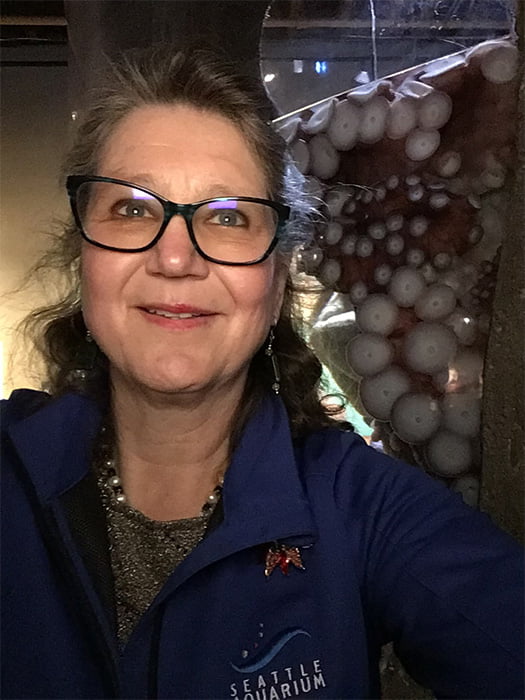
Seattle Aquarium volunteer Jean Brosell standing in front of the octopus habitat at the Seattle Aquarium for a photo.
Aquarium volunteer Jean Brosell enjoys introducing evening event guests to the giant Pacific octopus and other residents of the Life on the Edge habitat.
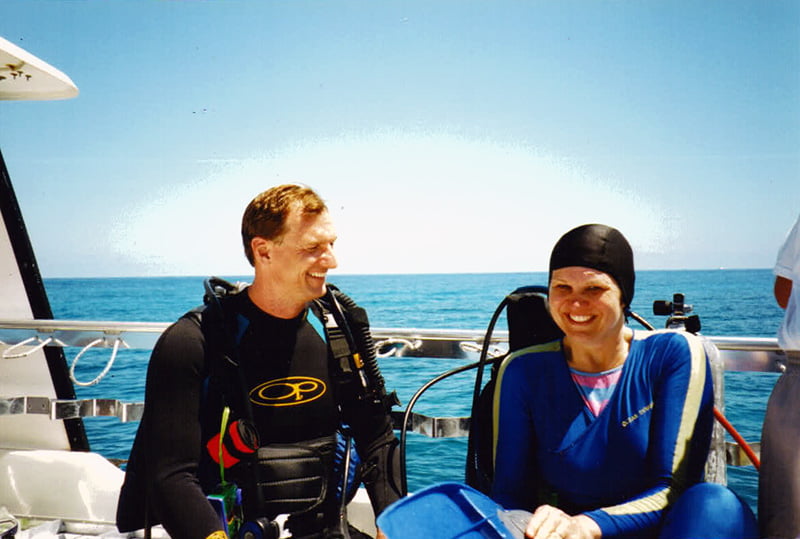
Jean Brosell smiling for a photo while wearing scuba diving gear, sitting on a boat out in the ocean on a sunny day.
A college course inspired Jean's love of the ocean, which she cultivated by diving regularly (pictured here on a 2014 visit to Mexico with her husband).

Jean has especially fond members of volunteering during Seafair. After giving a tour to one of the Blue Angels and his fiancé, a former Navy nurse, she received a Blue Angel pin from the couple.

And though Jean didn’t pursue a career in marine biology, she says that the Aquarium’s volunteer training program armed her with the knowledge she needs to feel comfortable on the floor.

“This is my fun volunteer job,” she says. “I thoroughly enjoy getting to interact with guests and helping them to have an enjoyable experience at the Aquarium. It is no stress, no hassle interaction with people from all walks of life—what could be better?”   

Ready to join Jean in sharing the Seattle Aquarium’s mission with visitors? Visit our volunteer page to explore volunteer opportunities, including evening opportunities like Jean’s role, and to register for our upcoming volunteer orientation!


More stories in this series:

Helping guests “glow up:” a surprise perk of volunteering at the aquarium

Volunteer as a diver at the aquarium? “Do it!” says Whitney Golay

Rockfish: They’re just like us!

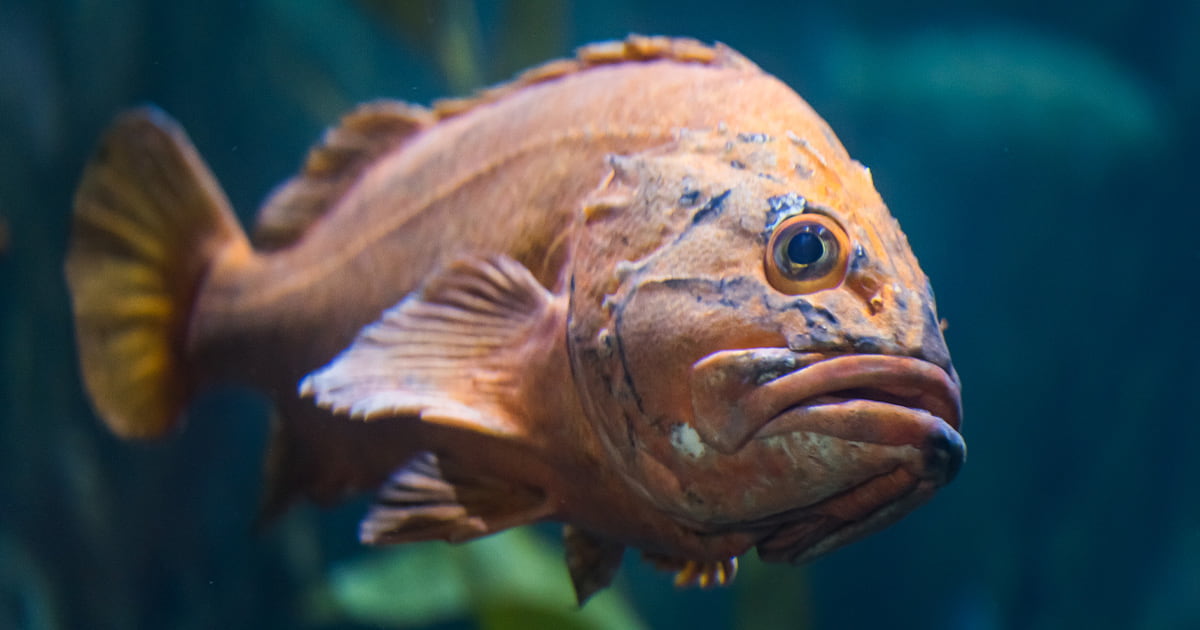
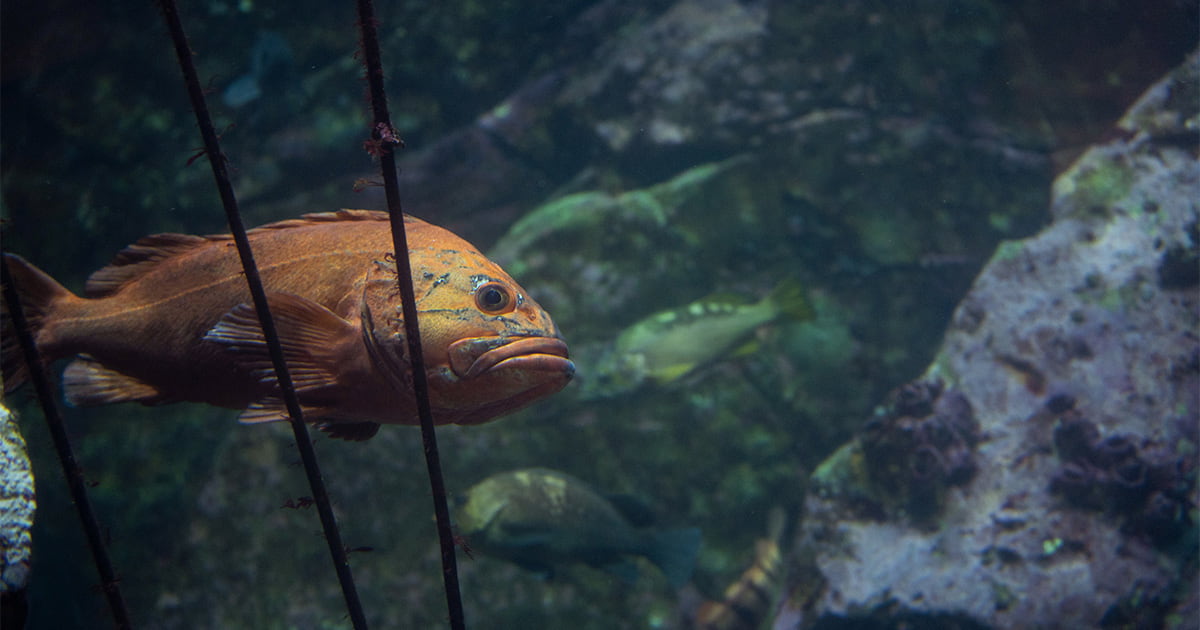
Meet the Seattle Aquarium’s latest SEAlebrities: Rock and Roll, the rockfish! They are just two fish out of the 14 different rockfish species found at the Seattle Aquarium. But there are many more types of rockfish in the wild, with 24 species in the Pacific Northwest and more than 100 species worldwide.

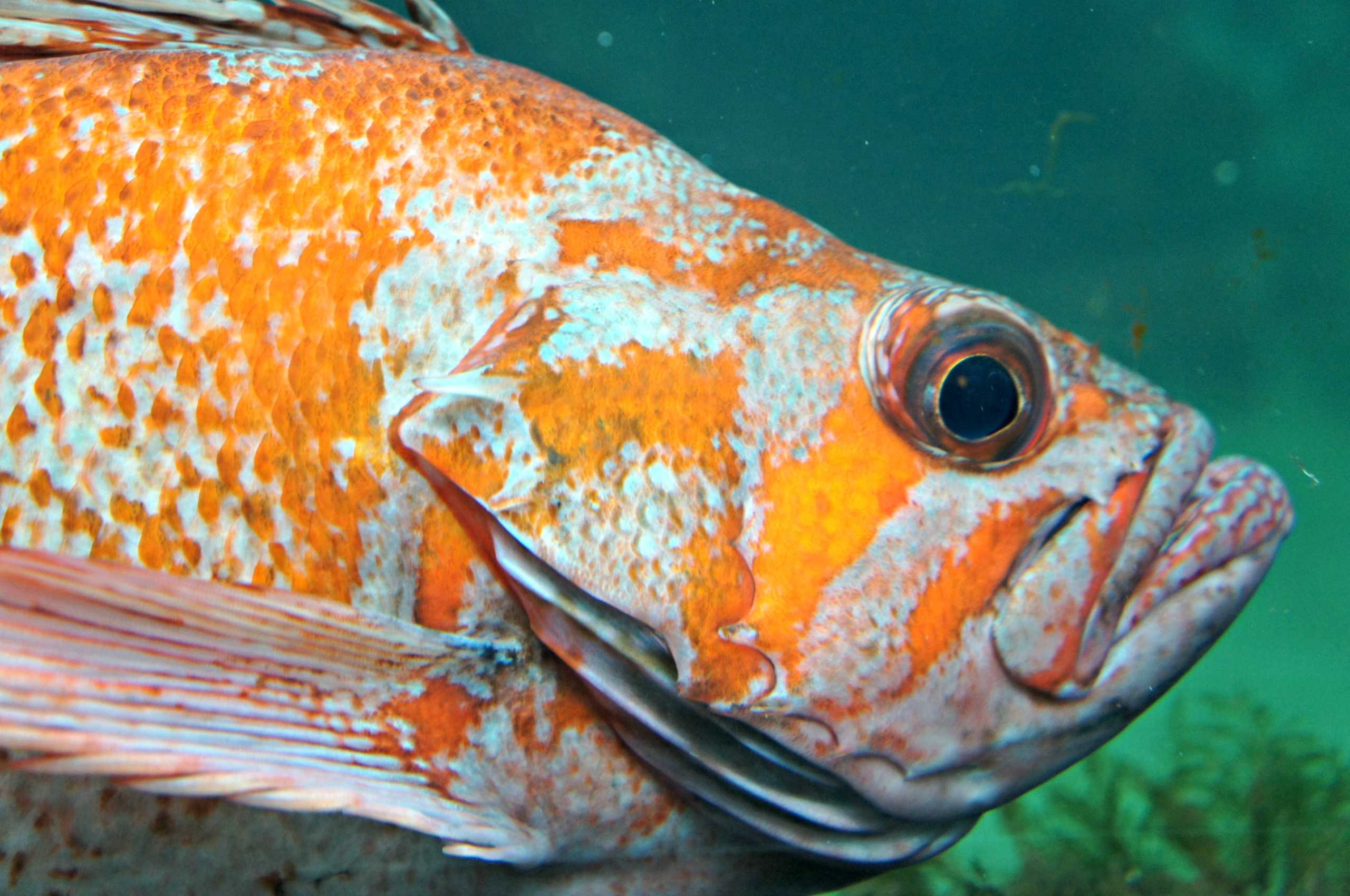
Yelloweye rockfish swimming underwater.

When looking at a rockfish, it’s easy to point out how different they are from humans. But we share a lot more similarities than you might think:

1. Age is only a number.

Admit it—getting older can be stressful sometimes. But one similarity humans and rockfish have is the ability to age gracefully. While most other fish have lifespans of two to 10 years, rockfish tend to live very long lives—up to 100 years or more! Unfortunately, there is a downside: Many rockfish who live to be 100 years or older don’t reach sexual maturity until they’re nearly 20 years old. Since they are susceptible to overfishing, some rockfish don’t have a chance to reproduce before they’re caught in a fishing net. That’s why most rockfish are listed as a species to avoid in sustainable seafood consumer guides.

2. Our differences make us who we are.

Though all people share common physical characteristics, our appearances vary widely and each of us is unique. Rockfish are the same way. Some species can be as small as 6 inches, while others may be 3 feet long and weigh up to 40 pounds! Rockfish can be red, orange, black or green, or even have a splotched or striped pattern. 

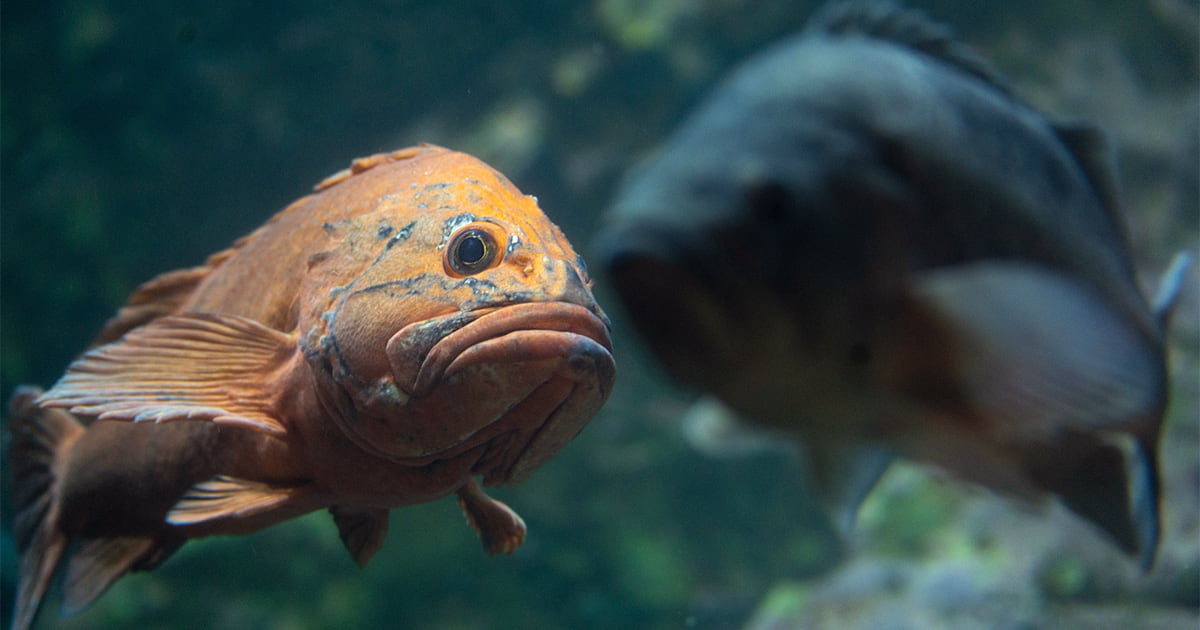
Yelloweye rockfish swimming underwater, turning towards another fish in front of it.

3. “Should I stay home or go out?” Rockfish can be introverted and extroverted.

Some people love to be social butterflies, while others prefer to go it alone. The same applies to rockfish. Some rockfish species live in schools, with hundreds or even thousands of individual fish! Others live more independent lifestyles and are protective of their solitary homes. 

4. Their tastes differ.

Human diets can range widely, depending on our individual wants and needs. Rockfish are the same way. Their go-to meals include plankton, small crustaceans such as crabs and shrimp, smaller fish like Pacific herring, and even jellyfish and squids!

5. (A healthy, clean) home is where the heart is.

Humans, fish and every living organism on the planet need a healthy, clean environment to thrive. You can help rockfish and other species by doing your part to protect Puget Sound and the ocean beyond, and choosing seafood from the “Best Choices” and “Good Alternatives” lists on the Seafood Watch cards at the Seattle Aquarium.

Yelloweye rockfish swimming underwater near a rocky underwater habitat.

Helping guests “glow up:” A surprise perk of volunteering at the Aquarium

Welcome to the second in our series of blog posts devoted to some of the amazing people who volunteer for the Seattle Aquarium. We’ll be highlighting others in the weeks to come. Interested in becoming a volunteer yourself? Scroll to the bottom for details!

When people hear that Aina Hori grew up in Hawai‘i, invariably they assume she surfs. She chuckles at this fantasy, clarifying that yes, the beach was her playground, and no, she didn’t ride the waves. Nonetheless, she loved the ocean, and her appreciation grew on elementary school outings. “In Hawai‘i, a lot of field trips take you to nearby beaches,” recalls Aina. “They build an understanding of where we live and why we have to take care of our environment.”

It was on these excursions, as she interacted with volunteers, that Aina discovered she wanted to be connected to the sea. Her interest developed as she spent hours exploring tide pools and getting familiar with the ocean. Eventually, when she set off for the University of Washington (UW), unsure of her major, she heeded the wisdom of her parents, who advised her to study something she really enjoyed. Luckily, the UW had just established a new marine biology major, and in June 2022, Aina was among 50 students in the first in-person graduating class. This fall, she’s continuing her studies through the School of Marine and Environmental Affairs at the UW. 

Aina heard about volunteering for the Seattle Aquarium from her classmates and decided she’d like applying her schooling to the real world. On her Saturday shifts as a habitat interpreter, she meets many families with children. Remembering how her experience with volunteers impressed her as a kid, she encourages those who are interested, letting them know a career in marine biology is possible. 

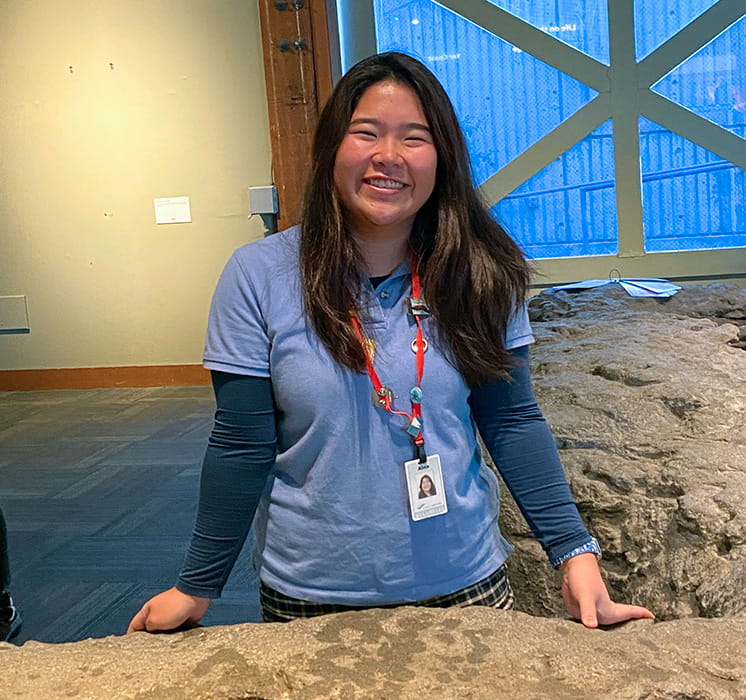
Seattle Aquarium volunteer Aina Hori standing in front of the Aquarium's Life on the Edge habitat.
Aina can be counted on to greet Aquarium guests with a smile during her Saturday shifts as a volunteer habitat interpreter.
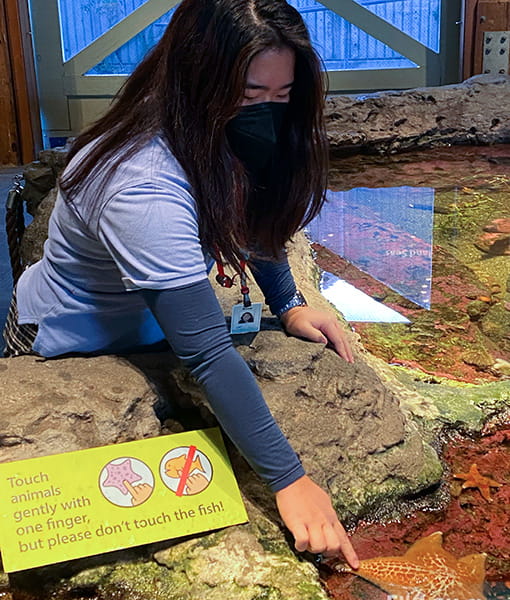
Seattle Aquarium volunteer Aina Hori standing at the Seattle Aquarium Life on the Edge touch habitat, reaching out and touching a sea star with one finger.
Aina loved exploring tide pools when she was growing up—now she helps Aquarium guests discover tide pools animals in our Life on the Edge habitat!

What does she like most about her role? “It’s a pleasure to show visitors who’ve never experienced the Pacific Northwest ecosystem—let alone water because they’re from landlocked areas—that you can get an urchin hug…it has a mouth…it’s an animal…the amount of times that a person’s face ‘glows up’ never gets old!” she says delightedly. 

Between graduate school and volunteering, Aina’s calendar is full. But she still makes volunteering at the Aquarium a priority, as she feels that in addition to increasing her aquatic knowledge, it also enhances her life skills, such as interpersonal communication and being at ease with people from all around the world. And she’s built a network of co-workers and supporters who she can rely on, wherever her future takes her. 

Aware that balancing school and other responsibilities is challenging, she offers this advice for students contemplating volunteering: “Given the Aquarium’s requirements, if you want to help and are limited on time, let them know you’re interested along with your availability and they’ll work with you to find appropriate opportunities.” There are many prospects, including interpretation at evening events and seasonal needs like the Beach Naturalist and Cedar River Salmon Journey programs—positions that might not conflict with classes and other life obligations.

Aina’s commitment to the Aquarium is clear: she’s given more than 230 hours of service in her three years as a volunteer. One of the key reasons she loves being a habitat interpreter is that she helps visitors realize that each individual can make a difference to our environment. “I keep volunteering because, by sharing, I create a fascination so people care and want to help change the world for the better,” she says.

Ready to join Aina in sharing the Seattle Aquarium’s mission of Inspiring Conservation of Our Marine Environment? Register for our upcoming volunteer orientation today! You’ll find all the details on our volunteer webpage.

Volunteer as a diver at the Aquarium? “Do it!” says Whitney Golay

Welcome to the first in our series of blog posts devoted to some of the amazing people who volunteer for the Seattle Aquarium. We’ll be highlighting others in the weeks to come. Interested in becoming a volunteer yourself? Scroll to the bottom for details!

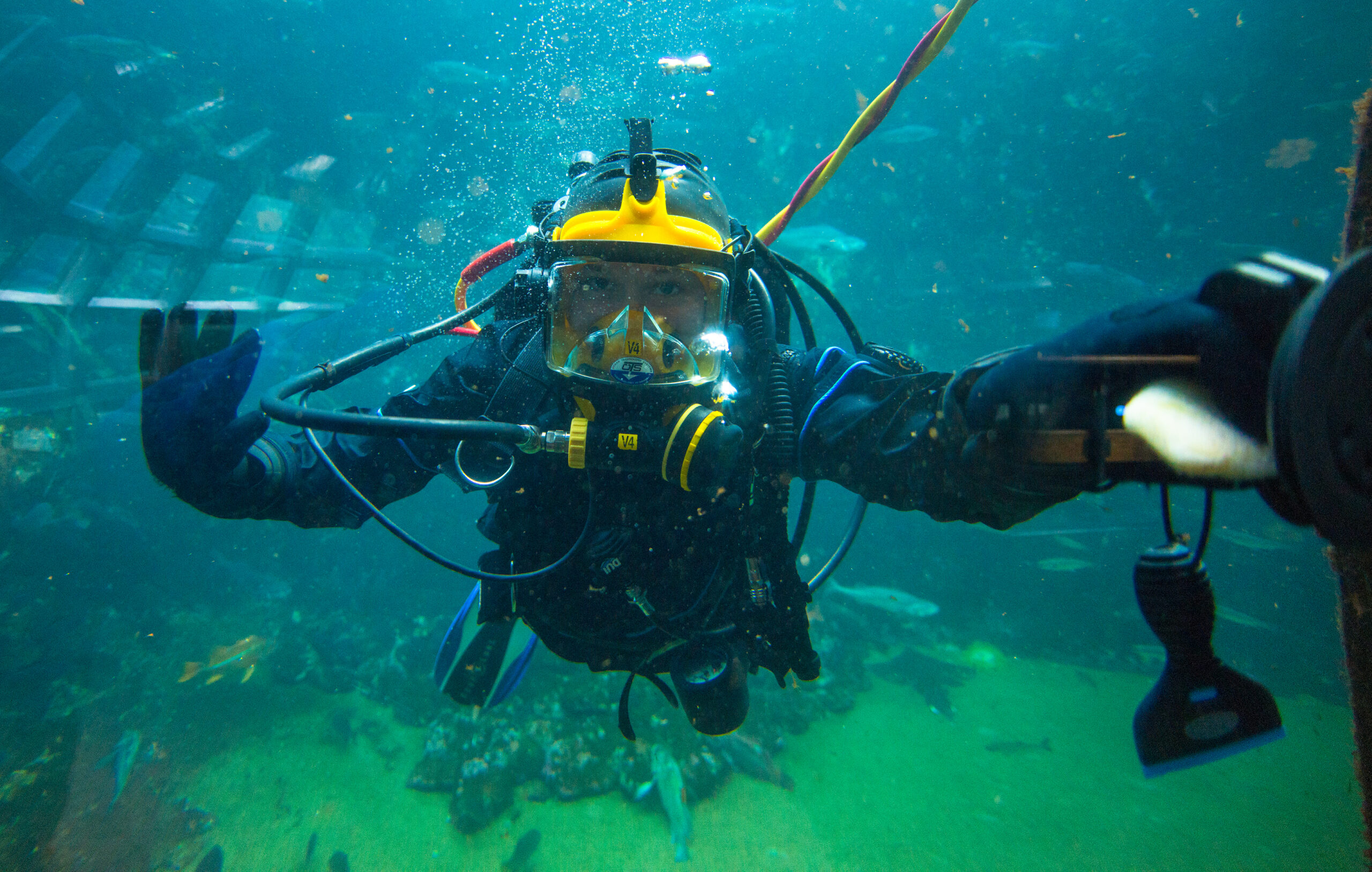
Whitney Golay started volunteering for the Aquarium in 2012 as a beach naturalist. In 2014, she added diving to the mix and, at last count, had logged more than 550 hours of service—all of them in our Pacific Coral Reef habitat. “It’s essentially a mini vacation where I can see tropical fish up close without having to go to Hawai‘i,” she says, “And I’m giving back at the same time.”

But Whitney’s appreciation for the marine environment isn’t limited to tropical waters. She studied marine biology at the University of Washington because of her love of the Salish Sea—a love she shares with her dad. “When I was growing up, my family would spend weekends on the Kitsap Peninsula, checking out all the tide pools and some of my favorite Salish Sea creatures, nudibranchs,” she says. 

Whitney’s journey to becoming a diver started in 2010, while she was working in Friday Harbor, analyzing underwater rock wall photos on a computer. When a co-worker signed up for a scuba class, she decided to join. “And, a few months later, I was getting to look at all the underwater sights that I’d been staring at through the computer screen,” she comments. She got her dive masters in 2014 and started volunteering for us the same year.

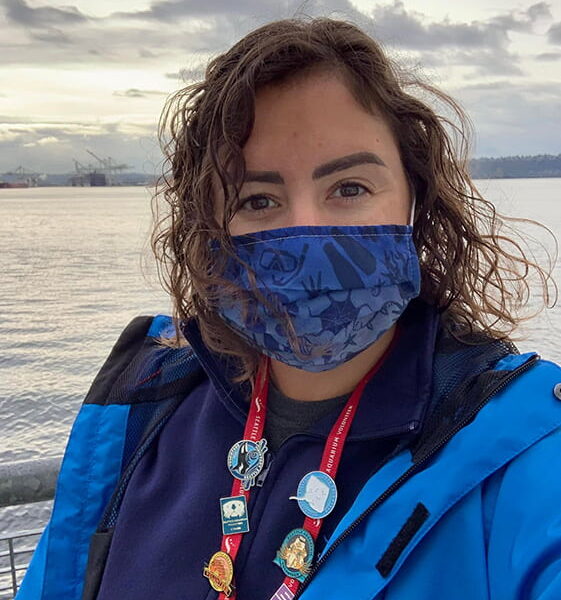
Seattle Aquarium volunteer Whitney Golay posing for a portrait in front of Elliot Bay.
Whitney proudly displaying her many volunteer pins, earned over her many years of service to the Seattle Aquarium (thank you so much, Whitney!).
Seattle Aquarium volunteer Whitney Golay in full underwater dive gear cleaning an underwater habitat at the Seattle Aquarium.
Volunteer diver Whitney in action in our Pacific Coral Reef habitat.

Now, Whitney spends her volunteer shifts diving in the warm-water habitats at the Aquarium, where she feeds the fish, watches the antics of the porcupinefish (one for her favorites), cleans the habitat and waves to guests on the “dry side.” She especially loves waving to young girls, who she hopes are inspired to share her passion for the ocean and conservation.  

When asked what she would say to someone who is considering becoming a volunteer diver at the Aquarium, her short answer is, “Do it!” She adds, “It’s a unique opportunity. You’re able to see some of the species up close that you are never going to see otherwise.” 

Potential volunteer divers are required to have a minimum of 12 dives in local diving conditions within the last year and an advanced open water diver certificate. Divers must also commit to at least one three-hour shift at the Aquarium, every other week for at least a year. Interested in learning more? Visit the adult volunteer page on our website and fill out our diver experience form!

Western snowy plovers: They’re just like us!

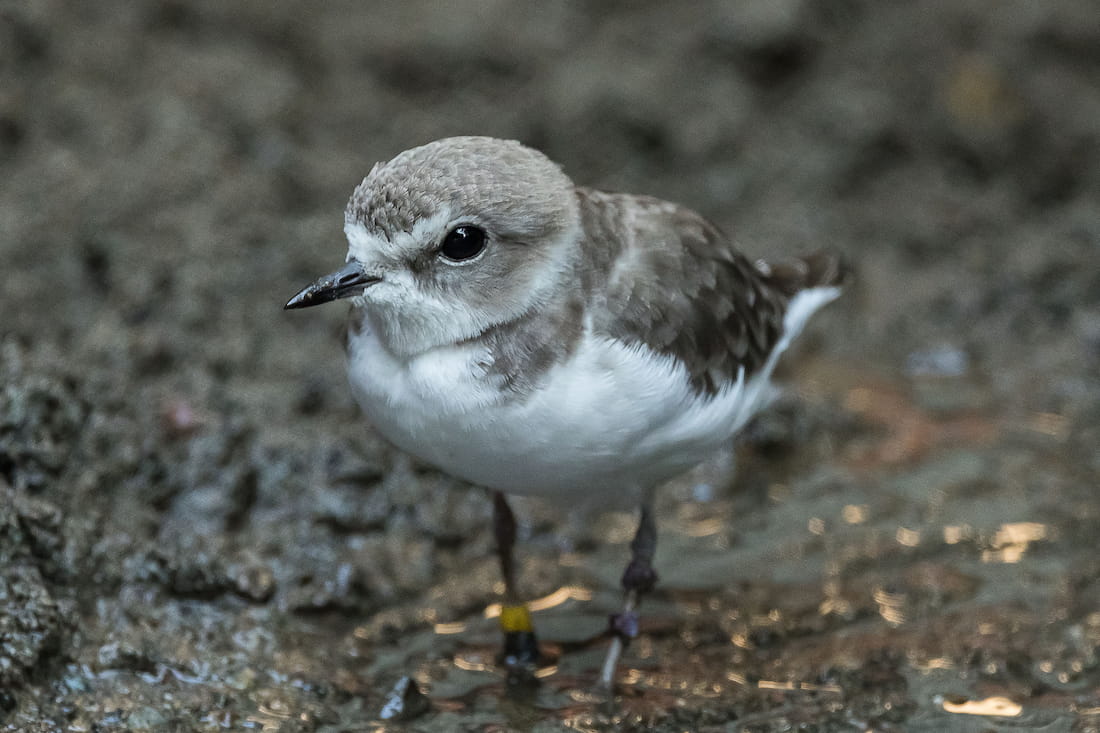
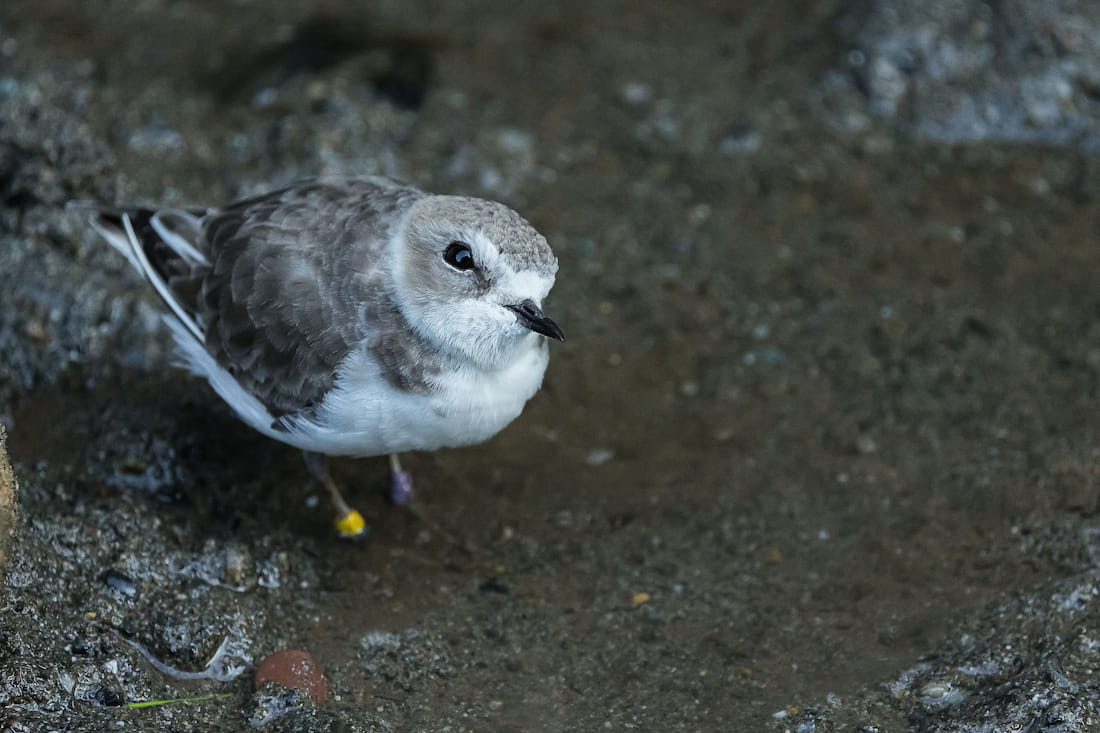
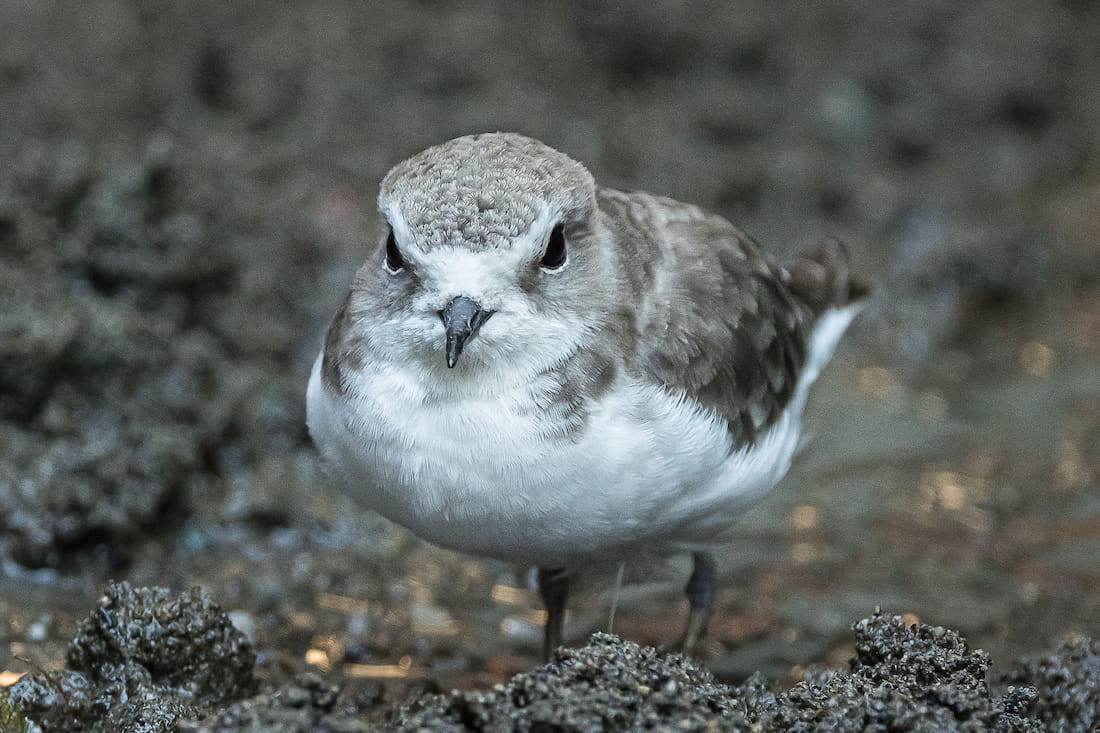
Introducing Crush the western snowy plover, one of our new Seattle Aquarium SEAlebrities! After being injured, she was rehabilitated at the Monterey Bay Aquarium in California, then moved to make her home with us in 2019. You can find her in our Birds & Shores habitat. 

At first glance, you might think that people don’t have a lot in common with Crush and her species, Charadrius nivosus. After all, humans can’t fly (at least, not unassisted) and human adults are pretty much guaranteed to weigh more than two slices of sandwich bread (or about 2 ounces, which is where adults of this species typically tip the scales). As it turns out, though, we share a lot of common ground!

Six ways that western snowy plovers are just like us

1. They dress to impress.

During their breeding season, May to September, both males and females add a little extra flair: black stripes above their eyes, near their ears and along their necks (although these markings are less distinct on females). 

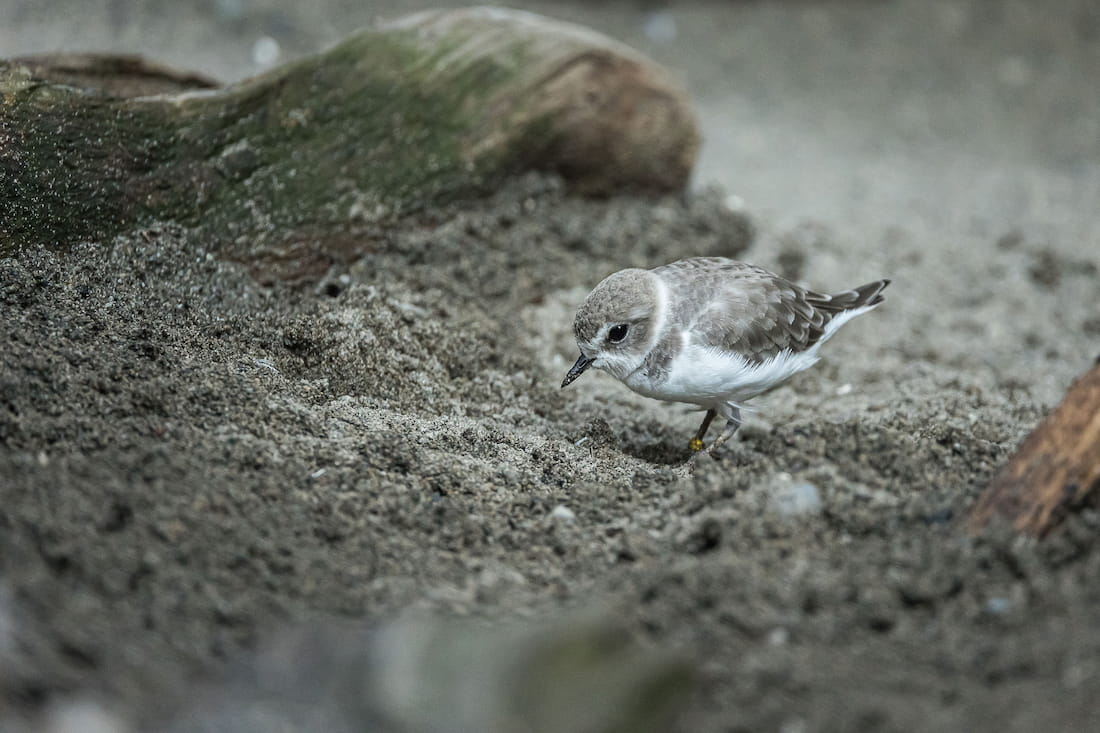
Western snowy plover at the Seattle Aquarium looking down as it stands in a sandy habitat.

2. In the right surroundings, they blend in perfectly.

The bodies of western snowy plovers are pale, sandy brown on top with a white underside. What else is pale, sandy brown? Sand, of course! And sandy beaches are where western snowy plovers make their homes, along the Pacific coast from Washington to northwest Mexico. Unless they’re in motion, their coloration and tiny size make them hard to spot in the wild.

Western snowy plover looking up with a titled head, leaning to the left, at the Seattle Aquarium.

3. They have independent spirits.

Western snowy plover eggs hatch after an incubation period of 26–33 days. And then the chicks are literally off and running: They’re able to leave the nest and forage on their own within three hours! What are they looking for? Prey like insects, marine worms, crustaceans and invertebrates. 

4. They fight for what’s important to them.

While their eggs are incubating, both male and female western snowy plovers may defend their nest and the surrounding area by posturing (or spreading out their wings), chasing and even fighting potential predators (such as gulls and falcons) or other perceived threats to their families-in-the-making. 

Western snowy plover standing and looking towards the camera.

5. They work with what they’ve got.

Western snowy plovers make their nests on the sandy beach, in slight depressions on the dry ground (sometimes even in human footprints!). And they line those nests with just about anything they can scavenge: pebbles, shell fragments, fish bones, bits of driftwood and more. 

6. They can get hurt—even by people with the best intentions.

Western snowy plovers have been listed under the Endangered Species Act since 1993, and their numbers are still declining. Unfortunately, human impacts are the main problem for this struggling-to-survive species. The good news is that we can be part of the solution too! Read our western snowy plover webpage for more details and to learn how you can help.

“Resharking” the ocean: Five lessons learned

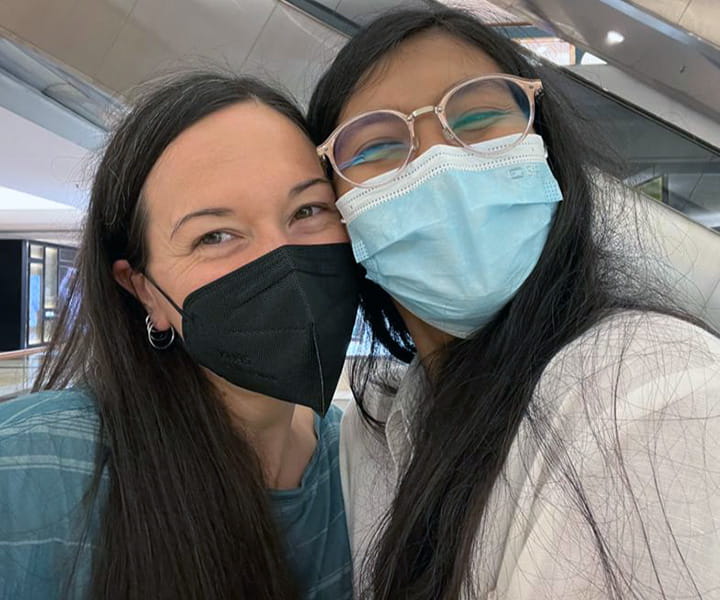
Dr. Erin Meyer and Nesha Ichida both wearing masks and smiling while posing for a selfie.
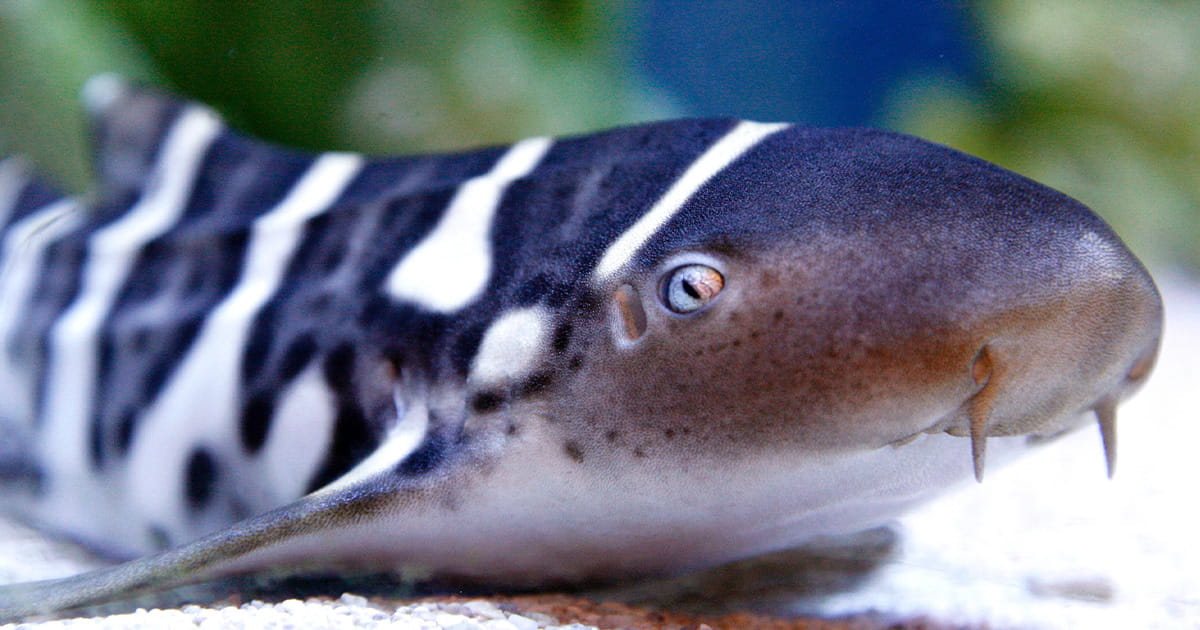
Dr. Erin Meyer meets Nesha Ichida, StAR Project Indonesia Program Manager, after the two worked together remotely for more than two years. The StAR Project is a global effort to recover Stegostoma tigrinum (Indo-Pacific leopard sharks) and the first project of the ReShark coalition.

Sharks and rays are vanishing at an alarming rate due to fishing and habitat loss. When these keystone species disappear, their entire ecosystems collapse. For over two years, the Seattle Aquarium has been part of a global coalition devoted to changing the story and “resharking” the ocean.

In August 2022, the coalition—called ReShark—achieved a major milestone in its first project. Eggs laid by Indo-Pacific leopard sharks (Stegostoma tigrinum) in the SEA LiFE Sydney Aquarium were moved from Australia to a new shark nursery in Raja Ampat, Indonesia. Pups have already hatched and are growing quickly! When they’re mature, they’ll be released into their home waters to help bring back their species locally and safely within marine protected areas. And ReShark’s work will continue, with new eggs, new locations and new species to recover.

Dr. Erin Meyer, Director of Conservation Programs & Partnerships at the Seattle Aquarium, has helped build the coalition from its earliest days and chairs the project’s Steering Committee. She shared five key lessons from the first chapter of its work.

1. Aquariums can help bring back endangered marine species.

Aquariums have been advocating to protect ocean health, mobilizing communities and educating people about endangered marine animals. We can also help reverse the exponentially increasing number of species listed as endangered or critically endangered. For some endangered species, protecting and restoring habitat areas isn’t sufficient. Because if their numbers get too low, they can’t successfully reproduce. And that’s where aquariums can step in because we are the organizations with the expertise and experience in breeding, rearing, feeding and caring for these animals in ways that no other organization can do. It’s an incredible opportunity to put our knowledge to work to restore threatened species in the ocean.


How ReShark Works

  1. Sharks and rays living in accredited aquariums lay eggs (or, depending on the species, pups).
  2. Eggs or pups are transferred to special nurseries built by local communities in areas where species are in decline and other protective measures have not brought back their numbers.
  3. At the nurseries, trained local aquarists rear shark and ray pups.
  4. Once ready, juvenile sharks and rays are tagged and released into their home waters.


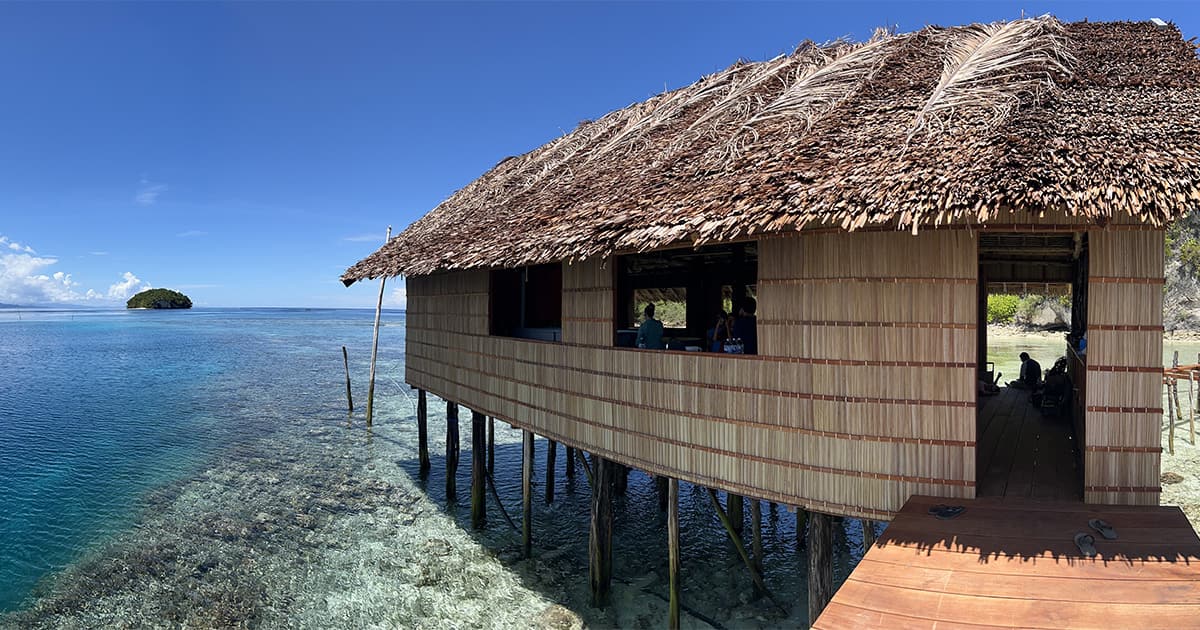
A thatched hut built on stilts over shallow water along an ocean coastline in Indonesia.
This nursery, built by the local community in Indonesia, is where shark pups hatch and grow, as part of the ReShark coalition's initial project.

2. Building global partnerships takes time.

The first time I heard the idea for what would become ReShark was in early 2018, about a month after I got the job at the Aquarium. I then became part of a small group of colleagues from around the world that kept talking about the possibility over the next two years. Could we do it? If we did, how would it work? We formally launched the first project in February 2020. Then the pandemic began. Still, we kept going, working virtually with local leaders in Indonesia to get permits, building a nursery for baby sharks at the Raja Ampat Research & Conservation Centre, training aquarists in Indonesia, finding viable eggs to ship. Moving our first set of eggs in August took a huge amount of work behind the scenes by so many people. (See all ReShark partners involved in this work.) In August, I got to see the nursery for the first time in person—this amazing structure we’d all been working toward for two years. For me, that’s when it became very real.

ReShark by the Numbers

70+ partners | 13 countries | 2.5 years of planning

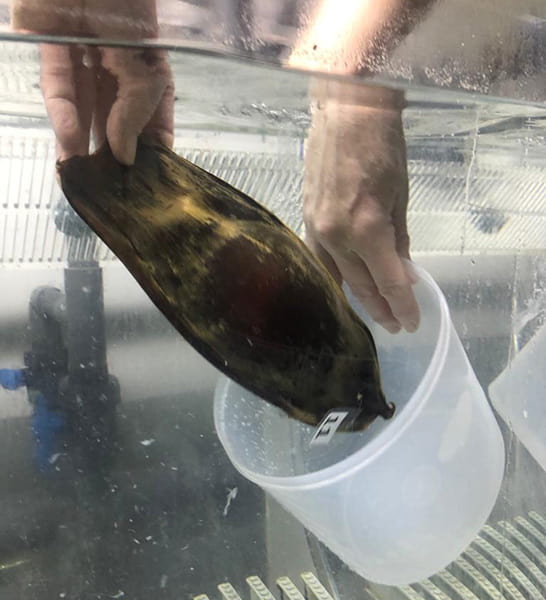
A large shark egg being carefully handled underwater, the egg is labeled with the number 11.
A ReShark team member carefully handles a shark egg.

3. Cross-cultural collaboration moves at the speed of trust.

Conservation is about people. And we are agents of change, both damaging and regenerative. Collaborative conservation is intentional, co-led and begins with a blank slate. ReShark’s first project is co-designed and co-implemented with the West Papuan government in Indonesia as critical partners in this coalition. It would not have been possible without local leadership. Doing cross-cultural conservation work in a way that centers the priorities and needs of the people in the country where the work is taking place is incredibly important for this project and for the future of conservation in general. I often hear in the environmental justice community that work like this moves “at the speed of trust.” It takes years to earn trust and seconds to break it. As ReShark grows to include more species and more locations, we will continue to center the perspectives and expertise of local partners, breaking the colonialist approach to conservation, challenging our biases and checking our privilege. Conservation requires leaning into uncomfortable spaces, and we’re not shying away from that.

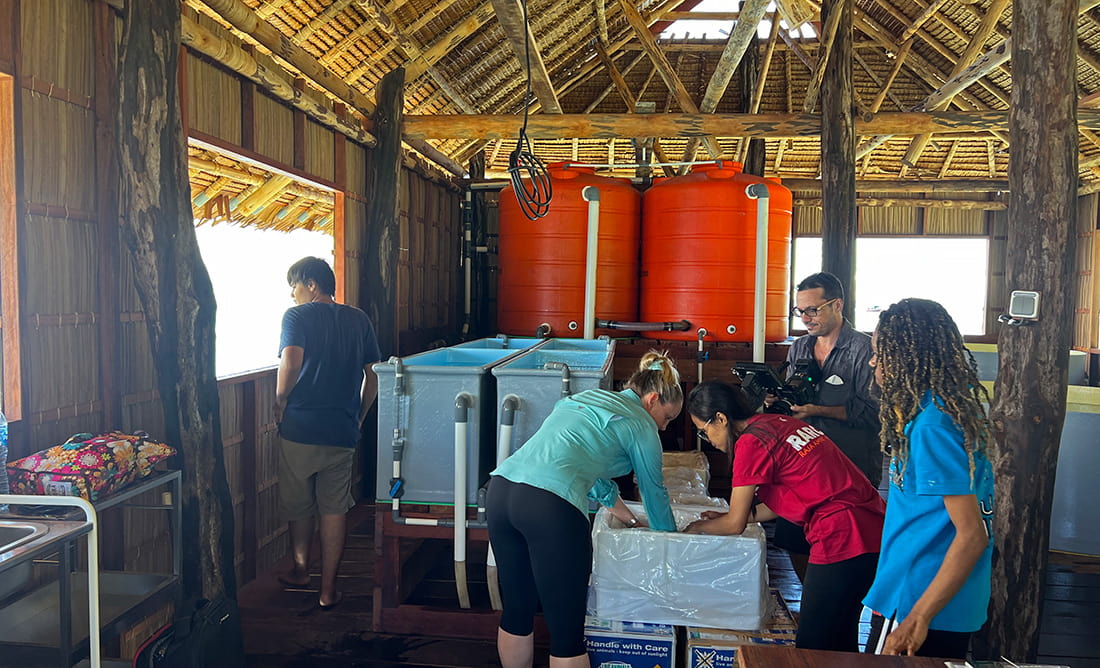
Two women lifting shark eggs out of transport crates in an egg nursery located in Indonesia, while a man films them with a camera.
In this scene from ReShark's first egg transport, coalition members work together to carefully unpack shark eggs in the nursery.

4. Restoring species means being willing to learn and adapt.

I’m not a shark biologist; my expertise is in invertebrates, ecosystems and conservation action. I’ve learned that it’s a far harder thing to move eggs around than I ever thought it would be. It seems so simple! You get the right animals, the right habitat, they make eggs and then you move the eggs, right? Wrong. It’s incredibly complicated. Bringing people to the table with unique experience and expertise is how this project has gone as far as it has. And we will continue to bring new perspectives and new expertise to the table as we grow. So far, we’ve successfully moved eggs and seen pups hatch. These are huge milestones! And now we’re hopeful that the animals will thrive, that we’ll be tagging and releasing them in the coming months. But we don’t yet know the outcome of this work because nobody’s ever done this before. 

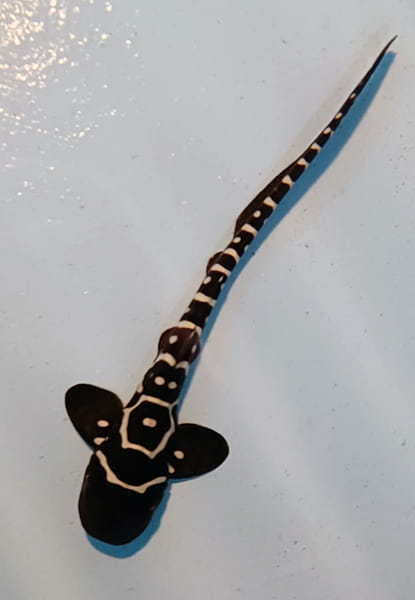
Newborn Indo-Pacific leopard shark pup resting on the bottom of a nursery habitat.
A newly born Indo-Pacific leopard shark pup explores his nursery habitat. When he's ready, he'll be released into marine-protected waters in the Coral Triangle as part of a world-first species recovery effort.

5. Hope is the key.

When the Seattle Aquarium’s Ocean Pavilion opens in 2024, we will have the opportunity through that platform to show people these incredible animals that exist on the other side of the Pacific Ocean. We’ll also have a new platform to talk about this initiative to bring sharks and rays back from the brink of extinction: to not only tell people that there are almost 400 species of sharks and rays listed as endangered or critically endangered around the world, but also, here’s what we—all 70+ partners—are doing to turn that back around. I believe that will bring a sense of hope to people who visit.

And importantly, our visitors can take action in their daily lives to help sharks and rays throughout our one world ocean. We’re all connected. 

“When they’re hungry, they’ll let you know:” Caring for dogfish

Senior Aquarist Chris Van Damme gingerly holds one end of a herring when feeding Elliott and the other Pacific spiny dogfish at the Aquarium. Dogfish—who are just as enthusiastic about meals as their furry namesakes—can chomp through their food with astonishing speed and force. As Chris shares in our interview, it’s just one of the many reasons these creatures inspire awe and affection from their caretakers.

Chris Van Damme kneeling in front of a large viewing window into the Underwater Dome at the Seattle Aquarium as a dogfish swims inside the dome behind him.
Chris Van Damme, senior aquarist, in front of the Underwater Dome at the Seattle Aquarium. Stop by the Underwater Dome to see the dogfish at the Aquarium during your next visit!

Q: What do you find fascinating about dogfish?
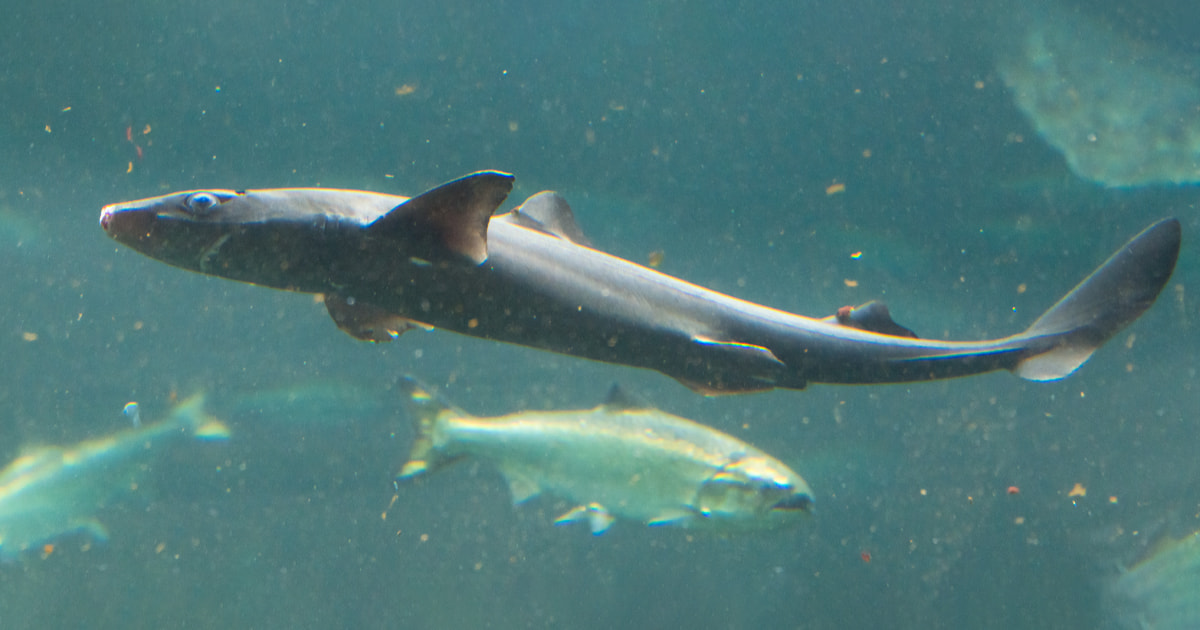
A: You wouldn’t know it from their name, but dogfish are sharks. They’re a smaller species of shark, but like all sharks, they’re fast and sleek. They can turn on a dime. They’re immensely strong. 

Dogfish are also record-setters. They have among the longest pregnancies of any animal: 22 to 24 months. (Fun fact: Dogfish pups are born ready to hunt!) They reproduce late in life—as late as their mid-30s for females—and they live long lives—80 years or more! They’re also remarkable travelers. One of my colleagues found a dogfish in California that had been tagged in Alaska.

Q: What surprises people when they visit dogfish at the Aquarium? 
A: Visitors who hear there are sharks living in the Aquarium’s Underwater Dome sometimes mistake the sturgeon—a prehistoric-looking animal—for dogfish. Dogfish are understated. They can be hard to spot, and you’ve got to be patient.

Q: Where can you spot dogfish in the Underwater Dome?
A: In the mornings, unless it’s time to eat, you’ll often see them sitting on the sand at the bottom. At other times, you’ll see them swimming about midway up in the Dome. 

Q: How does the Underwater Dome mirror how dogfish live in Puget Sound?
A: First, the water here comes directly from the Sound. Its temperature and salinity match their natural environment. Also, the Dome is a multi-species habitat just like in the wild. And, like in Puget Sound, there are open sandy bottoms where they can rest. 

Q: What do dogfish at the Aquarium eat?
A: They eat a variety of herring, anchovy, clam, squid and shrimp. Their diet here mimics their diet outside the Aquarium, and that’s important to their health.

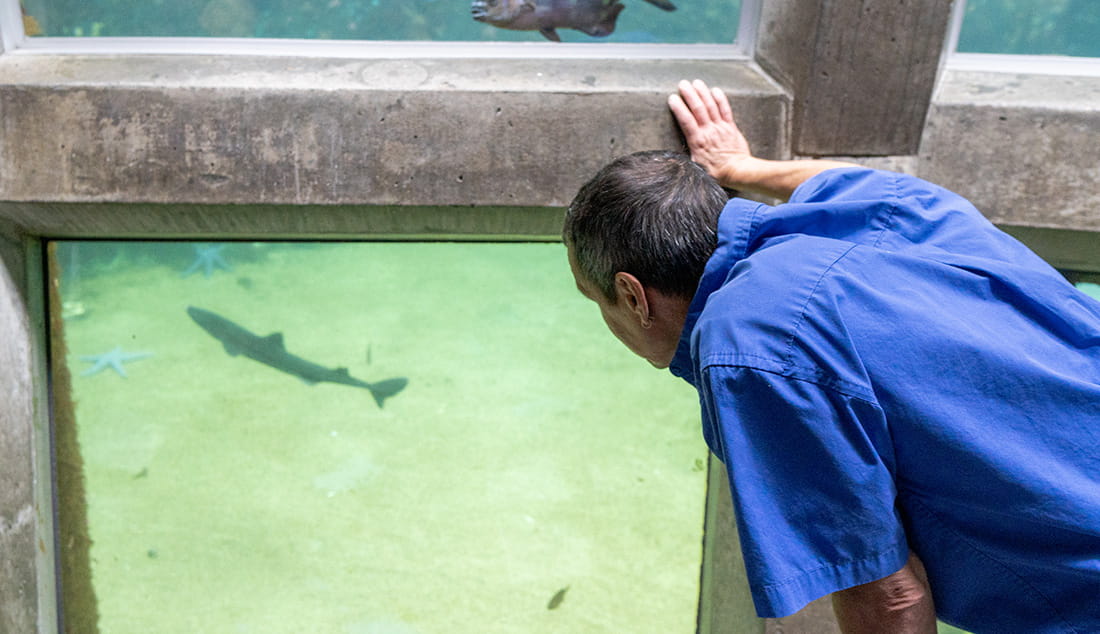
Chris Van Damme leaning over and placing a hand on the exterior of the Underwater Dome habitat at the Seattle Aquarium as he looks inside the habitat at a dogfish swimming by.
Take your time when looking for the dogfish in the Underwater Dome! They can sometimes be hard to spot as they swim throughout their habitat.

Q: Do they consider other fish in the Dome as prey?
A: No, we dive and target-feed them by hand every afternoon to minimize the possibility of that happening. (And since they are primarily scavengers, it’s a highly unlikely scenario anyway.) We also do a surface feed, where we drop larger pieces of food to the bottom for them.

Q: What is it like to hand-feed dogfish?
A: They have very sharp teeth, so it’s important to release the fish before they get too close!

Q: How do they eat outside the Aquarium?
A: They often hunt in packs like dogs—that’s why they’re called dogfish—and can eat their way through schools of fish. (Fun fact: Dogfish can hunt in packs of up to 1,000!) 

Q: Are local dogfish populations healthy?
A: Thankfully, our local dogfish populations are healthy. In part that’s because we don’t have a targeted fishery here (meaning that we don’t eat them). Atlantic spiny dogfish, by contrast, are eaten in Europe. Our local dogfish populations are also managed by National Oceanic and Atmospheric Administration fisheries and by the Pacific Coast Management Fishery Council, which helps keep populations healthy.

That said, dogfish and all the animals living in our local waters are affected by what goes in our sewers and drains. (Tip: Learn how you can protect ocean health on our Act for the Ocean page.)

Q: What is a good pathway to a career like yours?
A: I studied oceanography at the University of Washington, which is a good field for studying the marine environment as a system. Oceanography combines physical, chemical, biological and geological science. If you’re specifically interested in working with sharks or helping to manage healthy shark populations, you should consider studying marine biology. 

Q: As a diver, have you encountered dogfish outside of the Aquarium?
A: I can think of only a handful of times I’ve seen them while diving. Their senses are a lot better than ours. They see and hear us before we know they’re around, and they move fast. 

They’re beautiful animals. It’s such a treasure and a treat to find one as a diver. It’s a gift. 

Now that you’ve read Chris’s thoughts, check out our dogfish page to learn more about Elliott and the other dogfish at the Aquarium. On your next visit to the Aquarium, look carefully for Elliott in the Underwater Dome!

Adults 21+ Special Events!

June 18  |  June 25  |  July 2

Explore the Aquarium at night with friends, family or by yourself!

Today only, your gift will be matched dollar-for-dollar up to $25,000 thanks to the generosity of donors Betsy Cadwallader, J & Tim, and Jess & Andy Peet. Help us reach our $50,000 goal!

End the year with a gift to the ocean.