This site uses cookies. View our Cookie Policy to learn more about how and why.

Regular hours: 9:30 am – 6 pm
Last entry at 5 pm

Superpod: A new book for kids who love whales!
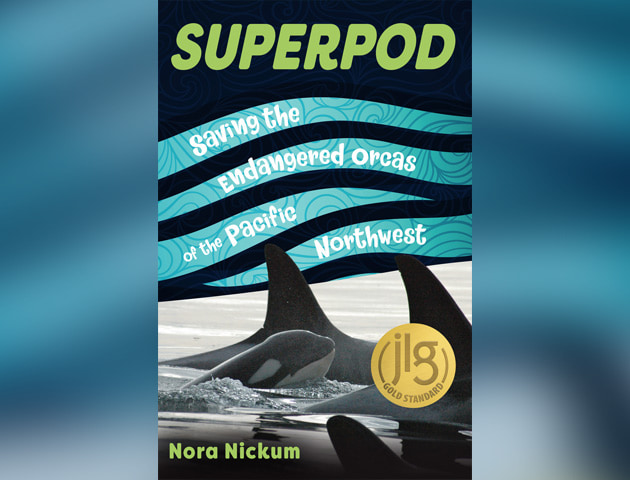
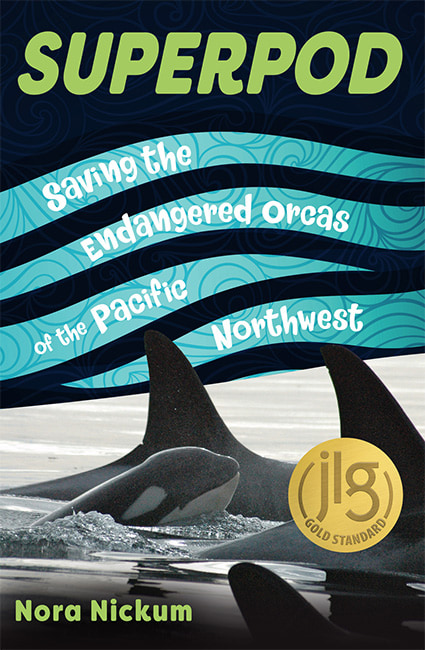
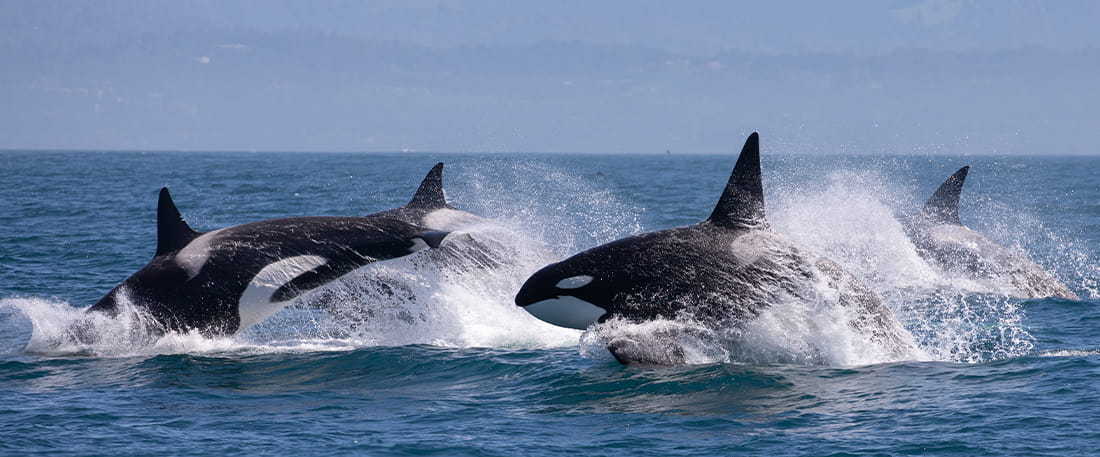
Photo of orcas at the surface of the ocean featured on the cover of the book Superpod: Saving the Endangered Orcas of the Pacific Northwest by Nora Nickum.

Join us for a book event on Sunday, April 16, 2023, to ask Nora some questions of your own and get a signed copy!

You can also pick up a copy at our gift shop the next time you visit us at the Aquarium, or order it from the Aquarium gift shop online or your local independent bookstore.

There’s a new book for kids ages 8–12+ about the amazing southern resident orcas, and it’s written by Nora Nickum, who leads our ocean policy program! Superpod: Saving the Endangered Orcas of the Pacific Northwest comes out April 11 from Chicago Review Press.

We asked Nora what she discovered about these iconic whales in the process of writing the book, what you’ll find in its pages, and what the Seattle Aquarium is doing to help these orcas recover.

You’ve been working on orca recovery for a long time. What’s something new you learned while doing the research for this book?

I learned that orcas are born tail-first! Their tails are floppy to start with. Getting the tail out first means it can harden in the cool water so the baby orca can use it right away to swim up to the surface for a breath of air.

I also had fun talking with Dr. Bob Otis about why orcas breach (jump out of the water). It turns out it’s still something of a mystery, but there are enough clues from his years of research that I was able to guess what was happening the time I saw an up-close breach from shore at Lime Kiln Point State Park. 

Did you get to go on some fun field trips while you were writing Superpod?

Yes! I interviewed a lot of dedicated people who are working to help the orcas, and they do their work in amazing places, so I tagged along whenever possible. I went out on a boat with Dr. Deborah Giles and Eba, the scat-sniffing dog, from Wild Orca as they collected scat samples from transient orcas (see Eba in action in this video from the Seattle Aquarium!).

I also visited scientists working in a lighthouse, stopped by the Whale Trail site at Alki Beach, and went to a few spots along the Cedar River where Seattle Aquarium volunteer naturalists helped me catch glimpses of spawning Chinook salmon. I highly recommend that readers check out Whale Trail sites in the region and participate in the Cedar River Salmon Journey this fall!
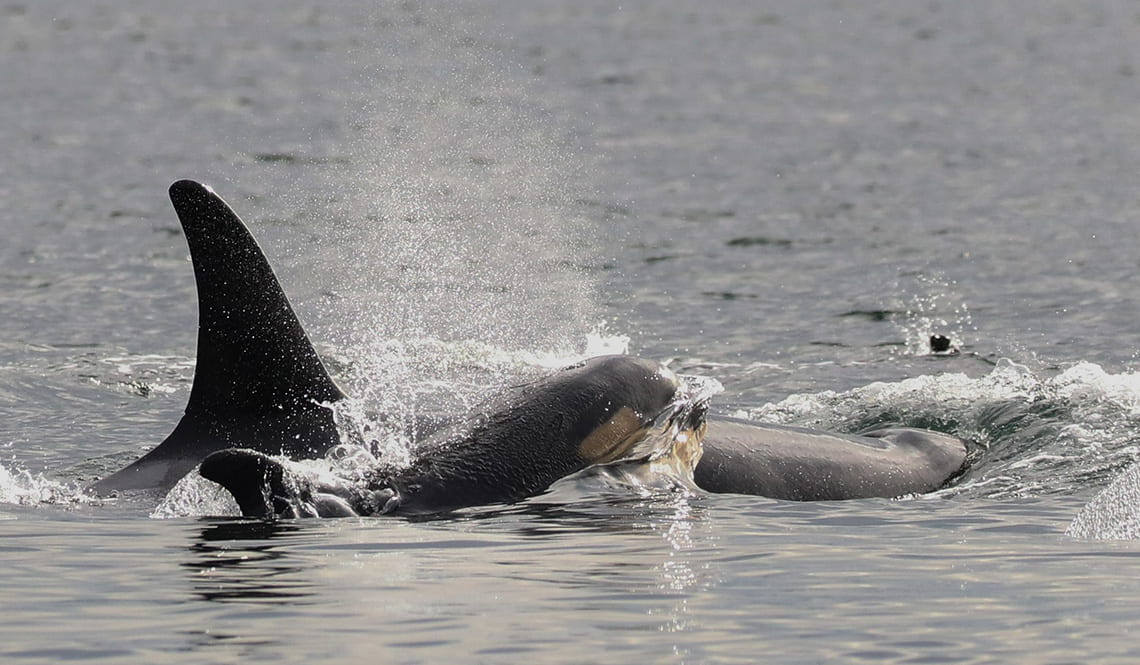
A juvenile orca whale surfacing while swimming alongside its mother.
Phoenix swims alongside his mom, Tahlequah. Photo: Danielle Carter

There are some cool photos in Superpod—exuberant breaches, a transient orca flinging a seal pelt, and amazingly close encounters with shore-based whale-watchers. How did you gather all those pictures, and do you have a favorite?

I do love those! Some of my other favorite photos were taken by scientists from the air, showing orcas playing together and chasing salmon underwater. Those aerial photos are like a window into a fascinating and usually unseen social life beneath the waves.

I was so lucky to find scientists and talented photographers who were willing to share their images (one was Danielle Carter, who worked for the Seattle Aquarium for many years), and to be able to use public images from the Washington state archives and NOAA. It was important to list the NMFS permit numbers associated with many of the photos—researchers get permits that allow them to get a little closer than other boaters can, and to take photos while they’re there. 

You lead policy work for the Seattle Aquarium. How can policy advocacy help the orcas? And what can readers do?

There are so many things we can each do to help restore the Salish Sea and protect the orcas, like choosing sustainable seafood, following Be Whale Wise guidelines and giving the orcas as much space as possible when boating, and picking up litter at the beach. But policy change is also important because it can make large-scale improvements happen faster. We’ve been advocating for state and federal funding to restore salmon habitat; policies to protect kelp and nearshore ecosystems that support forage fish and salmon; changes in boating regulations to quiet the waters so orcas can communicate and forage more successfully; and measures to reduce toxic pollution. Readers—and Aquarium guests—can join us in raising our voices for these kinds of policies and find lots of other action ideas in the book.
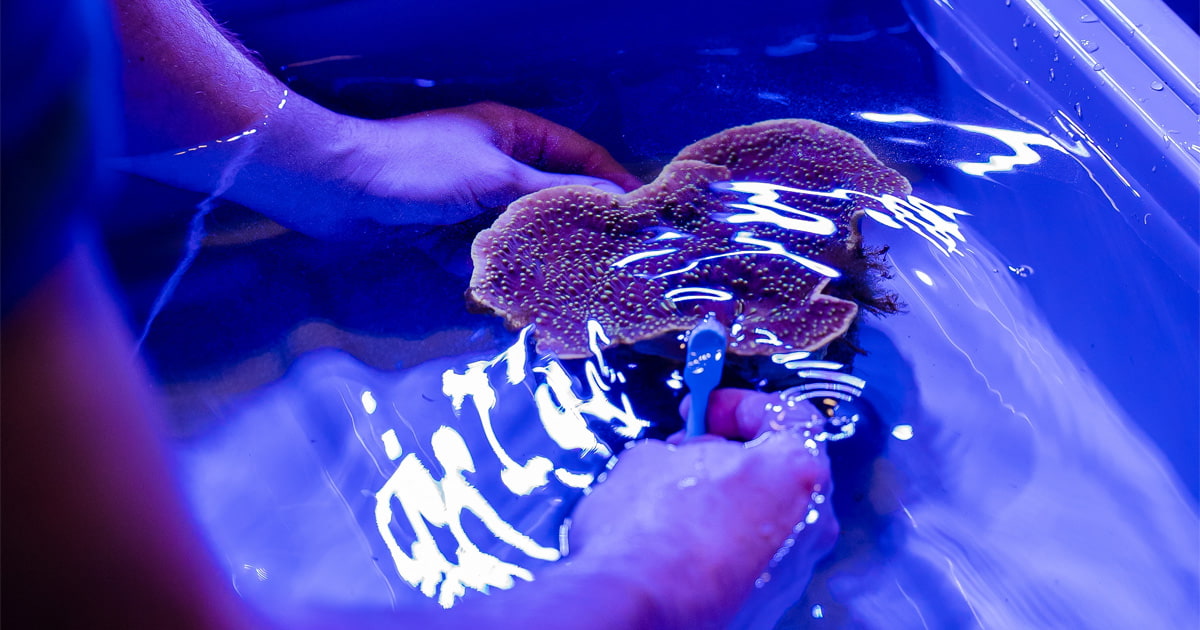
New series goes behind the scenes at our Animal Care Center

Visitors to our Ocean Pavilion will experience underwater life on the other side of the planet. They’ll witness tropical reef ecosystems that face similar challenges to our local waters and meet extraordinary creatures who represent what’s at stake if we don’t work together to regenerate a healthy ocean.

As the Ocean Pavilion rises along our waterfront, we’re welcoming and caring for its future residents in our new state-of-the-art offsite Animal Care Center.

Introducing Animal Care Stories

Our new series takes viewers behind the scenes to see how our dedicated animal care team is preparing for the Aquarium’s historic expansion.

In the first three episodes, our team begins to move animals from the existing Aquarium piers to the Animal Care Center. The team shares their diligent planning efforts and their excitement about the role each animal will play in Ocean Pavilion ecosystems.

It Takes an (Aquatic) Village

At the Aquarium and the Animal Care Center, experts work together across multiple teams. 

  • Animal care team: Aquarists are specialists on the fish and invertebrate species in their care. Nimble, observant and deeply committed, they get to know Aquarium residents on an individual level by caring for them every day.
  • Veterinary team: Every animal at the Aquarium—from tiny to very large—receives attentive and compassionate medical care from our full-time veterinary team. The approximately 110 species who will call the Ocean Pavilion home will receive the same excellent standard of care as our current residents.
  • Water quality team: Our expert water quality team carefully monitors animals’ environments around the clock. They use special instrumentation to track the level of dissolved oxygen, pH, temperature and other conditions in Aquarium habitats. As animals travel to the Animal Care Center, the team uses technology to monitor their trip in real time and does additional testing upon arrival for a holistic picture of water quality.

"The animals we care for are individuals with their own quirks and personalities. My favorite task is feeding; you’re making that connection and providing hands-on care."

Beyond Ocean Pavilion

Even after the Ocean Pavilion opens, the Animal Care Center will provide space for important conservation work. Its facilities will allow us to grow our species recovery programs, including our participation in the global ReShark coalition, dedicated to recovering threatened shark and ray species, and our program to restore pinto abalone in the Salish Sea. It’ll also be home to our plastic pollution research and rehabilitation efforts for stranded or injured marine animals, like Shi Shi the sea turtle. 

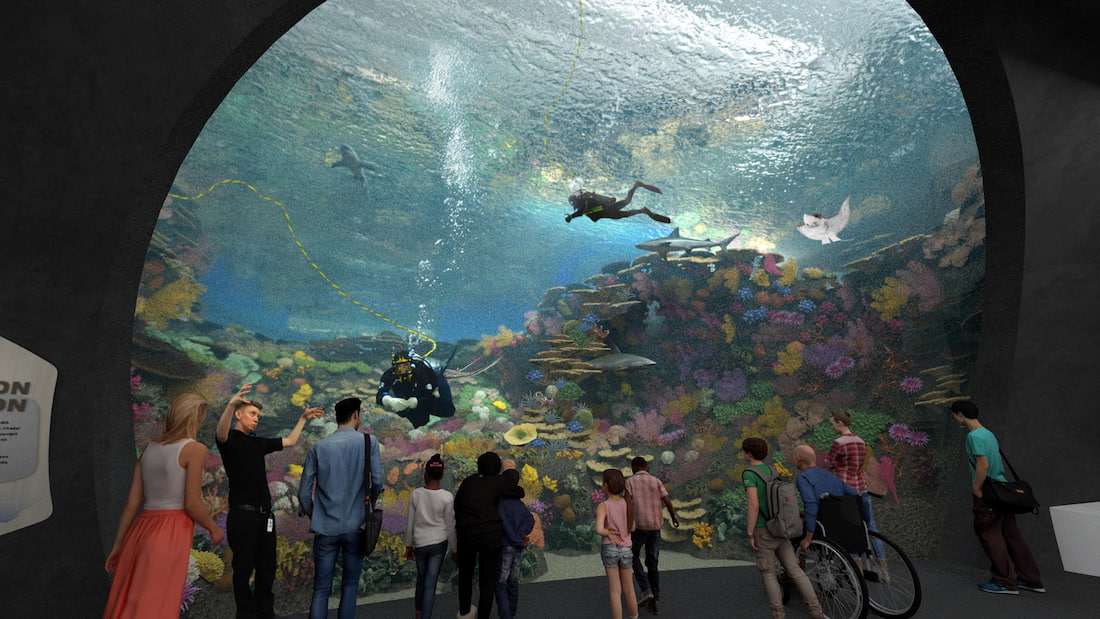
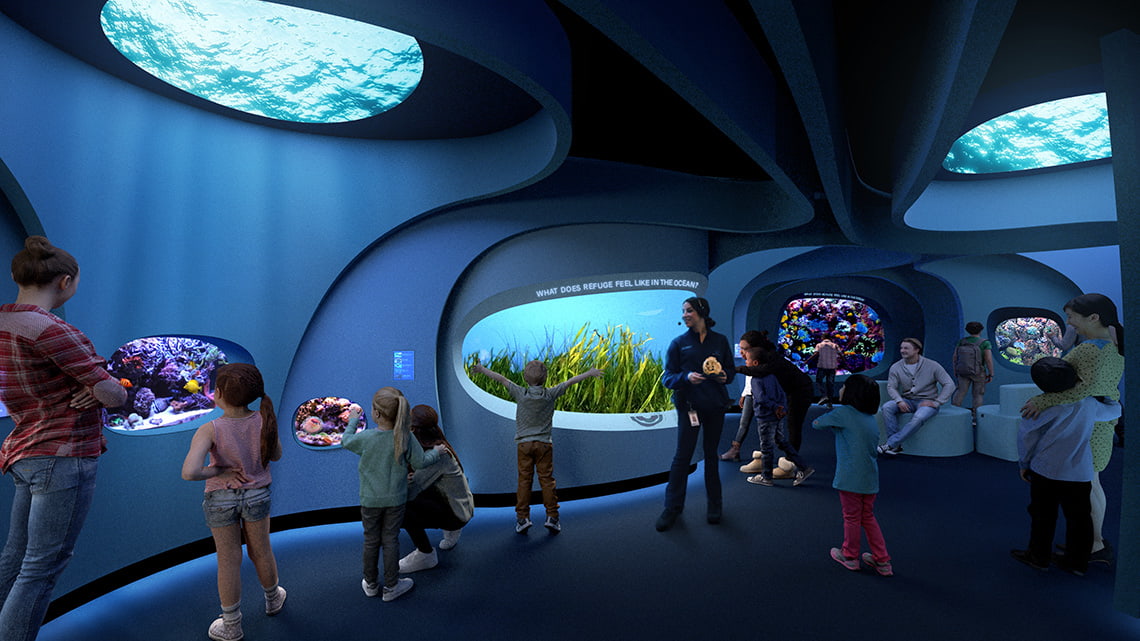
Rendering depicting guests viewing different animal habitats in the future Ocean Pavilion.
The Animal Care Center provides vital space to care for new animals that will live in Ocean Pavilion habitats, like those pictured above. The center also supports our broader animal care and conservation work.

Unwrap the future: Tom Ford Plastic Innovation Prize winners announced

Drum roll, please: The TOM FORD Plastic Innovation Prize powered by Lonely Whale just announced the winners of their global competition to develop a scalable and biologically degradable alternative to thin-film plastic polybags.

A bit of background: Tom Ford is one of the most influential names in fashion, an industry that uses almost 180 billion thin-film plastic polybags each year. It’s not yet estimated how many are used across other industries—but what is known is that thin-film plastics are nearly impossible to recycle and make up a full 46% of all ocean plastic pollution, or approximately 5 million metric tons. To help put that number in perspective, a single metric ton is equal to 2,205 pounds!

Understanding the deep and urgent need for more sustainable and nontoxic alternatives to thin-film plastics, Tom Ford partnered with Lonely Whale to launch the competition in 2020. Last spring, eight companies were named as finalists.

Each submitted their thin-film plastic alternatives for testing to determine which would meet both consumer needs—durability, flexibility and scalability—and undergo quick, safe degradation in environmental conditions. Their performance was compared to two controls: low-density polyethylene plastic film and brown kraft paper. Testing was conducted at two sites: the Seattle Aquarium and the University of Georgia’s New Materials Institute.

A rigorous—and wet!—testing process at the Aquarium

Our testing was primarily focused on biological degradation, to better understand how the materials behave in both the temperate marine environment and an organism’s internal environment—in other words, in an animal’s stomach—if they aren’t disposed of properly and end up in the ocean. 

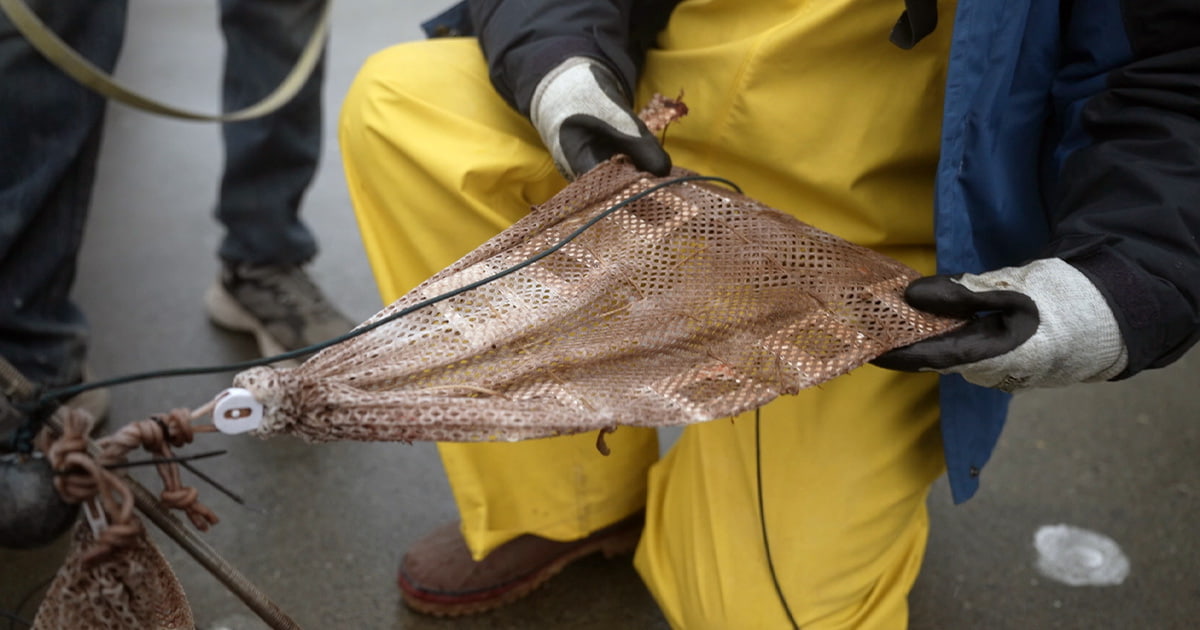
Our team of marine plastic scientists and scientific divers conducted testing in two locations between April and December of 2022. One was off the back of our pier, in the temperate waters of Elliott Bay (with temperate waters representing the vast majority of the planet’s marine waters) at two different depths: near the surface, and near the bottom. 

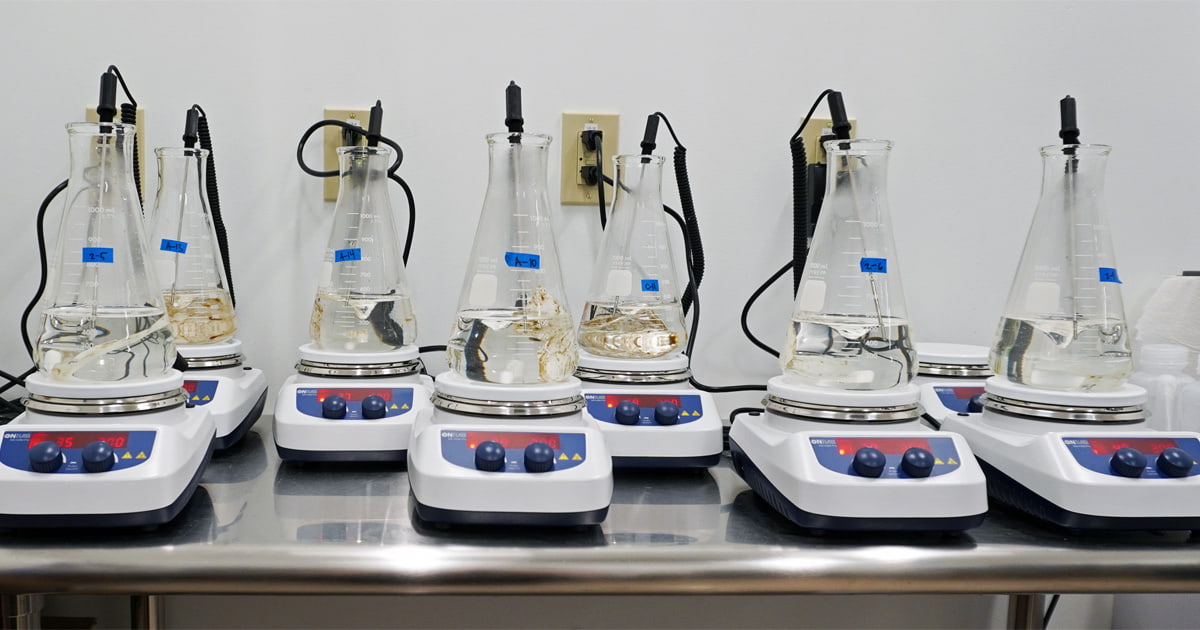
The other was our Clean Seas research laboratory, using first-of-its-kind modeling designed to approximate the effect of the materials on the health and well-being of marine mammals, specifically gray whales, if the materials were ingested.

A mesh net bag containing plastic alternatives is examined after being pulled out of the water during a test for the plastic innovation prize.
Field testing took place off the back of the Seattle Aquarium’s pier, with samples pulled out at specific intervals and taken to our lab for further testing. Photo: Dmitriy Savchuck.
A number of testing beakers set up on a table each containing a solution simulating the stomach of a whale for an experiment on how plastic alternatives might be digested.
Simulated whale guts in our lab. Samples were “digested” for 24 hours, then tested. Photo: Amy Olsen.

And the winners are...

Test results were written into a final report and delivered to the prize’s scientific and technical advisory board—which included our own Vice President of Conservation Programs and Partnerships Dr. Erin Meyer—and team of judges, who determined the winners. 

In first place is the American company Sway; with Zerocircle, based in India, in second; and Notpla, based in London, in third. All three developed seaweed-based plastic alternatives. As described on Sway’s website, seaweed grows up to 60 times faster than land-based crops and can sequester up to 20 times more carbon per acres than forests, and cultivating it is inexpensive, requires no pesticides or fertilizers, and uses little equipment. 

The winners will collectively receive a $1.2 million dollar prize purse—as well as continued support from Lonely Whale and the early adopter coalition, including companies such as TOM FORD, Nike, Stella McCartney and J. Crew. Coalition members have agreed to test the winning materials within their supply chain, making a real difference right now.

What can individuals do?

Not a major fashion designer or a research scientist? You can still help! Here are a few ideas:

  • Pick up litter on a local beach or, better yet, organize a group of friends or family members to join a local beach cleanup.
  • Switch to reusable dishes and utensils. Bring your own reusable mug or bottle when you get coffee or water. Skip the plastic utensils and straws when you get takeout food.
  • Choose products with less packaging. Pay attention to how much incidental plastic comes with what you buy. Strive to cut down on your daily plastic consumption, buy used instead of new whenever possible and reward corporations that package responsibly!
  • Buy in bulk rather than individually packaged items. Some stores even allow personal containers, like Mason jars, for bulk products including grains and spices.
  • Shop local to reduce shipping and packaging plastics.
  • If you live in Washington state, contact your legislators and ask them to pass policies to curb plastic pollution and reduce waste. Visit our Act for the Ocean page to learn how to get in touch.
  • Sign up to receive our occasional action alerts on ocean-related policy issues like plastic pollution.

National Geographic captures a milestone in our work to “ReShark” the ocean

In January, years of planning culminated in a hopeful moment on a beach in Raja Ampat, Indonesia. That moment centered on two baby sharks: Charlie and Kathlyn.

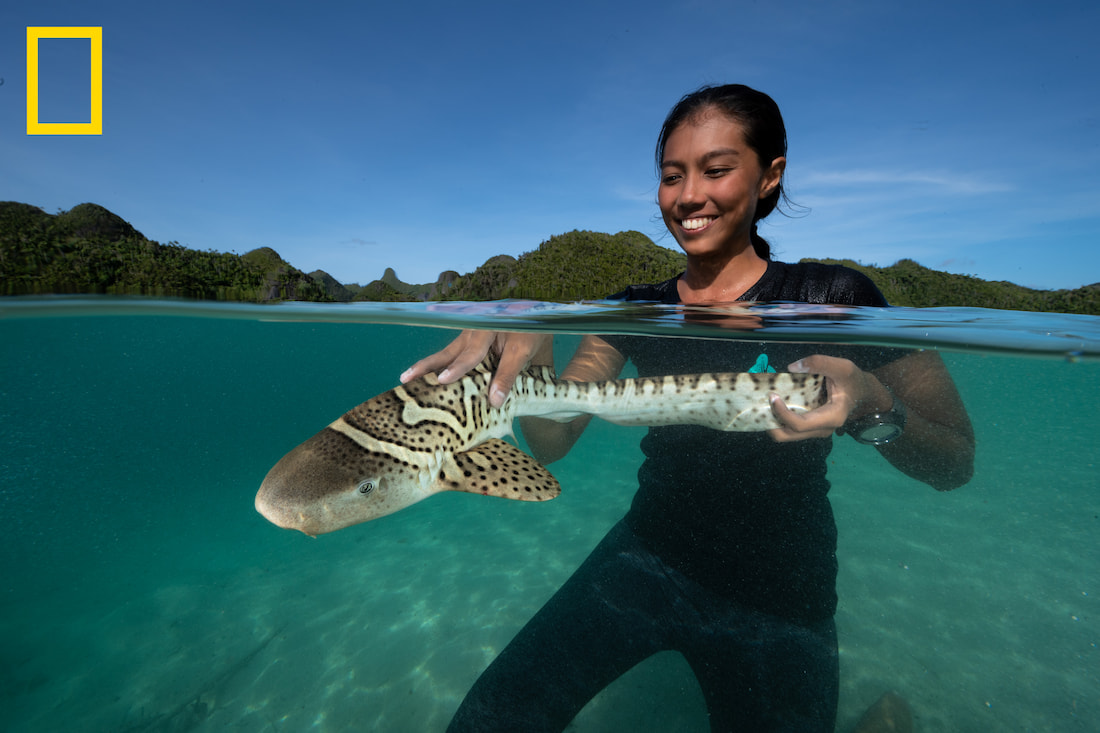
First Charlie, and next Kathlyn, were gently cradled in the water by marine scientist Nesha Ichida of Thrive Conservation. 

A Seattle Aquarium team, Indonesian government officials, Kawe tribal community members and other conservationists watched closely. Photographers Jennifer Hayes and David Doubilet were nearby to capture the moment for National Geographic.

Nesha grasped each shark in her hands for the final time. Then she let go.

Nesha Ichida stands in clear water up to their shoulders and holds on to an Indo-Pacific leopard shark pup before releasing it.
Scientist Nesha Ichida of Thrive Conservation releases Kathlyn, named for Kathlyn Tan of Rumah Foundation. (Ichida had released Charlie, Kathlyn’s older sibling, 20 minutes earlier.) Charlie is named after Professor Charlie Heatubun, head of the Raja Ampat Research and Innovation Agency. Photo: David Doubilet and Jennifer Hayes, National Geographic.

“I’m happy. And excited. And hopeful.”

Dr. Erin Meyer, Seattle Aquarium chief conservation officer in National Geographic

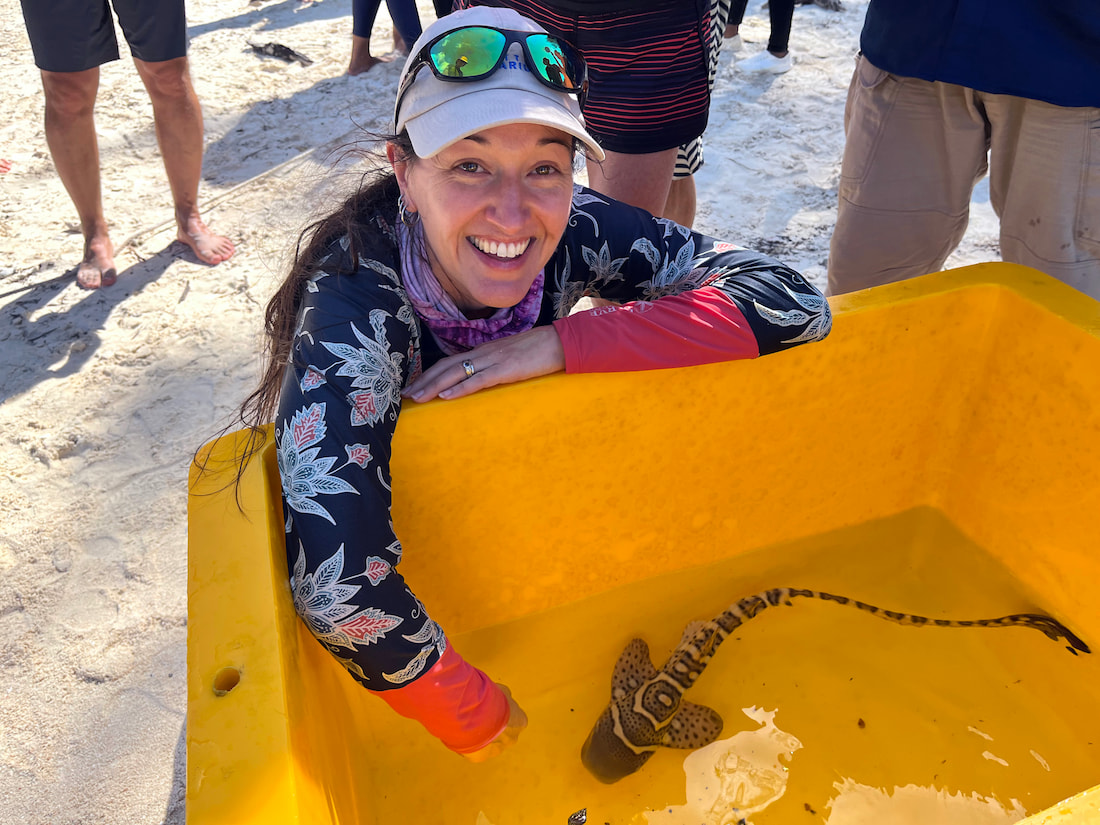
Dr. Erin Meyer kneeling on a beach in front of a large tub which holds a Indo-Pacific leopard shark pup before the pup is released into the wild.
Dr. Erin Meyer, Seattle Aquarium vice president of conservation programs and partnerships, greets Charlie upon his arrival to the Wayag Islands. Photo credit: Indo Pacific Films.

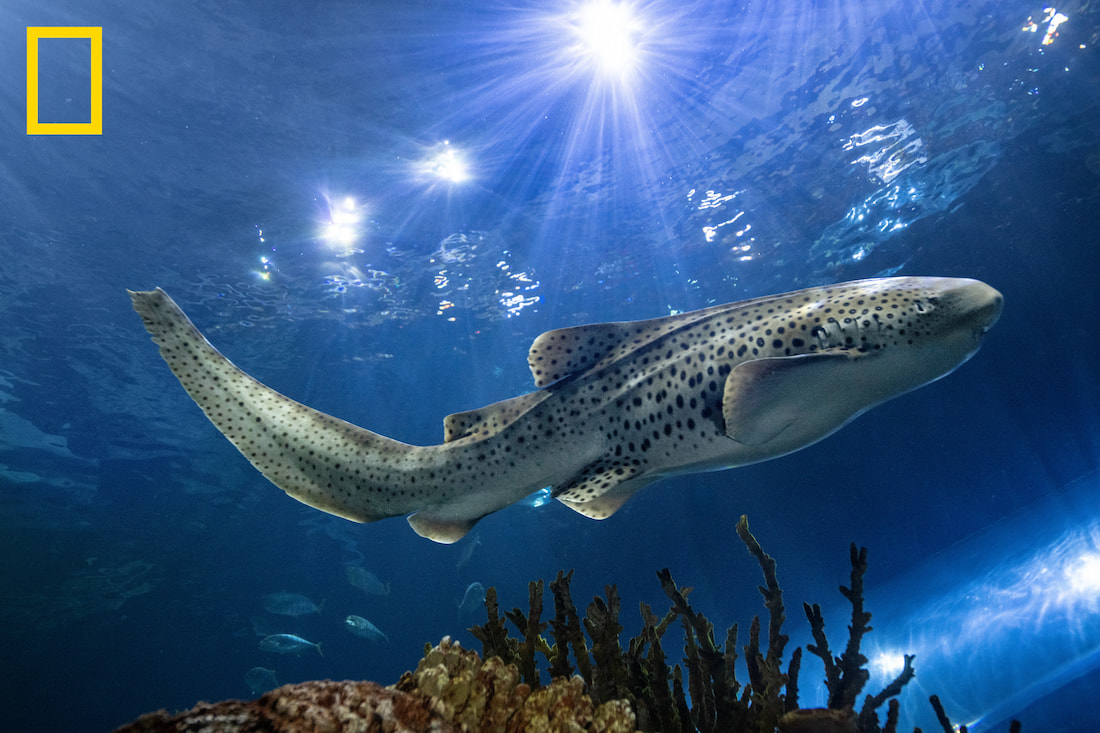
Charlie and Kathlyn are beacons of hope. As Indo-Pacific leopard sharks (Stegostoma tigrinum and also called zebra sharks), they belong to an endangered species. Due to commercial overfishing, these sharks have nearly disappeared from their home waters in the Coral Triangle. And despite a series of protective measures added in recent years, their numbers haven’t come back. 

Hatching an ambitious plan

Sadly, our ocean is losing sharks and rays at an astonishing speed: More than 37 percent of species are at risk of extinction.

We and our global ReShark partners are working to change that story. 

Dr. Erin Meyer of the Seattle Aquarium first discussed the idea of an international partnership in 2018. She helped assemble and lead a group of founding members that has grown to include more than 70 organizations in 15 countries—aquariums, local governments, conservation nonprofits and many others. 

Professor Charlie D. Heatubun, head of the Raja Ampat Research and Innovation Agency and the namesake of baby shark Charlie, calls ReShark’s success “proof of the tight collaboration between all the parties.”

Aquariums offer expertise—and eggs

ReShark’s innovative model begins at aquariums.  

The eggs that hatched into Charlie and Kathlyn were laid at the SEA LiFE Sydney Aquarium in Australia. They were then transported to Raja Ampat. Charlie and Kathlyn hatched at a special nursery built and managed by the Raja Ampat Research and Conservation Centre located at Papua Diving’s Sorido Bay Resort. 

There, the siblings were cared for by a local team of aquarists who proudly consider themselves “shark nannies.” After growing into healthy pups, they’d been brought to marine-protected waters for release. 

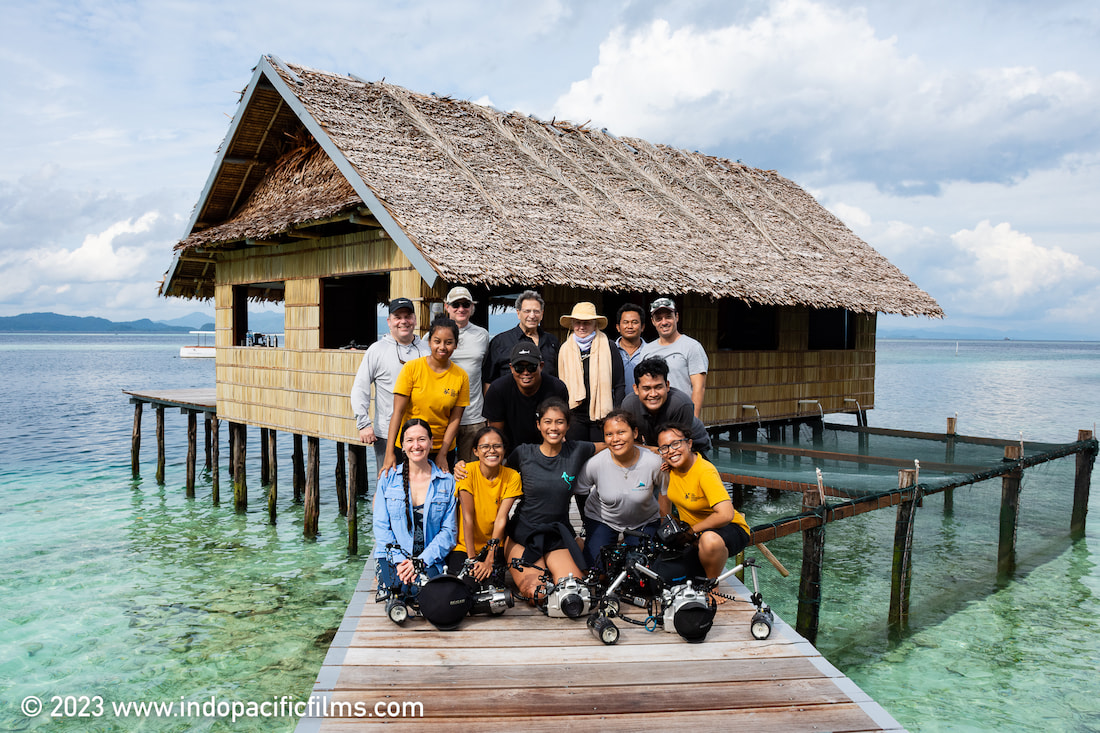
Members of the ReShark collective pose on a wooden walkway for a group photo in front a hut built over shallow ocean waters in Indonesia.
Members of the ReShark collective, including the Seattle Aquarium’s Dr. Erin Meyer (front row, left), at Raja Ampat Research and Conservation Centre’s shark nursery in Indonesia. Photo credit: Indo Pacific Films.

Charlie and Kathlyn’s journey from an aquarium to marine-protected waters will be repeated many times over. ReShark’s plan is to release 500 baby Indo-Pacific leopard sharks over the next several years.

“If we do what we’re planning to do … within 10 to 20 years, we see them coming back to an absolutely healthy, genetically diverse population with zero chance of extinction,” says Dr. Mark Erdmann of Conservation International and a ReShark founding partner.

“We have species disappearing off the face of this planet at a rapid rate, and in some cases the only place we have the genetics left or we have the species left are often in aquariums.”

Jennifer Hayes, photographer for the National Geographic story speaking on Good Morning America

An adult female Indo-Pacific leopard shark swimming in its habitat at Shedd Aquarium in Chicago.
An adult female Indo-Pacific leopard shark glides through the Wild Reef habitat at Shedd Aquarium in Chicago. Photo: David Doubilet and Jennifer Hayes, National Geographic.

ReShark and the Ocean Pavilion

When our new Ocean Pavilion opens, it will be home to a small number of Indo-Pacific leopard sharks. As a result, we’ll not only continue to play a leadership role in ReShark’s growth—we’ll also be able to directly breed these sharks and send their offspring to Raja Ampat for release. And visitors to the Ocean Pavilion will see these exceptional animals, understand what we’re at risk of losing and learn how they can help. 

Rendering depicting guests in front of a future habitat in the Ocean Pavilion named The Reef, a large habitat with a viewing window into an undersea canyon filled with different species of coral.
The Reef, a future Ocean Pavilion habitat that will be home to Indo-Pacific leopard sharks who will produce eggs to help recover populations in the ocean.

Two new policies to reduce packaging waste and plastic pollution

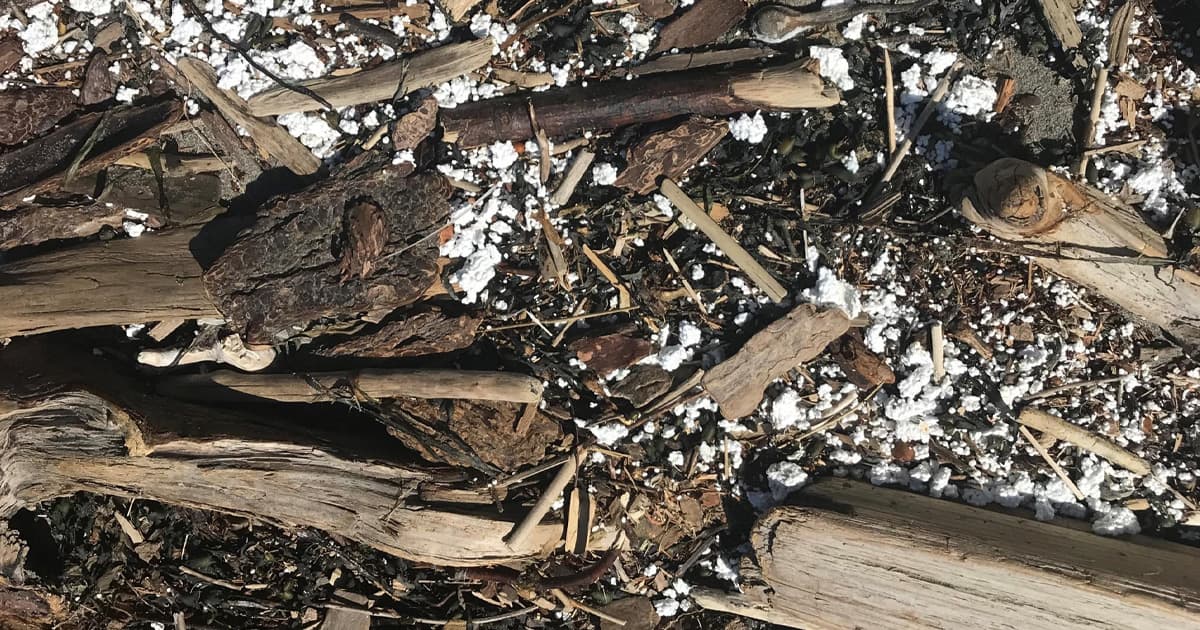
The Seattle Aquarium has been working to reduce sources of plastic pollution in the environment—in 2020 we helped pass the Reusable Bag Bill to eliminate thin, single-use plastic bags in Washington state and in 2021 we worked with our partners to ban certain expanded polystyrene foam products like recreational coolers and packing peanuts.

This year, two of our top priorities for the 2023 Washington state legislative session aim to address the problems of recycling and packaging waste (SB 5154/HB 1131) and plastic pollution (HB 1085).

Modernizing and transforming our recycling system

The Washington Recycling and Packaging (WRAP) Act (SB 5154/HB 1131) will establish a producer responsibility program which will reduce unnecessary packaging and paper, fund statewide recycling services, and ensure that materials are actually recycled. Under producer responsibility, companies that make packaging are responsible for the costs, environmental impacts and end-of-life of their products, so the burden doesn’t fall on the end-customer or local government. It’s a proven, successful approach to increase package recycling and the norm in Canada and much of the European Union.

In 2021, Maine and Oregon became the first U.S. states to pass packaging producer responsibility legislation, and Colorado and California joined in 2022. Now, Washington has an opportunity to join them.

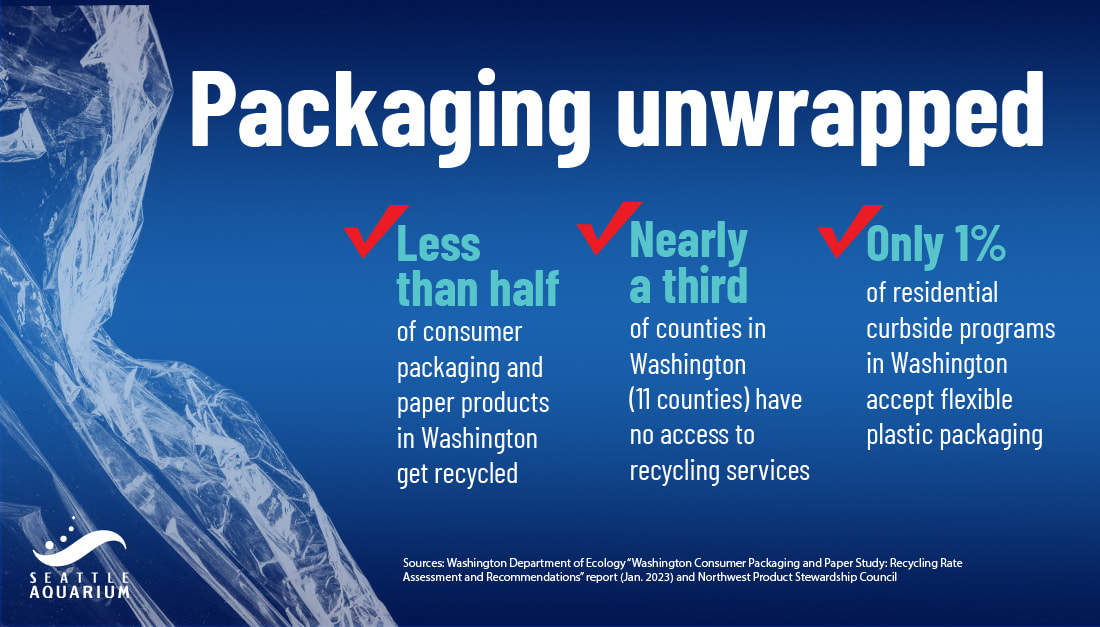
Packaging unwrapped. Less than half of consumer packaging and paper products in Washington get recycled. Nearly a third of counties in Washington (11 counties) have no access to recycling services. Only 1% of residential curbside programs in Washington accept flexible plastic packaging. Sources: Washington Department of Ecology "Washington Consumer Packaging and Paper Study: Recycling Rate Assessment and Recommendations" report (Jan. 2023) and Northwest Product Stewardship Council.

Walking the talk in our gift shop

The Seattle Aquarium’s gift shop, operated by our partner Event Network, has been working to reduce the hard-to-recycle packaging and unnecessary packaging waste they receive by reaching out to their individual vendors to collaborate on more sustainable alternatives. Here are a few examples of packaging switches that our gift shop has made so far:

  • Eliminating and replacing plastic bags and plastic foam with eco-friendly or reusable alternatives.
  • Removing plastic windows from cardboard boxes that are then recyclable.
  • Eliminating “box-within-box” packaging—smaller, lighter-weight packages reduce emissions and pollution associated with transportation.
  • Requiring items to be shipped between layers of recycled paper sheets instead of individually wrapped in plastic bags.
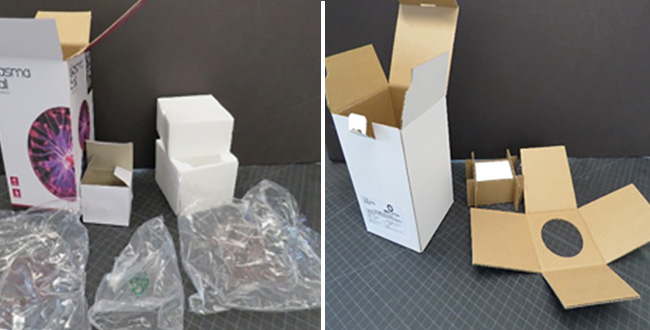
A toy plasma ball box and the inner packaging contents shown next to it including single use plastic bags and plastic foam block. Compared to a second photo of a redesigned box using no plastic and less total packaging.
BEFORE (left): Multiple single-use plastic bags and plastic foam in a large outer box. AFTER (right): We re-engineered packaging and product assembly, removing all plastic bags, plastic foam and inner boxes to reduce box size and weight.
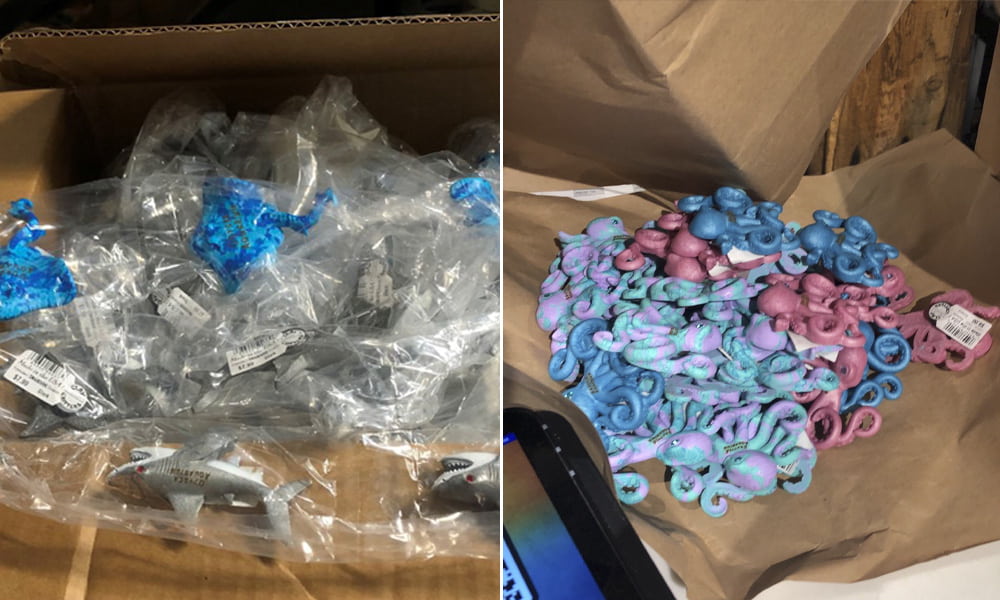
A photo of small toys individually packaged in single use plastic bags for shipping compared to a photo of similar toys now being shipped without single use plastic bags.
BEFORE (left): Products shipped in individual plastic bags. AFTER (right): Plastic bags replaced with recycled paper sheets to protect items during shipping.

We’re so glad to have Event Network as a partner and sustainability champion, and we’re excited that they have managed to convince producers to switch more than 70 gift shop items to more sustainable packaging. But they have found this way of making change to be time-consuming and resource-intensive. That’s where the WRAP Act can help! The policies in the WRAP Act will address this problem more efficiently statewide by establishing incentives with graduated fees and requiring packaging producers to meet targets associated with things like reusability and recyclability.

Reducing sources of plastic pollution

HB 1085 will make tangible improvements in reducing plastic pollution by addressing three sources of unnecessary and hard-to-recycle plastic waste: single-use water bottles, mini plastic toiletries and thin-walled or soft-shelled foam-filled floats for docks. Read more about the sustainable alternatives required by this bill in our previous blog post on our 2023 Washington State Legislative Session policy priorities.

Take action!

  • If you live in Washington, find your WA legislative district and urge your legislators to transform our recycling system by supporting the WRAP Act (SB 5151/HB 1131) and reduce plastic pollution by supporting HB 1085 in the 2023 session.
  • Choose products with less packaging. Buy used instead of new whenever possible. Buy in bulk rather than singly packaged snacks and other items. Reward corporations that package responsibly.
  • Check out our Act for the Ocean page for additional ways you can help the ocean and marine wildlife!

Thank you to the Washington state legislators who are fighting ocean plastic!

We thank Sen. Rolfes, Rep. Berry and Rep. Mena for being the lead sponsors of these bills to transform our recycling system and reduce plastic pollution, and we also extend our thanks to all of the co-sponsors.

Field research becomes fur seal rescue on Washington’s outer coast

On a wet and windy day in January, a field research excursion that almost didn’t happen ended up being a life-saving experience for a young fur seal pup. 

Seattle Aquarium Senior Conservation Research Manager Dr. Shawn Larson looked at the weather forecast—predicting high seas, rain and high winds—and almost called off the trip to Sand Point, a remote beach on the Olympic Peninsula. She and Seattle Aquarium Research Scientist for Clean Seas Veronica Padula had planned to meet a team from the Oregon Coast Aquarium, Curator of Marine Mammals Brittany Blades and Senior Mammologist Ashley Griffin-Stence, to observe sea otters as a training exercise and part of our ongoing research on the species

But Brittany and Ashley were already on their way, so Shawn and Veronica headed out with their heavy rain gear. The group met at the trailhead, hiked three miles to the beach and, despite the weather and a very high tide, were rewarded with the sight of many sea otters in the water offshore, including mothers and pups.

Three wild sea otters floating on their backs in the ocean off the Washington coast.
After a wet and windy hike, the group was rewarded with the sight of many sea otters.

“You could tell something was wrong.”

Suddenly, all four women noticed a cry of distress and started searching the water for a sea otter pup in need of its mom. Then they realized that the sound was actually coming from the beach behind them. They turned, followed the cries and discovered a young northern fur seal pup. 

“In my 22 years of doing this work, I’ve never seen a northern fur seal pup on the beach,” says Shawn. Adds Veronica, “You could tell that something was wrong with it. It looked like it was struggling somehow.”

When they got closer, the group realized that the pup was entangled, with material wrapped tightly around its neck. They knew what to do: call the National Oceanic and Atmospheric Administration (NOAA) West Coast Marine Mammal Stranding Network

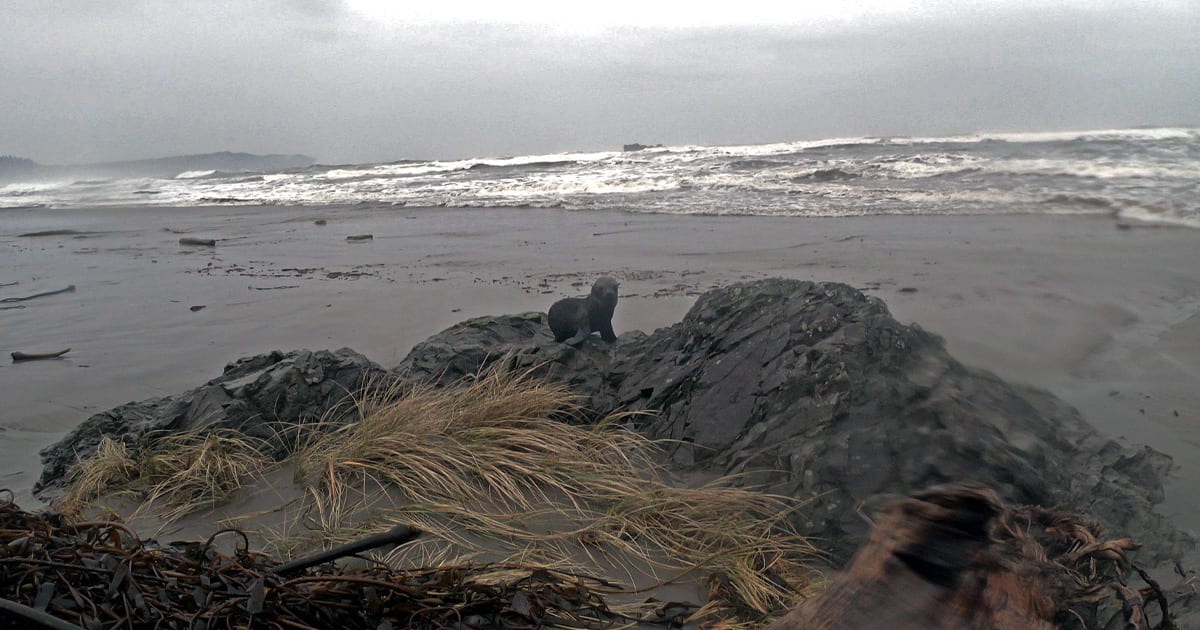
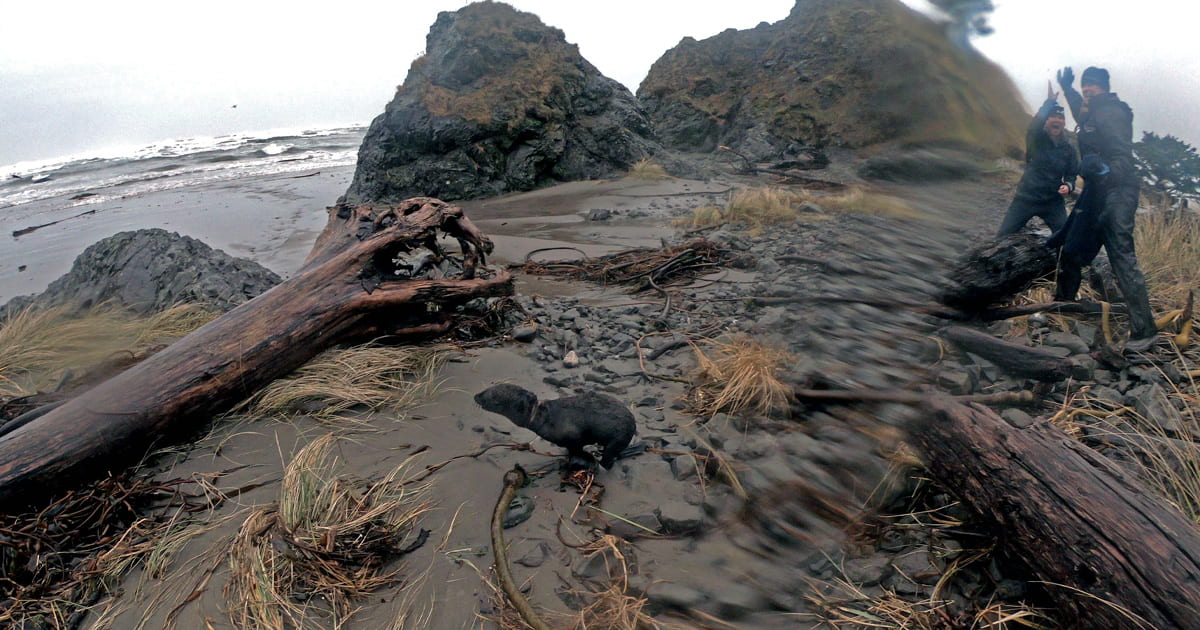
A young fur seal pup sitting on a rocky area along a beach in Washington on a cloudy day, looking towards the camera.
In her many years of field research on this remote stretch of coastline, Dr. Shawn Larson had never encountered a northern fur seal.

Typically, when a marine mammal is reported stranded or injured, a Network partner responds to assess the animal and determine the best course of action. But given the remote location, it would have taken responders many hours to arrive on scene—and, in a very happy stroke of luck, all four women are marine mammal biologists with specific experience handling and rehabilitating entangled fur seals. 

“This time of year, no one goes down there,” says Shawn. “No one else would have known what to do in that situation.”

Springing into action

Shawn, with a single bar of service on her phone, managed to complete the call and was given authorization from NOAA officials to disentangle the pup. Using a pair of scissors from her first aid kit, she swiftly cut the material—a loop of elastic, similar to what you’d find in a garden glove, stretched to its limit around the animal’s neck—while Brittany and Ashley secured its body. 

A young fur seal pup moves back towards the ocean on a rocky beach after having a loop of elastic removed from around its neck by authorized and trained rescuers, two of whom can be seen celebrating with a high five to the right of the pup.
With the entanglement removed, the fur seal pup headed back toward the water.

“If we hadn’t been able to remove the elastic, the animal likely would have died,” says Shawn. “He was already starting to look a little lean, an indication that he wasn’t able to eat well, and the material could have also restricted his breathing.”

Once freed, the pup quickly made his way to the water—where, we hope, he will live a long and happy life. 

Northern fur seals, listed as vulnerable by the International Union for Conservation of Nature, spend the majority of their lives at sea, coming ashore only for the summer breeding season on islands in the icy waters of the North Pacific and Bering Sea—or in other, more southerly locations if they’re injured or ill. Interested in learning more about them? Check out our webpage or, better yet, come visit northern fur seals Chiidax and Flaherty at the Seattle Aquarium!

2023 Seattle Aquarium Ocean Conservation Honors: Recognizing leaders who protect our ocean

Every year since 2004, the Seattle Aquarium has presented awards to extraordinary leaders who are working to protect the health of our marine environment for present and future generations. Our annual Ocean Conservation Honors event celebrates the honorees’ aspirations and impact, raises visibility for their important work, and offers them the opportunity to share their passion for our one ocean and a resilient future for all.

This year, we presented Governor Jay Inslee with the Seattle Aquarium Sylvia Earle Medal and Dr. Vera Trainer with our Conservation Research Award.

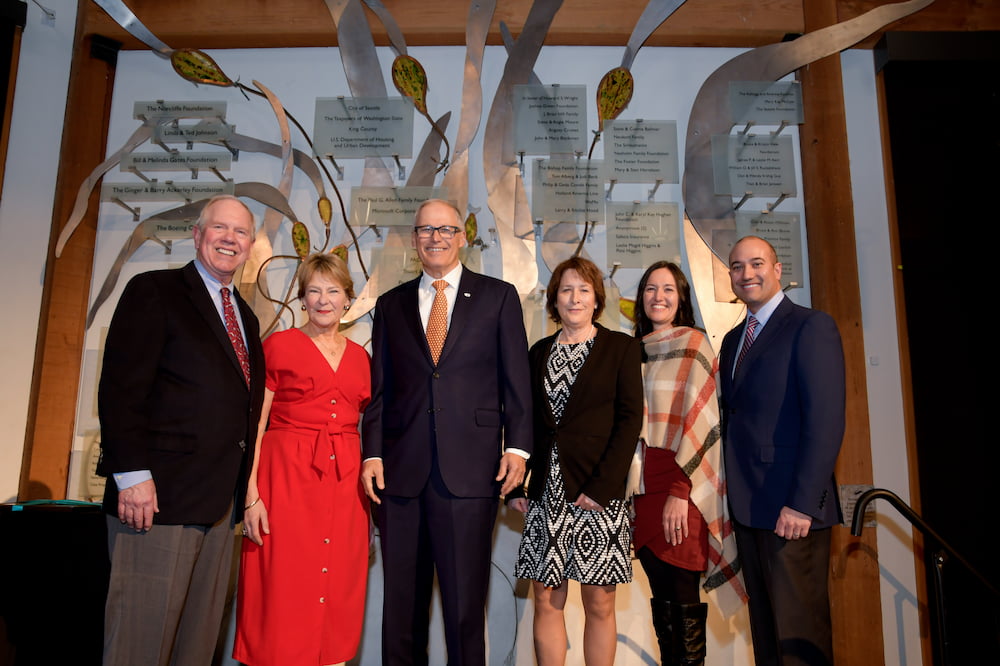
From left to right, Robert (Bob) Davidson, Governor Jay Inslee, Melissa Mager, Dr. Vera Trainer, Dr. Erin Meyer, and Michael Guidon at the Seattle Aquarium's 2023 Ocean Conservation Honors event.
Seattle Aquarium President & CEO Bob Davidson; Seattle Aquarium Immediate Past Board Chair Melissa Mager; Governor Jay Inslee; Dr. Vera L. Trainer; Dr. Erin Meyer, Director of Conservation Programs & Partnerships; and Seattle Aquarium Board Chair Michael Guidon (Photo credit: Curbow Photo).

Our Honorees

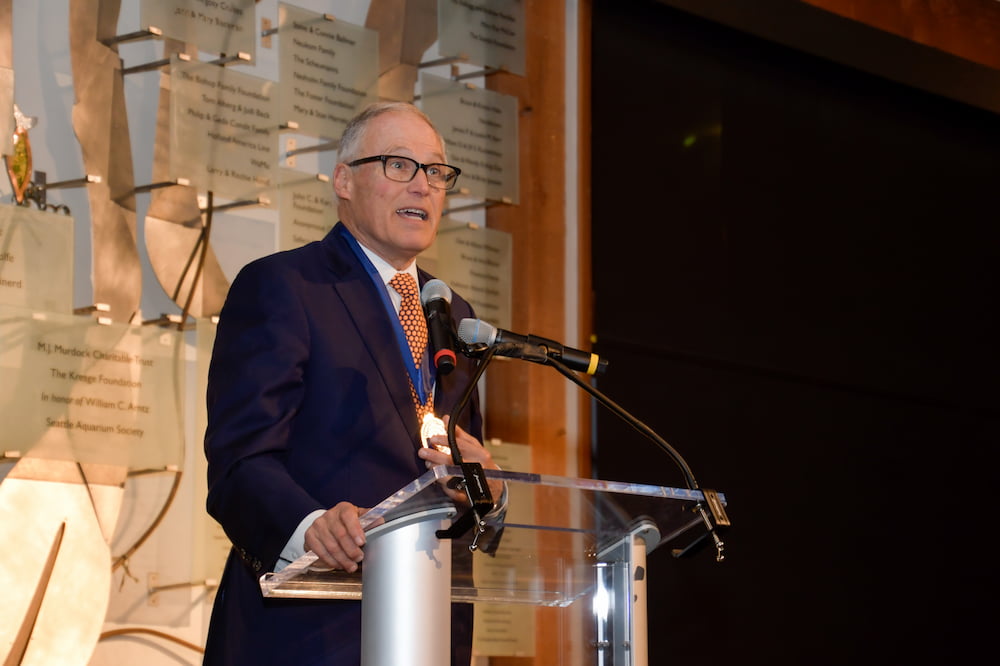
Washington State Governor Jay Inslee standing behind a podium while speaking at the Seattle Aquarium's 2023 Ocean Conservation Honors event.
Governor Jay Inslee (Photo credit: Curbow Photo).

The Seattle Aquarium Sylvia Earle Medal honors individuals whose leadership and lifetime accomplishments reflect and advance the mission of the Seattle Aquarium: Inspiring Conservation of Our Marine Environment. Formerly the Seattle Aquarium Medal, the award was renamed in 2018, after we presented Dr. Sylvia Earle with our first Seattle Aquarium Lifetime Achievement Award.

Under Governor Inslee’s leadership, Washington state is at the forefront of the climate action needed to restore the health of our Salish Sea and one world ocean. 

“The thing that beats despair is action,” Gov. Inslee noted while accepting his award. He vowed that Washington won’t go backward in the fight against climate change. “We should act every single day and do everything we can to save this planet and the living systems in the ocean,” he said. “Our children deserve it, and the Seattle Aquarium is going to help us do it.” 

Among his many accomplishments, Gov. Inslee co-founded the U.S. Climate Alliance and International Ocean Acidification Alliance; helped lead the Under2 Coalition, a global network of subnational governments committed to achieving net-zero emissions; co-wrote Apollo’s Fire: Igniting America’s Clean-Energy Economy; and established the Orca Task Force for action on behalf of endangered southern resident orcas and salmon.

Dr. Vera Trainer standing behind a podium, smiling for a photo while speaking at the Seattle Aquarium's 2023 Ocean Conservation Honors event.
Dr. Vera L. Trainer (Photo credit: Curbow Photo).

The Seattle Aquarium Conservation Research Award honors leaders and innovators in marine conservation research, with a particular focus on climate change, plastic pollution, sustainable fisheries and tourism, marine protected areas and socioeconomics. 

Dr. Vera Trainer is a local and international leader in the work to understand harmful algal blooms (HABs): proliferations of algae that cause environmental and economic damage. 

“I believe that this award is not only for what has been accomplished,” Dr. Trainer said as she began her remarks, “but what will be accomplished in the future.”

Following a 30-year career with NOAA, she is the marine program director of the University of Washington’s Olympic Natural Resources Center, co-founder of the Olympic Region HAB program and the founder of SoundToxins, a partnership that monitors HABs in Puget Sound.

This unique community collaboration of management and research agencies, fish and shellfish farmers, Native tribes and community volunteers provides advance warning of HABs that threaten seafood safety as well as ecosystem and human health.

Dr. Trainer explained, “By having trained partners around the Puget Sound who are the ‘eyes on the coast,’ we know when there is something unusual or threatening in our environment.” 

Congratulations to the 2023 Ocean Conservation Honors award recipients! It’s a pleasure and privilege to celebrate your accomplishments.

Join us to support quieter waters for orcas

From late October to early January—for the first time—many large ships in Washington waters slowed down for orcas. 

How does this help whales? Slower vessels make less noise. When the waters are quieter, endangered Southern Resident orcas have an easier time communicating with each other and echolocating to find and catch scarce salmon. Slow-moving vessels are also less likely to hit a whale, and as a bonus for the climate, the ships’ greenhouse gas emissions decrease.

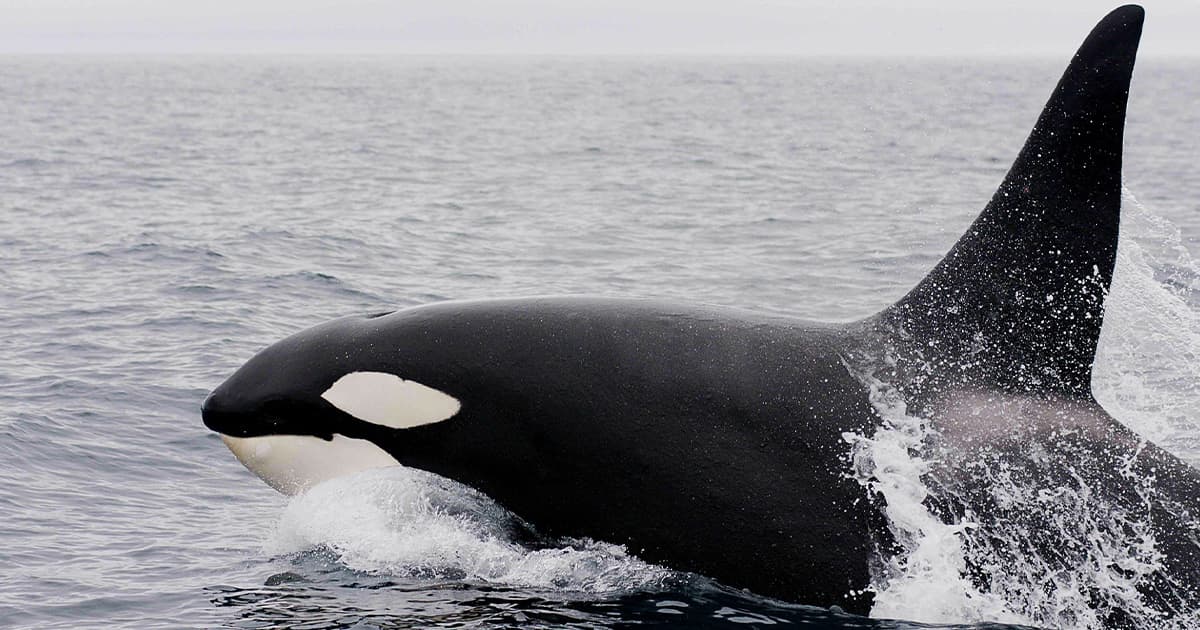
Adult orca whale breaching the surface of the ocean.

A promising partnership

The voluntary ship slowdown was made possible by a new program called Quiet Sound—a collaborative effort involving government agencies, the shipping industry, the U.S. military, tribal groups, environmental organizations like the Seattle Aquarium and the scientific community—and modeled after a successful program in British Columbia, Canada. The Washington waters trial encouraged vessel operators to reduce their speed in designated transit areas to targets of 11 or 14.5 knots, depending on vessel type. The result? Twenty nautical miles of a quieter, better protected habitat for orcas and other wildlife. 

Quiet Sound’s strong start

  • Week to week, between 46% and 69% of ships slowed down—a remarkable participation rate for a brand new, voluntary initiative.
  • The slowdown window overlapped with three-quarters of the days the Southern Residents were in Puget Sound in 2022.

An opportunity to do more

To continue and even expand this work, Quiet Sound needs additional funding from the Washington state legislature. This legislative session, the Seattle Aquarium is supporting a $700,000 two-year request in Olympia to do just that.

But large ships are just one source of underwater noise. This legislative session, we also have an opportunity to reduce noise from smaller recreational boats. Senate Bill 5371/ House Bill 1145 reflects the latest science-based recommendations from the Washington Department of Fish and Wildlife to create a 1,000-yard buffer around the endangered orcas for all small boats (except active commercial fishing and tribal fishing boats and permitted research boats). This simplifies currently complex regulations and reflects the latest science from NOAA, showing that a Southern Resident orca’s chance of catching a salmon is dramatically reduced when boats are moving at any speed within 1.5 km (1,640 yards). The bill also reduces the cost of a commercial whale-watching license, and boaters would not see any changes in what is allowed for viewing other whale species. The Seattle Aquarium supports this legislation, and we hope you will raise your voice with us.

Ready to help orcas?

  • Contact your Washington state legislators and ask them to support two initiatives to reduce noise impacts on orcas: funding for Quiet Sound and Senate Bill 5371/ House Bill 1145. Call the toll-free legislative hotline at 1-800-562-6000 (TTY for hearing impaired 800-833-6388) between 8am and 7pm, Monday through Friday, to leave a message for all three of your legislators at once.
  • Observe Be Whale Wise regulations and guidelines, at a minimum, when boating and try to give the endangered orcas even more space. That’ll make it easier for them to forage successfully.
  • Learn where to watch whales from shore: There are amazing spots around the region!
  • Report whale sightings so mariners can receive alerts when whales are in the area and take action to avoid them. You can report through Orca Network, the WhaleReport app (on Apple and Android) or the Whale Alert app (on Apple and Android).

For more orca inspiration, check out our short film Stories from the Salish Sea: Eba and the Orcas if you haven’t already! That webpage also has ideas for how you can take action to reduce toxic pollution, which will help increase salmon available for the orcas to eat—vital for their recovery.

Our new Caring Cove play space for kids — Now open!

Looking for something new and fun to do with young kids on a wet and dreary winter day? Come discover Caring Cove, an open play space where kids can deepen their connections to marine animals and their habitats by play-acting a variety of animal care activities.

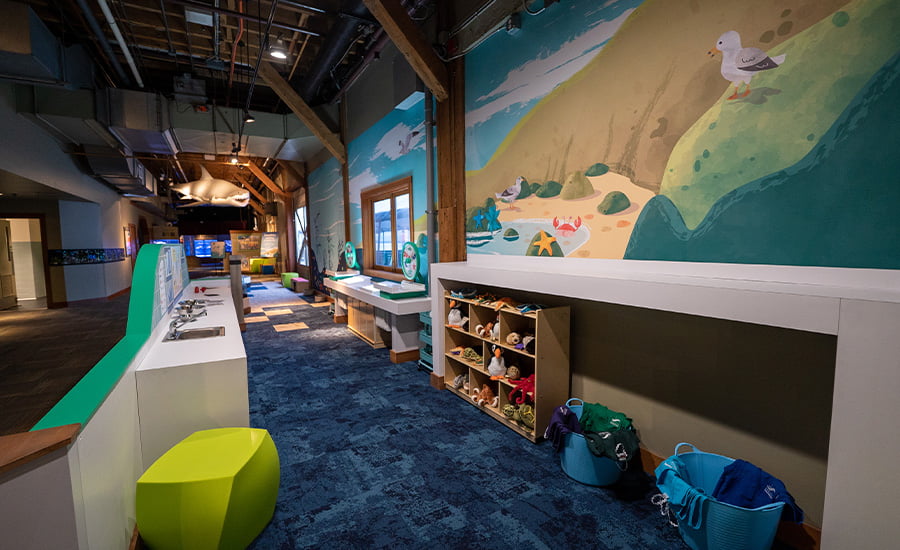
The Seattle Aquarium's caring cove exhibit play space showing multiple play areas for children.
Caring Cove features six different areas that encourage and support imaginative play for young kids.

Looking for something new and fun to do with young kids on a wet and dreary winter day? Come discover Caring Cove, an open play space where kids can deepen their connections to marine animals and their habitats by play-acting a variety of animal care activities.

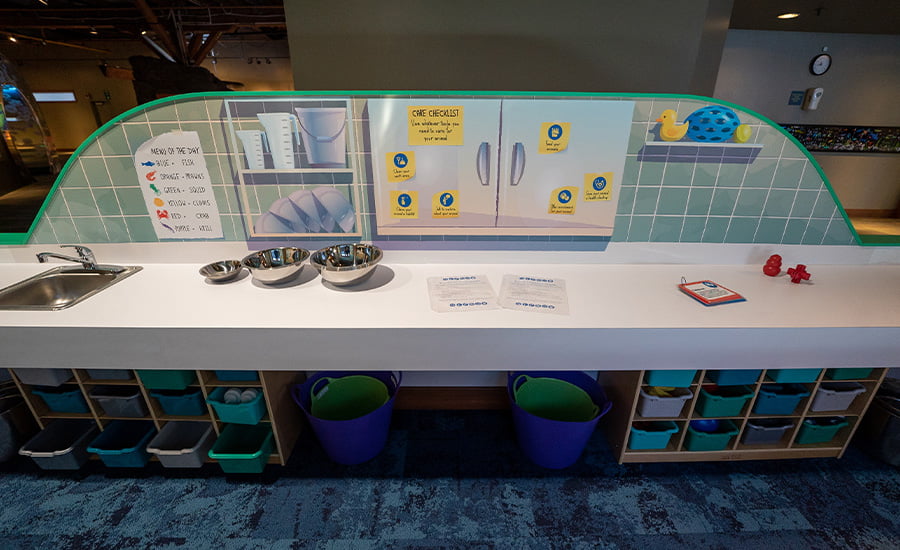
Caring Cove, which opened on January 15, features six different areas—many stocked with toy instruments based on the equipment used by our animal care staff—that encourage and support imaginative play for toddlers through children ages 8–10:

  • costume/animal area where kids can dress up as an Aquarium staff member and choose a plush octopus, sea star, sea otter, tufted puffin, sea turtle or rockfish to borrow and care for.
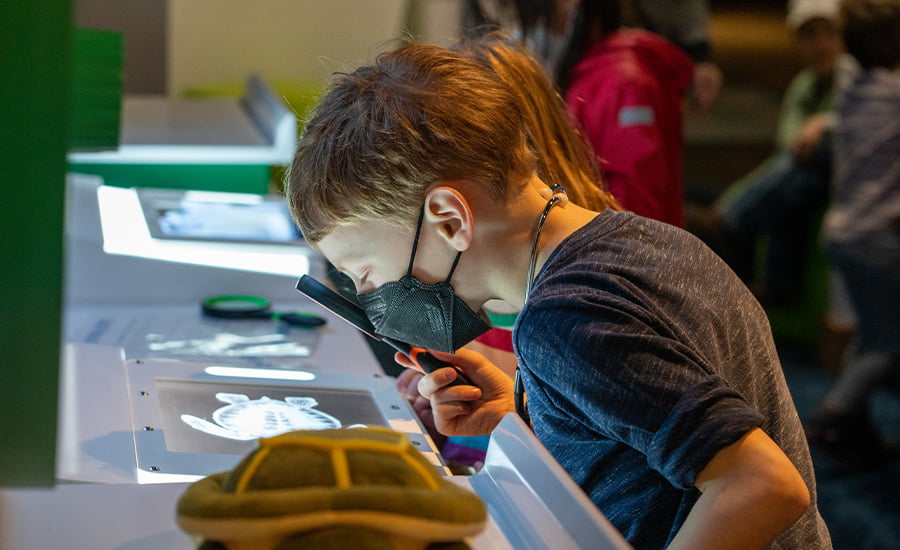
  • An exam station where kids can weigh their animal, examine it using our toy x-ray machine and do a routine checkup to ensure the animal is in tip-top shape.
  • feeding and enrichment station, where kids can prepare a pretend meal and design an activity for the animal to learn and play—known as enrichment in the world of animal care—or use a variety of tools to help keep their animal’s home clean.
  • holding habitat, where the animal can rest, play, eat or interact with other animals or kids.
  • felt wall, where kids can design an underwater ecosystem or animal home using our colorful felt pieces.
  • An artificial tide pool area for kids to practice looking closely, touching gently and exploring carefully—just as we encourage them to do in our touch pool habitat and on local beaches. Colorful, tactile, filled with faux sea creatures and just 14” high, this area is ideal for our youngest guests, who aren’t quite tall enough (or ready) to explore our touch pools. 
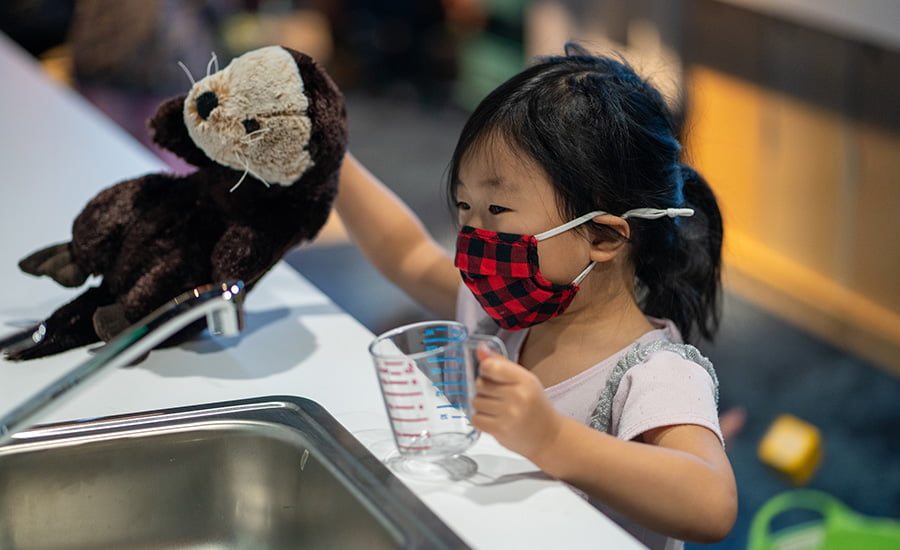
A young girl holding a stuffed sea otter toy and a measuring cup, approaching a play sink in Seattle Aquarium's Caring Cove play space.
Caring Cove is designed to help kids understand that animals, like humans, need nurturing and care. Here, a young visitor prepares a pretend meal for a hungry sea otter.

Caring Cove also features a reading area stocked with children’s books for parents and caregivers to read aloud or for kids to page through on their own; and benches for reading or resting while the kids play. 

Whether kids pretend to be an aquarist, an animal care specialist, a veterinarian, a diver, an interpreter or a role they create with their own imagination, they’re sure to have a wonderful time. Parents and caregivers too! “The whole area is for families,” says Interpretation Coordinator and Scientific Diver Nicole Killebrew, who served as the project manager for Caring Cove.

A play kitchen area at Seattle Aquarium's Caring Cove play space.
Kids can prepare a pretend meal and plan activities for their animals at Caring Cove's feeding and enrichment station.

The role of empathy in conservation action

The vision for Caring Cove began with a desire for an early childhood play space to support our empathy work, which is funded through a grant from an anonymous donor. Empathy is defined as the ability to understand and share the feelings of another—and research has shown that empathy for animals, particularly in children, can help spur conservation action on the animals’ behalf. “The interconnectedness between empathy and conservation action is inextricable,” says Nicole. “And now we have an imaginative play space where young kids can connect to marine animals that they may not even know are living things—like a sea star—and understand that they have the same needs for food, a home, nurturing and care,” she adds. “We’ve never had anything like it.”

A young boy looks through a magnifying glass at an x-ray of a turtle in Seattle Aquarium's Caring Cove play space.
One of the most important empathy best practices for children is helping them realize their own agency," says Nicole Killebrew. "That they can determine what their animal needs and care for it."

Special and immense thanks go to local business Dillon Works, who designed and fabricated Caring Cove; the Advancing Conservation through Empathy for Wildlife Network, which provided critical project funding; the anonymous donor who funds our empathy grant; and the dozens upon dozens of Aquarium staff members who contributed their time and expertise to the project. “It was truly an Aquarium-wide effort,” smiles Nicole.

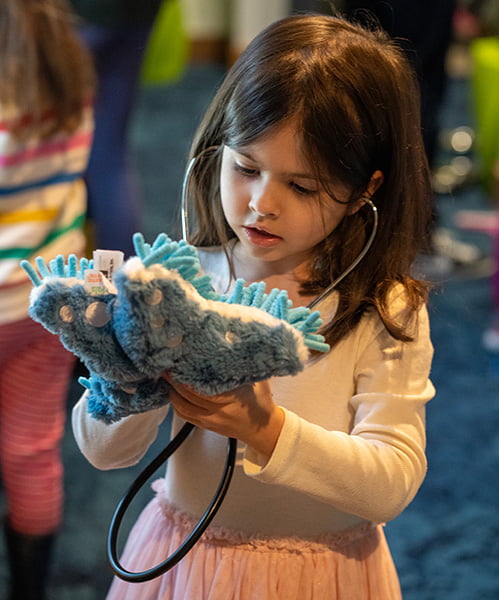
A young girl uses a play stethoscope to listen to a stuffed sea star.
Many of the toy instruments in Caring Cove are based on the equipment used by our animal care staff.

Come explore Caring Cove! Plan a visit and book your tickets today—we hope to see you at the Aquarium soon.

Adults 21+ Special Events!

June 18  |  June 25  |  July 2

Explore the Aquarium at night with friends, family or by yourself!

Today only, your gift will be matched dollar-for-dollar up to $25,000 thanks to the generosity of donors Betsy Cadwallader, J & Tim, and Jess & Andy Peet. Help us reach our $50,000 goal!

End the year with a gift to the ocean.