Category: Uncategorized

Living history: The Muckleshoot Tribe, canoes and the Salish Sea
Posted on by Emma Leiser
There’s something new to discover on the Ocean Pavilion’s public rooftop—that is, in addition to the native plantings and sandblasted images designed by, respectively, traditional ecological knowledge-keeper Valerie Segrest (Muckleshoot) and Owen Oliver (Quinault/Isleta Pueblo).
A recently installed sign offers an overview of the types of canoes used by members of the Muckleshoot Tribe to traverse the waters of the Salish Sea—and beyond—for thousands of years, as well as a glimpse into the importance and tradition of canoe culture.
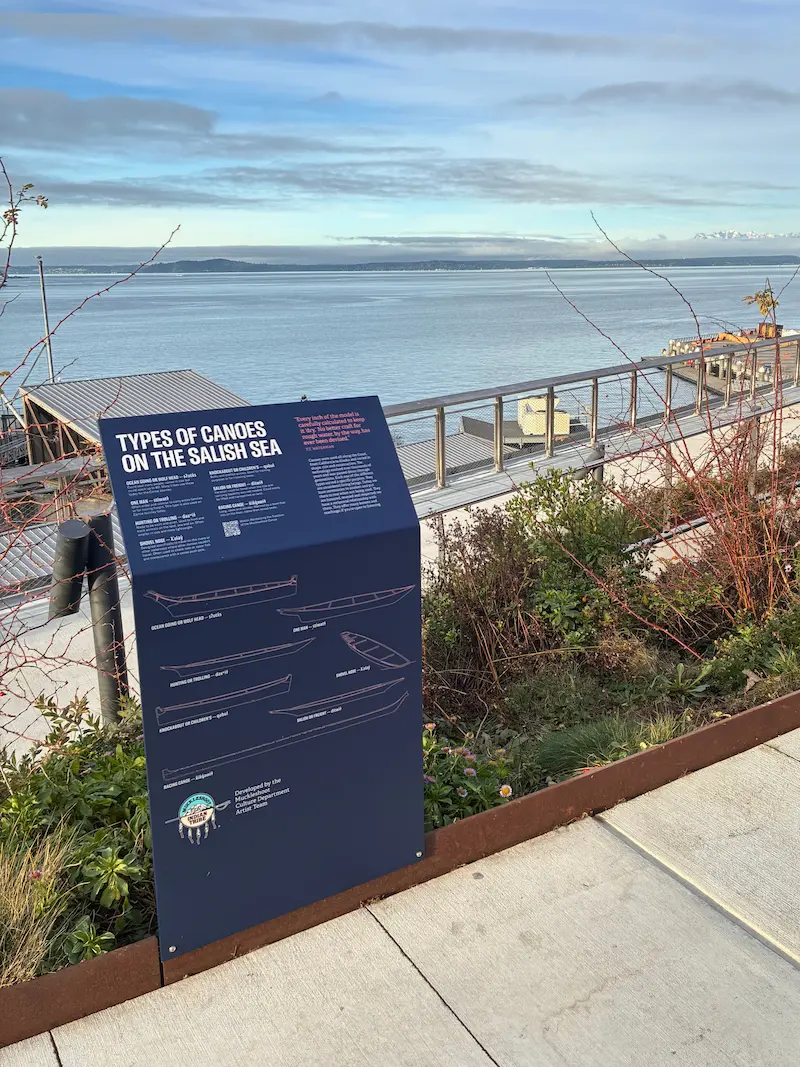
The newly installed sign anchors stunning views of the Salish Sea from the Ocean Pavilion’s rooftop.
The placement of the sign on the rooftop is intentional. As Muckleshoot Tribal Council Chair Jaison Elkins noted upon the announcement of our partnership with the Tribe in 2024, “This partnership reflects the Tribe’s deep connection to the Seattle waterfront where our ancestors celebrated the return of the salmon since time immemorial.”
To learn more about the history and significance of q̓il̕bid (“canoe” in the Muckleshoot language) culture, we recently spoke with several members of the Muckleshoot Tribe, who generously shared their thoughts with us.
Q: Can you tell us more about the Tribe’s history of traveling by water?
A: “Traveling by water was how we would get around, and I was told that’s why we have our paddle songs. When we would visit other tribes, we would sing so that they would hear us and the tribes would know who we were by which song we were singing.”
—Salena Jackson, Performance and Regalia Specialist
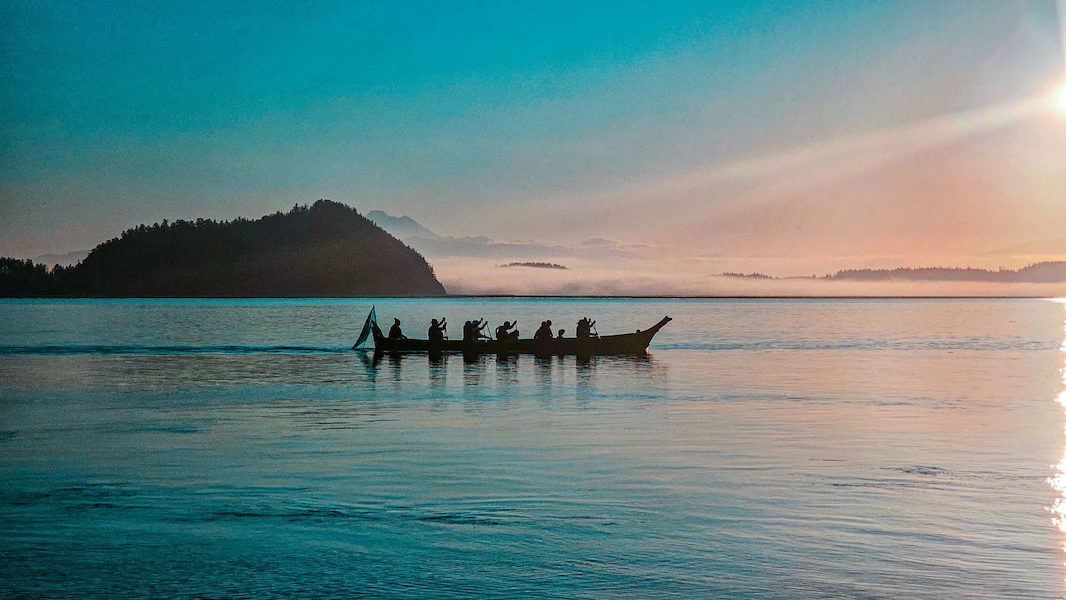
Eagle Spirit on the Canoe Journey leaving Lummi Island, headed for Samish Island. Photo courtesy of Adrian Markantonatos.
Q: The new sign features seven types of canoes, each with a specific purpose. What does that range say about the Tribe’s connection to water? How has that connection shifted over time?
A: “The variety of canoes speaks to the significant relationship we have, and historically have had, with water and the waterways. Just like how you’ll see different types of vehicles driving down the highway, each with a specific purpose—those waterways were our traditional highways, so in the same way, there would be a dynamic range of canoe styles.
We’ve lived in this area for thousands of years in such close proximity to the water, that it made sense to travel this way. It’s even reflected in our language—directions are given in relation to where the water is. As for the shift, we’ve seen a lot of changes but we’ve also held onto parts of our identity—one of those being our relationship with the water.”
—Sam Obrovac, Cultural Arts Coordinator, Muckleshoot Tribe
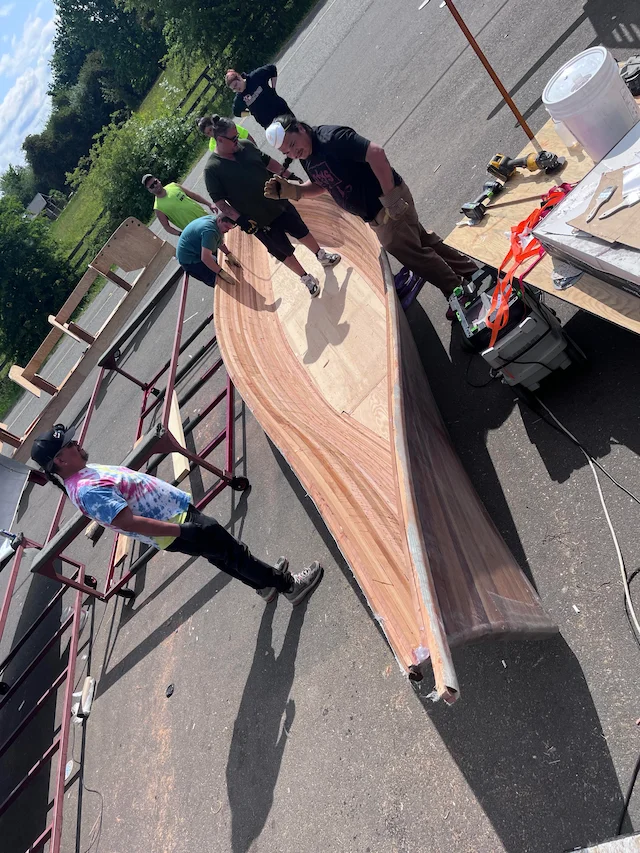
Muckleshoot carving team and Adult Work Training Program participants working on a cedar-strip canoe to give away at Canoe Journey 2023, Muckleshoot, Auburn, Washington. Photo courtesy of Sam Obrovac.
Q: The sign notes that the canoes are considered to be living beings. Can you tell us more about that?
A: “We treat the canoes like they’re living; we give them names that fit them because the canoes have a spirit. We introduce ourselves to them when we get on, and I’ve had a lot of conversations with those canoes. I talk to them just like a person. They’re like our babies; we take care of them and they care of us. Just like a newcomer in a family—the new canoes are our babies, and they go through cycles in their lives. Our new canoe, tubšedad, has a mind of his own.”
—Autumn MaGee, Canoe Family Manager
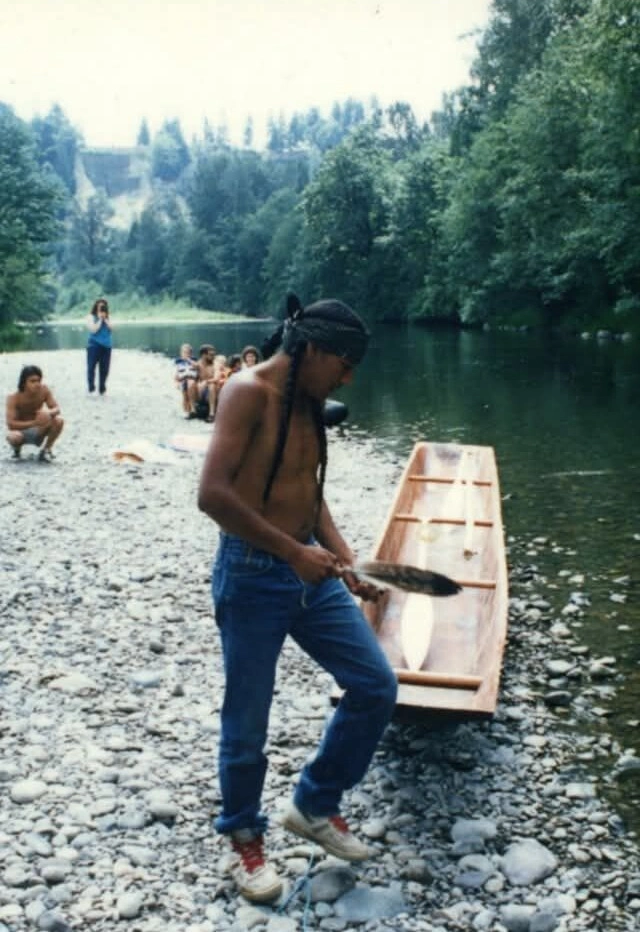
Napolean Ross blessing a shovel-nose canoe on the Green River.
Q: What else would you like people to know/understand about the Muckleshoot Tribe’s q̓il̕bid (canoe) traditions?
A: “This is how we hunted, this is how we fished, this is how we lived—reconnecting with that way of life is contagious and it keeps growing. Being out on the water and hearing those strokes, hearing the animals, hearing the water—that’s my peace.”
—Corey Ward-Jerry, Cultural Food Specialist
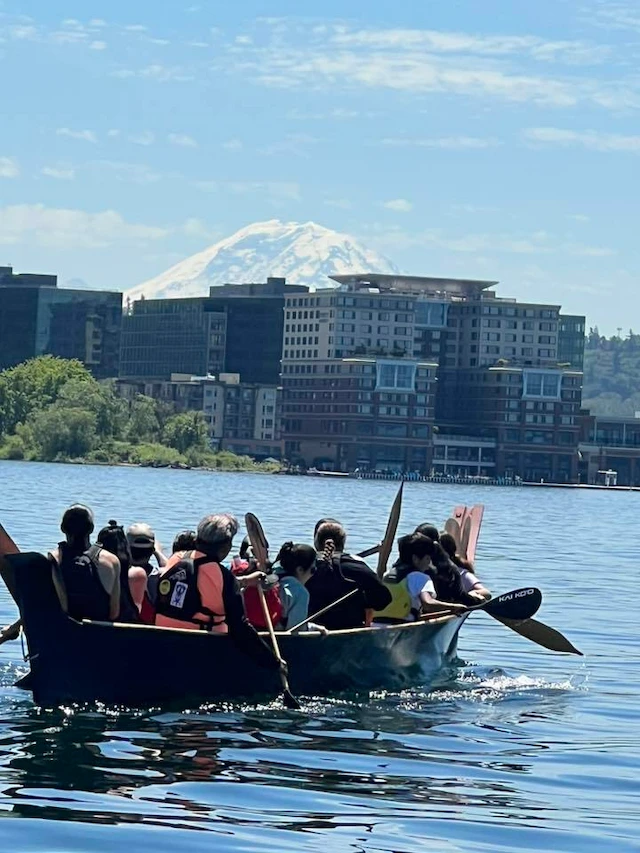
Canoe practice on Eagle Spirit at Gene Coulon Park, Renton, Washington. Photo courtesy of Corey Ward-Jerry.
Q: What opportunities do you see through the Tribe’s partnership with the Seattle Aquarium?
A: “I see a lot of learning opportunities for our youth to engage with this field of knowledge—having them potentially lead into careers in marine biology, or even just connecting with their natural environment. The idea that what we do affects the rest of the world and how we have to take care of the water.”
—Stephanie James, Culture Program Director
“Our ancestors tended to this land and defended this land. They have given us strength and wisdom, which empower us to continue inhabiting and caring for our lands while gathering resources, traveling the Salish Sea and fishing these waters. We are resilient; we are Muckleshoot.”
—Muckleshoot Tribe
We thank Salena, Sam, Autumn, Corey and Stephanie for contributing their wisdom and perspectives—as well as Sam, who closed with these beautiful words: “Witnessing this cultural resurgence, back to our Salish customs and identities, is a beautiful thing. It really is healing and powerful to see, and there are lots of additional people to thank who either held onto knowledge or went out and got it to share with the rest of us.”
To learn more, visit the Muckleshoot Tribe website and explore the collection of videos related to the annual Canoe Journey. Then, plan a visit to the Seattle Aquarium and make a stop on the rooftop to see the new sign. While you’re there, take a moment to gaze out at the waters of the Salish Sea and imagine the many generations of canoes that have crossed its waters.
Quiz: Which Aquarium otter is your alter ego?
Posted on by Emma Leiser
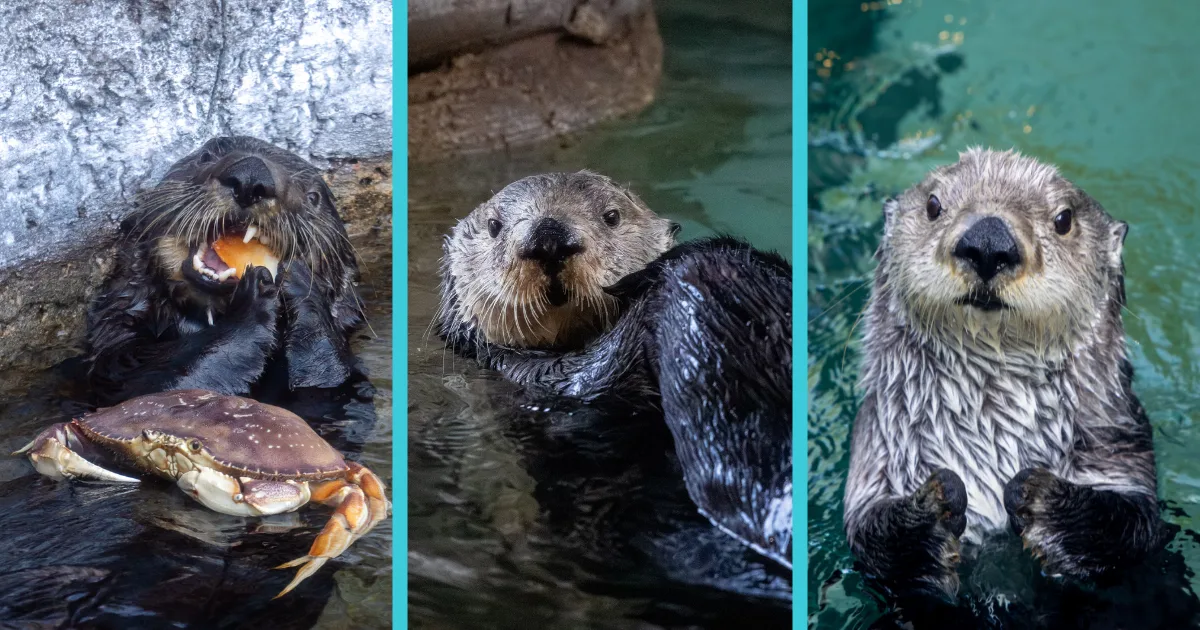
Getting to know Ruby, the new southern sea otter in our care
Posted on by Emma Leiser
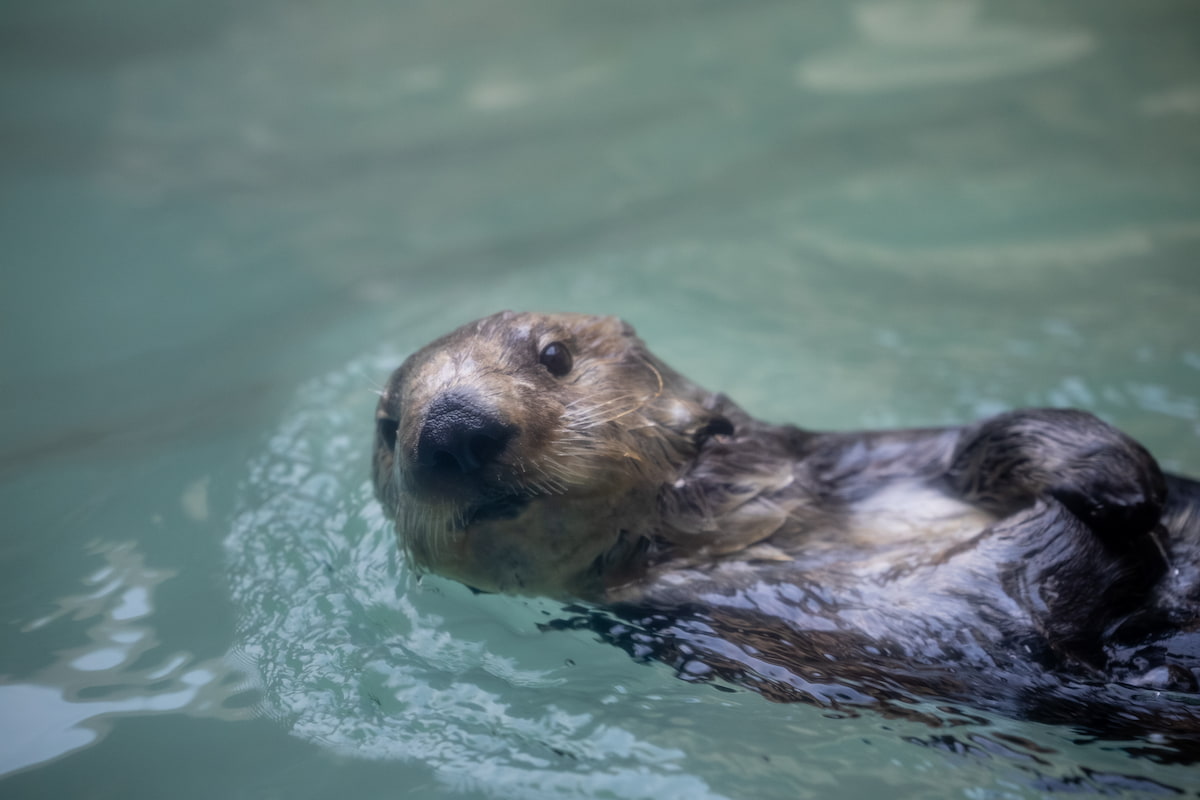
Have you heard the news? The northern sea otters in our care, Mishka and Sekiu, have a new habitat-mate! Ten-year-old southern sea otter Ruby joined us on November 19, moving from her former home at the Monterey Bay Aquarium (MBA).
Welcome, Ruby!
Starting (very) small
Ruby was found, stranded, as a newborn pup in September of 2015. Weighing just 1.9 pounds, she was one of the smallest pups her rescuers had ever seen.
She was raised behind the scenes at MBA in their sea otter surrogacy program. After several attempts at having her live on her own in the wild, the team at MBA found that she had become dependent on humans for food. She was ultimately deemed non-releasable by the U.S. Fish and Wildlife Service and went on to join MBA’s sea otter habitat in 2022—where she charmed guests and became a beloved ambassador for her species.
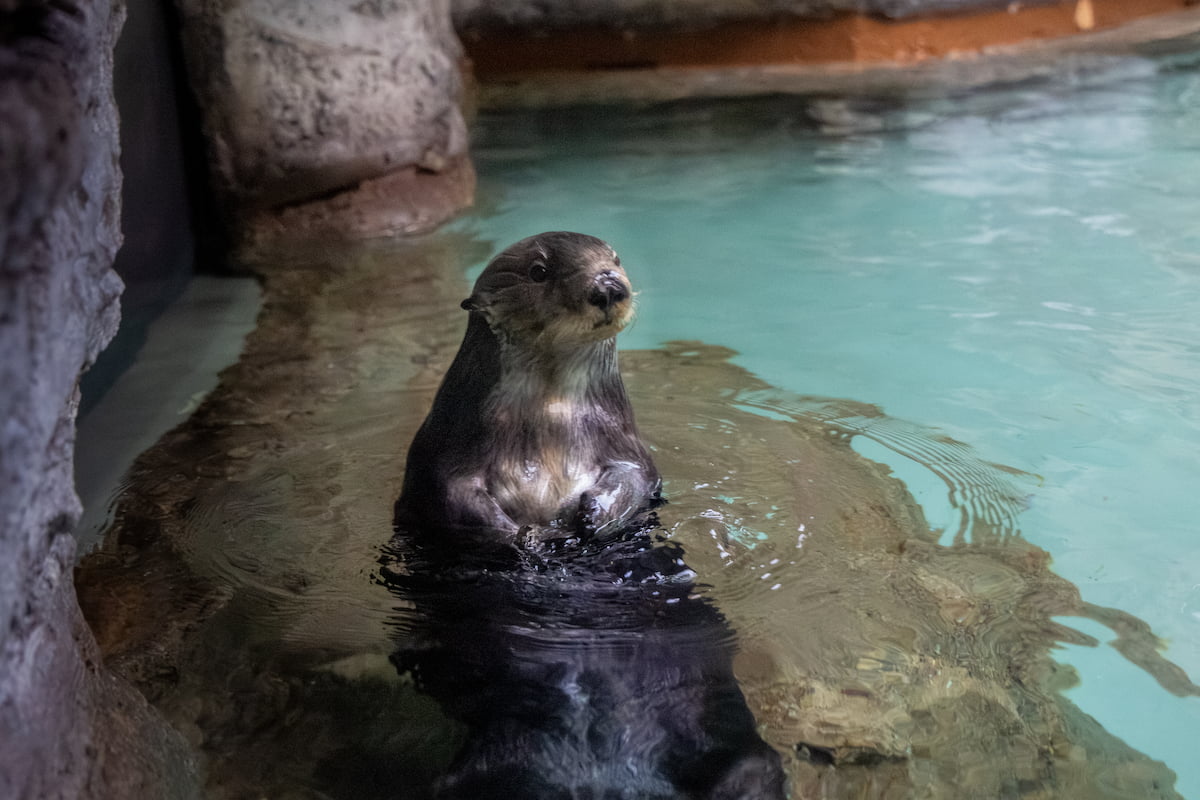
Ruby getting to know her new habitat at the Seattle Aquarium.
From Monterey to Seattle: A true west coaster
For months, our care team worked closely with MBA’s, shadowing their care of Ruby, learning about her history, likes and dislikes, social needs and more. Collaboratively, the teams decided that our otter population would be a great fit for her.
As we mentioned above, Ruby is the first southern sea otter in our care. Southern sea otters are considered a distinct population. And, while southern and northern otters don’t share wild habitats, they do happily cohabitate in zoos and aquariums—their care needs are identical.
(What’s the difference between northern and southern sea otters? It basically comes down to two things: their range and their size. Northern sea otters have a range from Washington state to British Columbia and Alaska. Southern sea otters are found in California. And northern sea otters are larger, with males weighing up to 100 pounds and females up to 70—while southern males top out at about 65 pounds with females around 45 pounds. For context, Ruby’s current weight is 44 pounds; with Mishka at 50 and Sekiu at 54.)
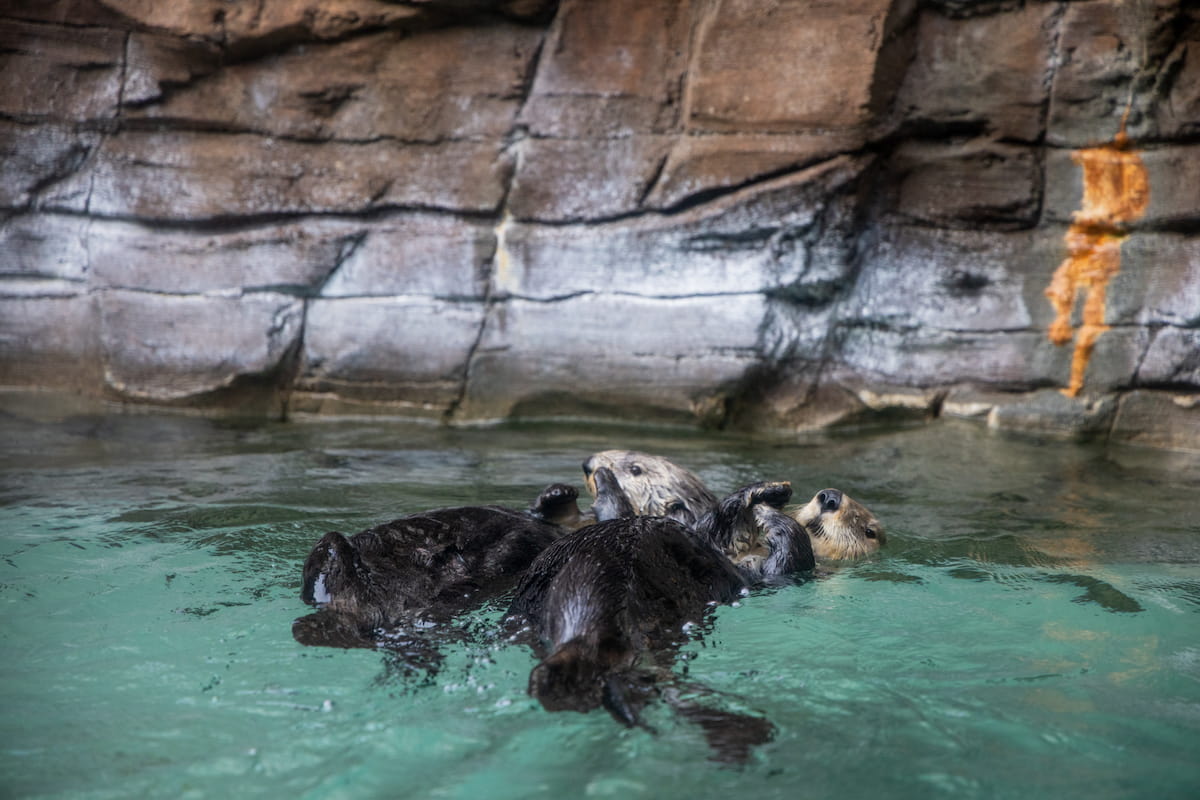
Ruby relaxing with Sekiu.
Settling in
After making the journey to the Seattle Aquarium on November 19, Ruby was quickly introduced to her new habitat—and then to Mishka and Sekiu. In short, things have been going swimmingly!
Comments Senior Animal Care Specialist Kelli Lee, “When introducing an animal into a new habitat, we expect them to be active and explore every inch. After they’ve had a chance to check out their space, we look for behaviors that show they’re comfortable, such as resting and eating. For sea otters specifically, we also look to see that they’re grooming, since that’s essential for staying warm.” (Learn more about how amazing sea otter fur is on our sea otter webpage!)
Kelli continues, “When introducing sea otters, we expect them to interact with each other by sniffing each other’s faces and heads. Then, after this typically brief interlude, we continue to make sure they’re all grooming, eating and resting.”
“They’ve been cohabitating well,” says Animal Care Specialist Michelle Munoz. “Ruby tends to follow Sekiu the most. You can see her resting with Sekiu in the main habitat, and at night, Mishka and Sekiu will haul out on deck by their mats, so Ruby will join them.”
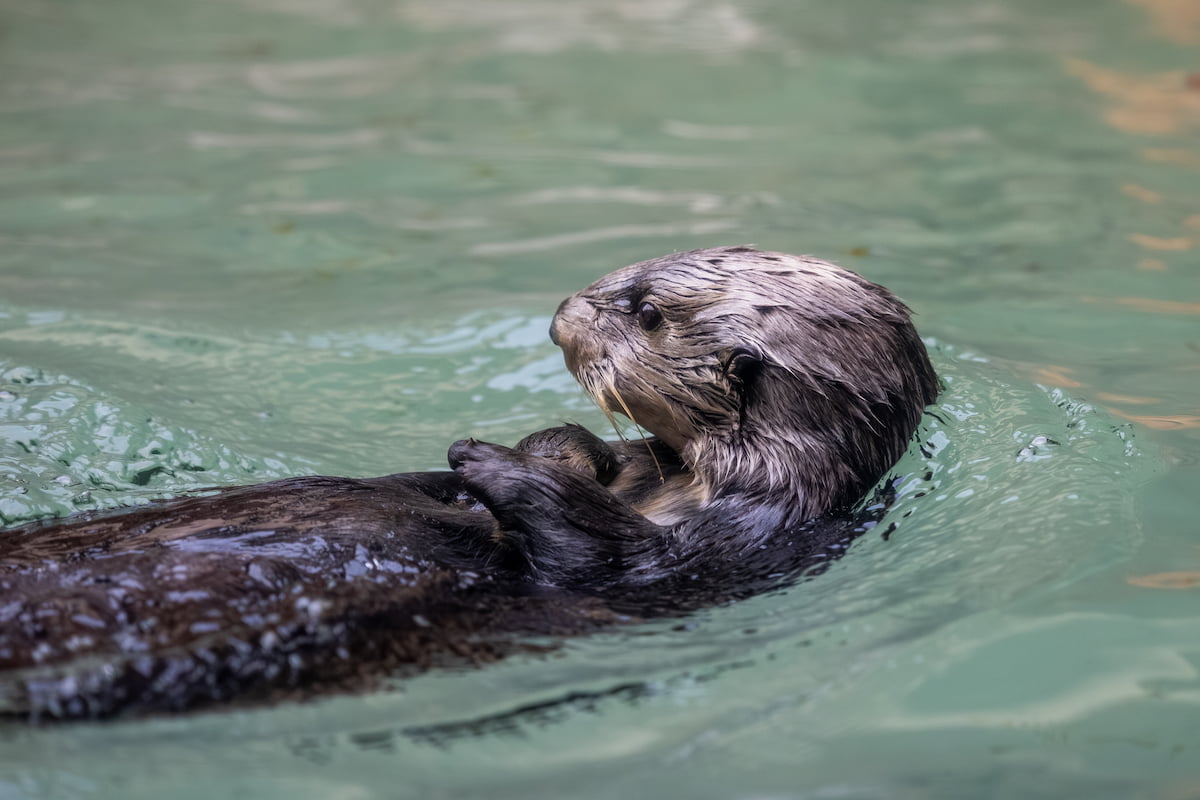
Ruby, we’re so glad you’re here!
Welcome to the Emerald City, Ruby!
Ruby’s preferences quickly became clear to her caregivers. Notes Kelli, “Ruby enjoys interacting with enrichment, such as puzzle feeders, a lot. Her favorite food is shrimp and her least favorites are surf clam siphons and stomachs.” (Can you blame her?)
She adds, “When spending time outside of feeding sessions, she likes to rest in areas of the water that are shallow, such as the arch between the two habitats.” Want to see what she’s up to? Check out our live webcam!
In the weeks and months to come, we’ll continue working with MBA as we learn more about Ruby. “Getting her comfortable in the space is our priority so she can do all the things a sea otter does—like grooming and eating,” comments Michelle. “Building a relationship with Ruby will help us work with her in the long run and also allows us to start training new behaviors with her!”
A decades-long commitment to sea otter conservation
For 30+ years, the Seattle Aquarium has led in the research of sea otters in Washington and contributed to recovery efforts with partners and collaborators around the world. We also have a long history of caring for individual northern sea otters who are unable to live in the wild.
Ruby’s arrival represents our continued commitment to sustaining and recovering sea otters, from California to Alaska and beyond. As a nonprofit, this work—both in the field and right here at the Aquarium—is only possible thanks to the support of our community. Every visit to the Aquarium supports this work and our conservation mission overall. We thank you!
We can’t wait for you to meet Ruby. Plan your visit today!
Saying goodbye to North American river otter Ahanu
Posted on by Emma Leiser
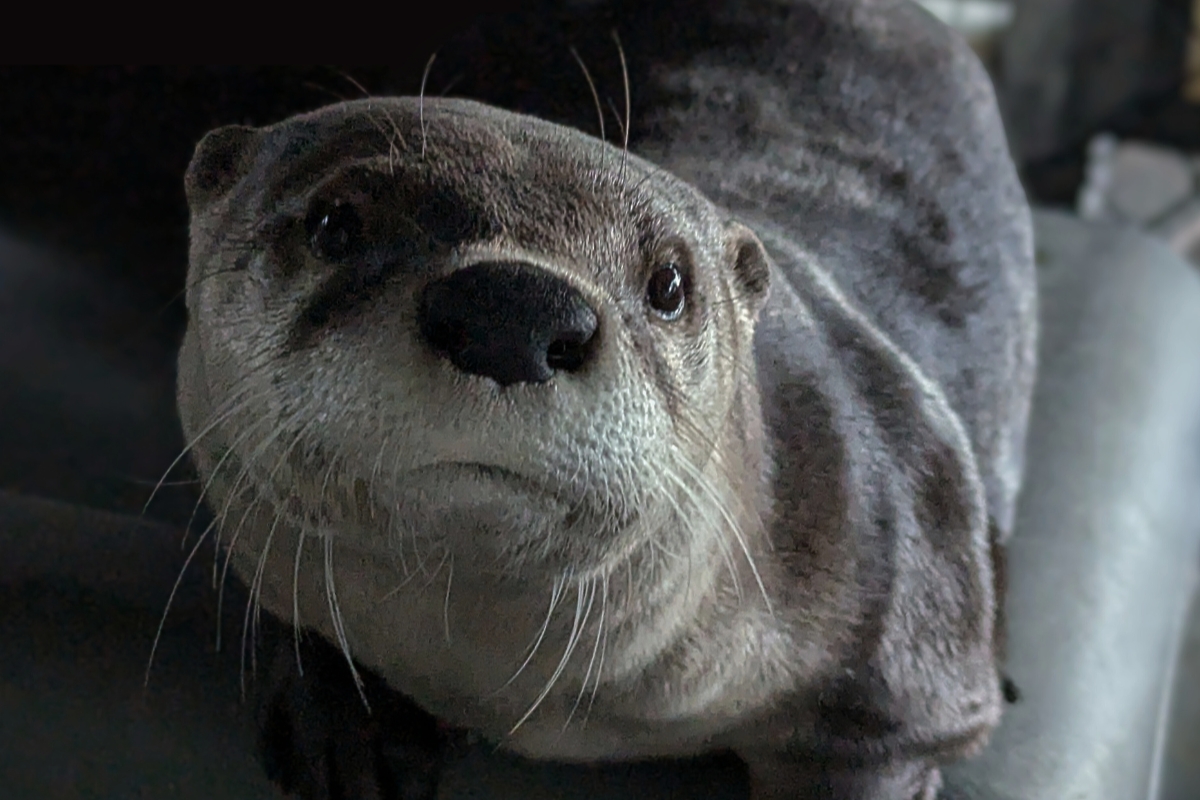
It is with great sadness that we announce the death of river otter Ahanu. He passed away unexpectedly during a routine sedated exam on the morning of November 5.
Ahanu, who came into our care in 2019, was beloved by Aquarium staff and volunteers—as well as the many thousands of Aquarium guests who loved watching him at play. Photo courtesy of Senior Animal Care Specialist Kelli.
Throughout his life, Ahanu had undergone numerous exams just like this one. Before the exam, he had been eating and playing normally. The sedation and exam itself went well, and he was stable throughout.
Sadly, sedation for any animal carries inherent risks and after the anesthetics were reversed, Ahanu did not rouse. Our full Veterinary team, along with several members of our Bird & Mammal team who were assisting with the exam, immediately began life-saving measures. After 50 minutes of CPR and multiple rounds of medications and assessments, the team made the difficult call that Ahanu had passed.
He hadn’t previously shown any respiratory symptoms—such as trouble breathing—but, during the X-rays and ultrasound that were part of the exam, our team discovered that one of Ahanu’s lungs showed abnormalities. We don’t yet know whether this affected his passing; it’s one of several questions our care team will be looking into as they perform his necropsy.
A long, playful life
Ahanu’s name means “he laughs” in the Algonquian language—and it’s no surprise that he captured so many hearts: He was born on Valentine’s Day in 2011 at the Oakland Zoo. He was transferred to the Denver Zoo at age 2 before coming into our care in 2019.
Ahanu joined us as a habitat-mate for Molalla, who had been living solo after his companion, a geriatric river otter named Skagway, passed away several months before.
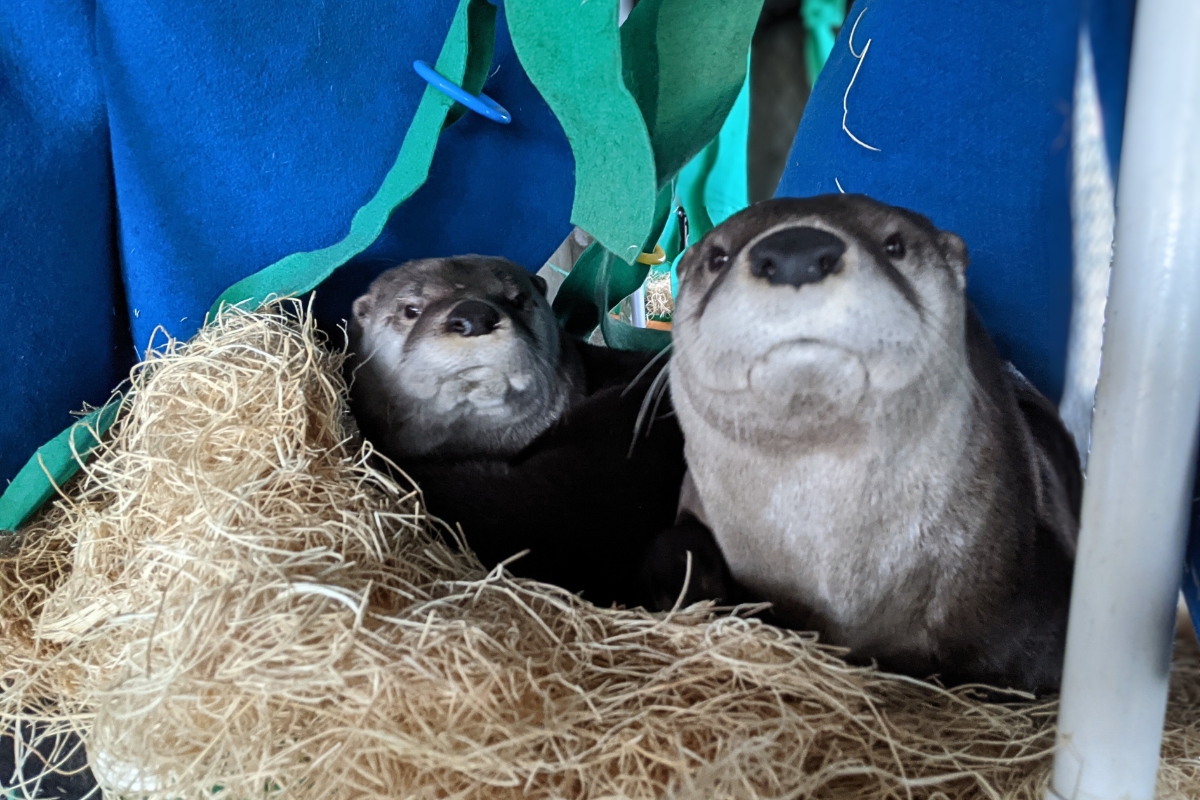
Ahanu (at right) cozying up with his habitat-mate, Molalla—affectionately known as Mo by his caregivers—in their habitat’s den. Photo courtesy of Senior Animal Care Specialist Kelli.
In zoos and aquariums and in the wild, the social structures of male river otters vary— they may live with their litter mates, alone, in bachelor groups (like the one formed by Ahanu and Molalla)—or even, temporarily, in family groups for breeding purposes. North American river otters are managed under an Association of Zoos and Aquariums (AZA) species survival plan—through this program, animals are transferred to AZA-accredited zoos and aquariums around the country to mimic species-specific social movements and enhance population sustainability and genetic diversity.
River otters have life spans of eight to 15 years in the wild; in human care (thanks to consistent veterinary care, readily available food and protection from predators), they may live for 15 to 20 years. At nearly 15 years old, Ahanu was entering his senior years—but he was still known for his playful antics, not to mention a voracious appetite.
Remembers Veterinary Technician Erika Russ Paz, “I always enjoyed going up for a training session with Ahanu and watching him chow down. River otters are extremely cute when they eat but have no manners. They just toss their heads back and chomp down on their food with mouths fully open, then stare at you insistently for their next piece.”
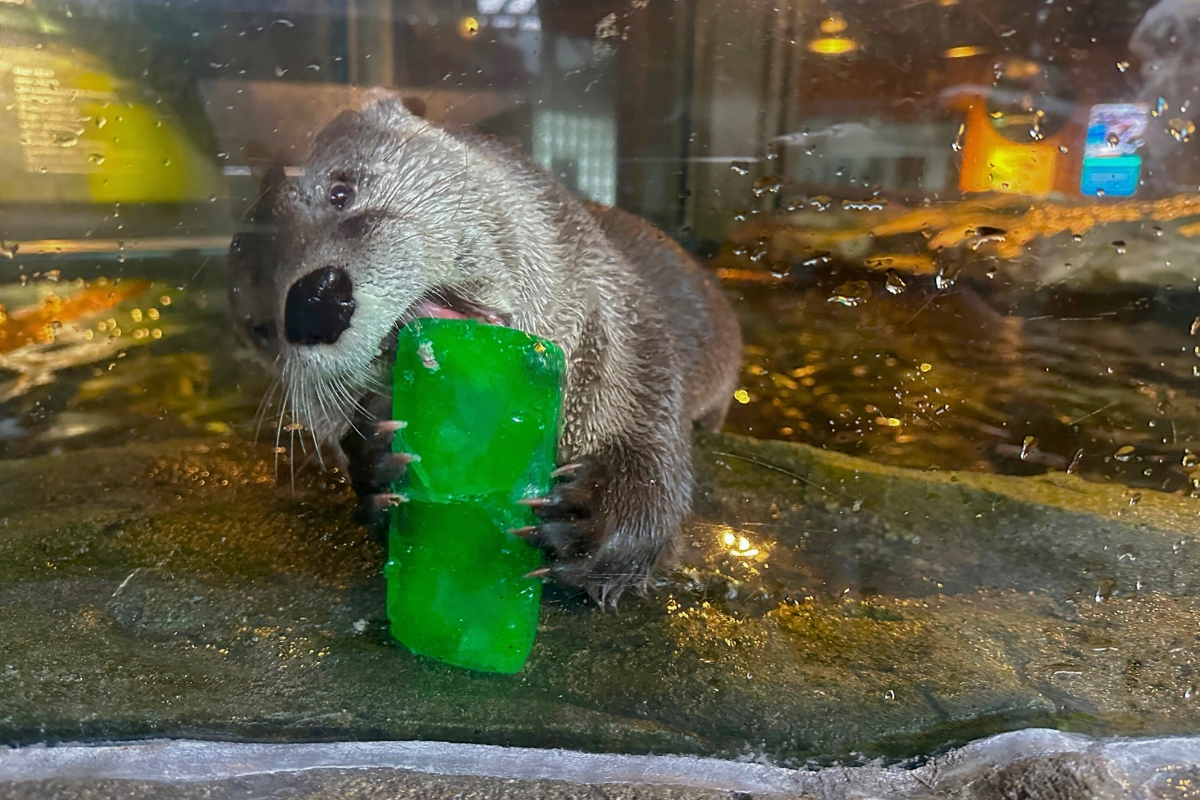
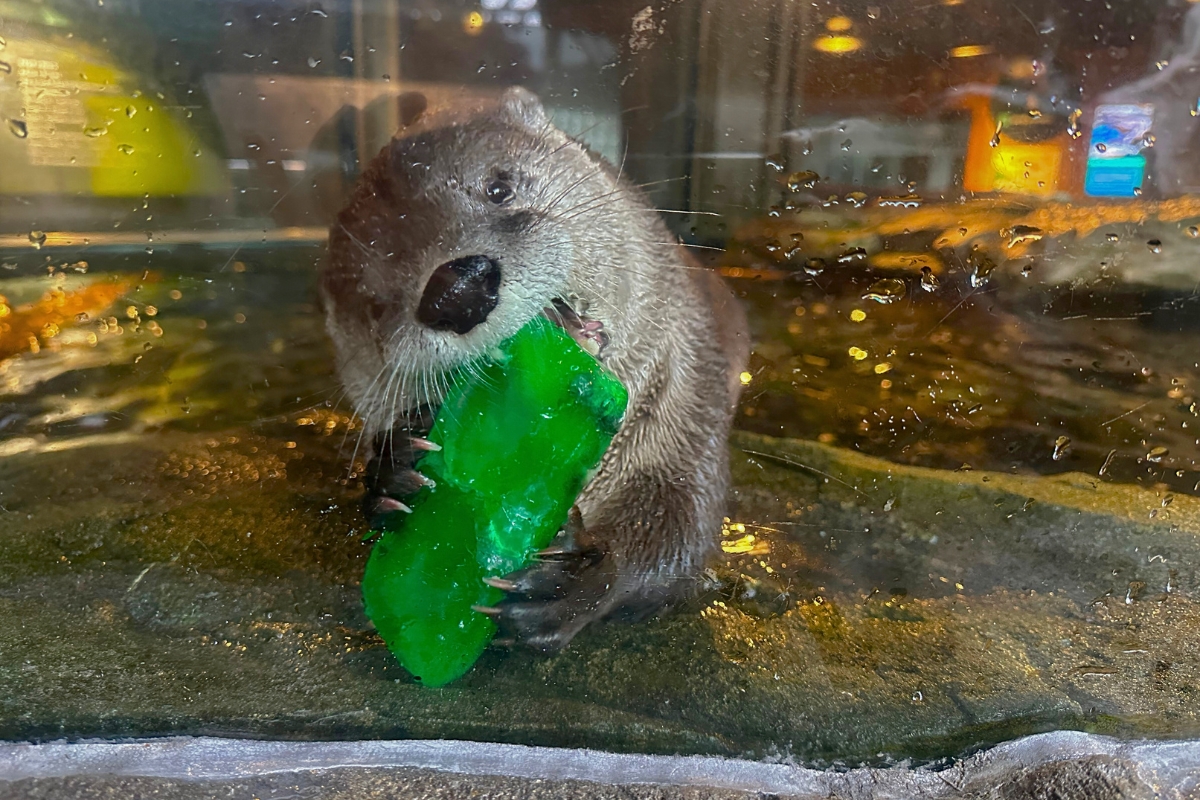
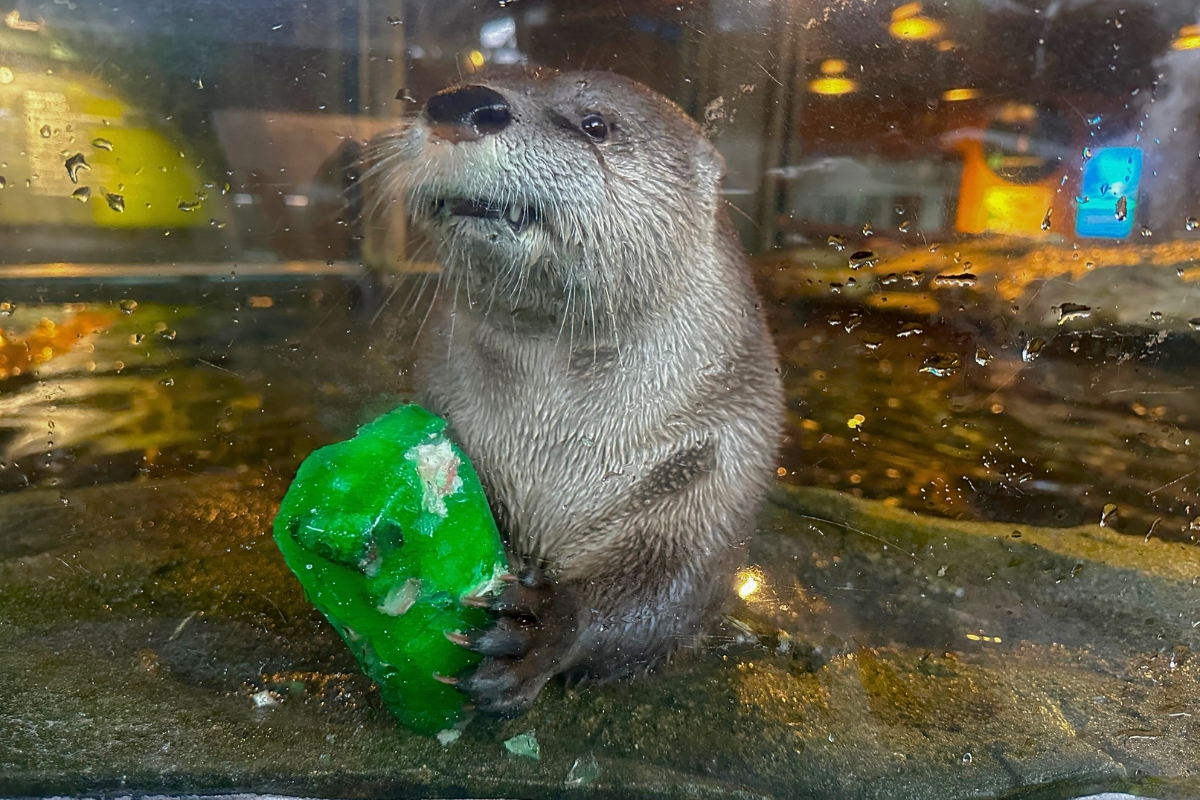
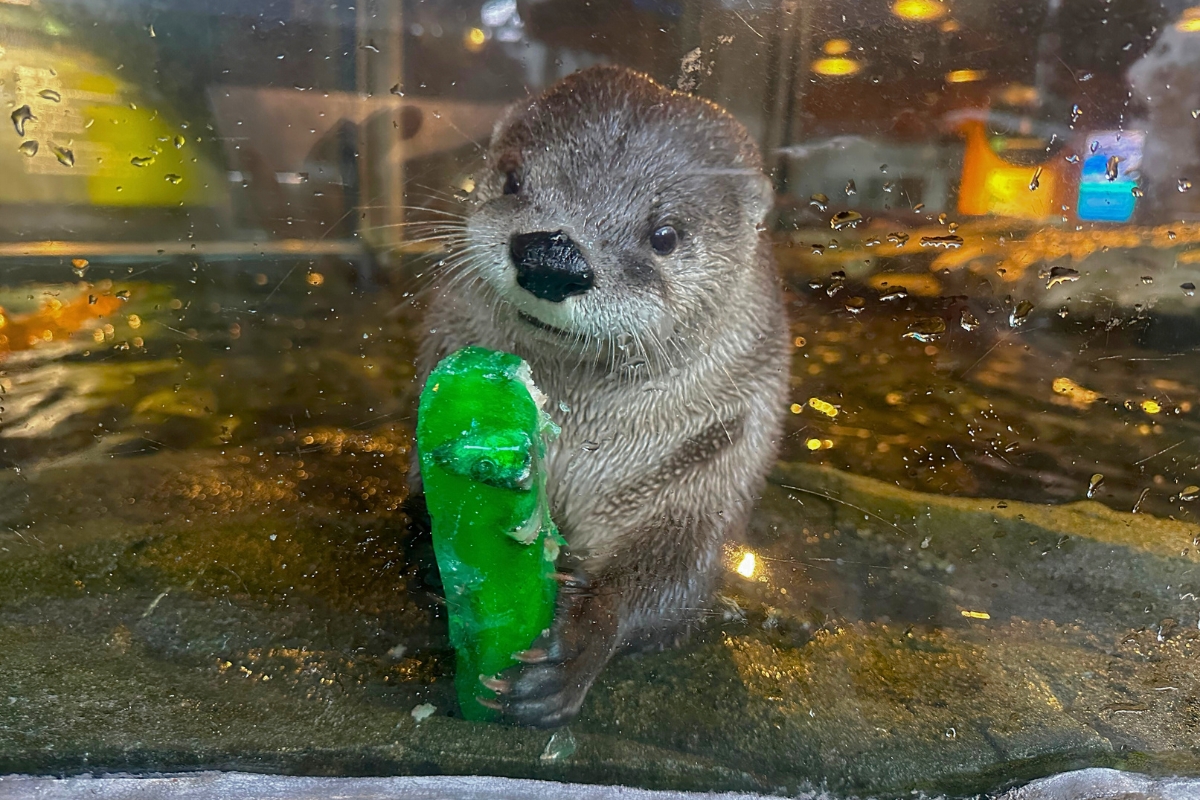
Ahanu devouring a special ice treat, stuffed with some of his favorite foods. Photos courtesy of Senior Animal Care Specialist Taylor.
An important ambassador for marine conservation
Ahanu not only delighted the hundreds of thousands of Aquarium guests who watched him at play—he also helped people learn more about the importance of his species in the broader scope of ocean health.
“With grace, agility, and enthusiasm Ahanu introduced millions of people to the charismatic nature of North American river otters. He moved people to care about his species, and the aquatic environments we share,” says Seattle Aquarium President & CEO Peggy Sloan.
She continues, “North American river otters represent a conservation success story. Nearly wiped out by the fur trade, they recovered due to successful reintroductions and habitat protection. Today these otters thrive in Washington. Ahanu’s story is one of environmental optimism and conservation success. His loss is felt by his care team and his large fan base—and these emotions mix with gratitude for the joy, empathy and action he inspired over many years in our care.”
Sad and loving farewells
When Vice President of Animal Care Lisa Hartman announced Ahanu’s passing to our staff, she noted, “Losing an animal is one of the hardest parts of our work, and it can be especially hard to navigate when the loss is unforeseen. Our teams provided Ahanu with the utmost care before, during and after the exam. Just as in our own lives, sometimes loss happens quickly and without warning.”
Ahanu’s loss is deeply felt by the devoted caretakers who knew and loved him over his years with us. Remembers Animal Care Specialist Ana Ibarra, “Ahanu was always up for a treat. Whenever we called the boys to feed them, Ahanu would be the first one to head up—but oftentimes he had to come back to their den and wake up Mo so they could go together.”
Former Supervisor of Birds & Mammals Aubrey Theiss shared some thoughts too. “Ahanu, I hope you’re blowing tons of raspberries, scratching everything you see, peeping at salmon, climbing trees and scaring hummingbirds, chewing rib bones, chasing minnows and digging all the holes. RIP, you crazy little guy.” And, from former Senior Animal Care Specialist Cheryl Becker, “Rest in peace, sweet boy. He always used to make me laugh at how he would partially sit on tubs—it looked like he was a lounging mermaid.”
Ahanu and Mo enjoying a cold plunge together. In the wild, river otters make their homes in a variety of habitats, near both marine and fresh water. Video courtesy of Animal Care Specialist I Anthony.
Ahanu’s current caretakers are now working to ensure that Molalla, Ahanu’s habitat-mate, receives extra support during this change. As noted earlier, it can be natural for males of this species to live alone—and we’ll be sure to provide updates in the future with any news of a new companion for Molalla.
In the meantime, we invite you to check our social media channels for more photos and to share your own memories of Ahanu. Thank you for joining us in our grief. Ahanu will be deeply missed.
Mirrors for oystercatchers? Take a look inside shorebird enrichment at the Seattle Aquarium
Posted on by Emma Leiser

A visit to the shorebird habitat at the Seattle Aquarium can resemble a trip to a superstore; there’s a little of everything. In addition to birds, you can find toy blocks, mirrors, heat lamps, wind chimes and even rubber ducks. But these items are more than just the world’s most eclectic shopping list. They’re part of enrichment for the Aquarium’s resident birds.
Enrichment refers to experiences and care that allow animals to express natural behavior or instincts and provide physical and/or mental stimulation. Different categories of enrichment include social/behavioral, sensory, food-based and devices.
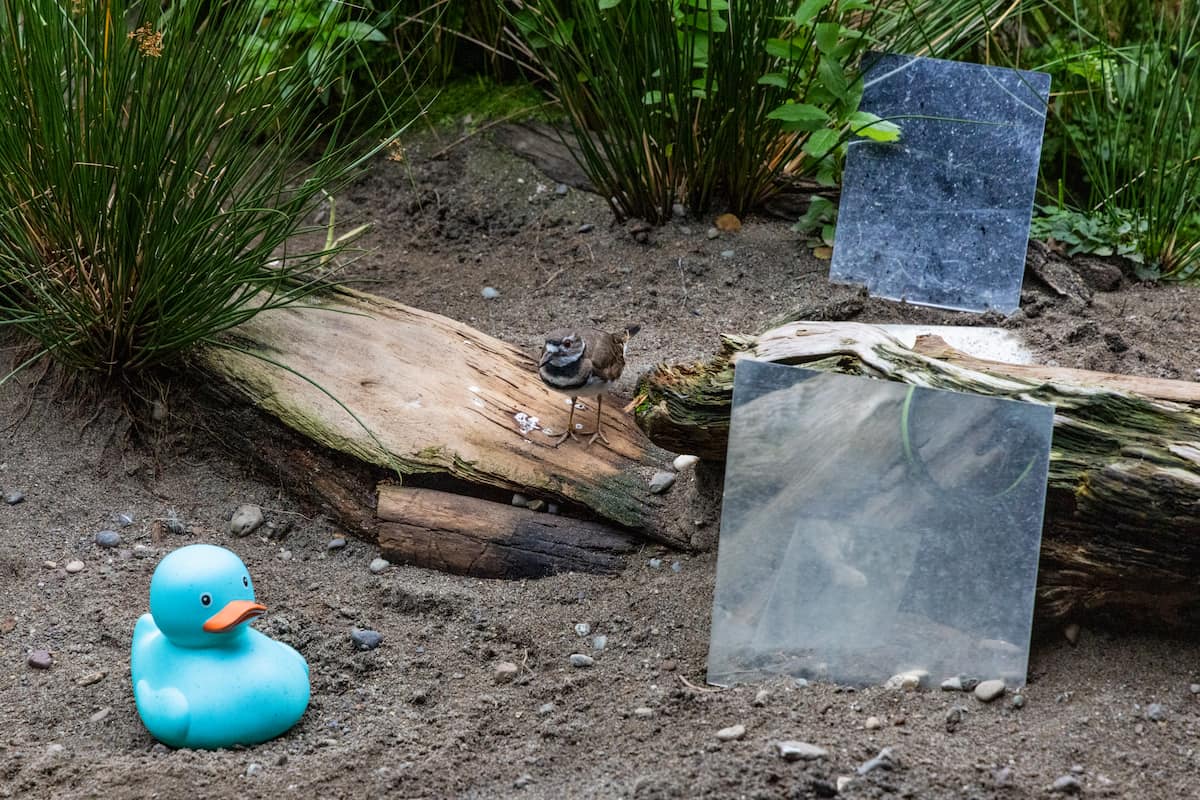
Mirrors and toys provide stimulating enrichment to shorebirds at the Aquarium.
At the Seattle Aquarium, our animal enrichment is designed and monitored by our dedicated Animal Care and Veterinary teams. These plans are reviewed during regular accreditation inspections by the Association of Zoos and Aquariums (AZA)—a global independent nonprofit that holds its member zoos and aquariums, including us, to the highest standards.
Before a new enrichment device or activity is implemented, it goes through a proposal and approval process by Aquarium staff. And for our birds and mammals, each enrichment device is approved on a per-animal basis. What works for a black oystercatcher might not go over so well with a Western snowy plover.
Because our Animal Care team knows the animals so well as individuals, they can tailor enrichment to meet everyone’s specific needs.
Enrichment in action
Devices are probably the most visible forms of enrichment. This category includes toys like rubber ducks and plastic blocks. Some enrichment items fall into multiple categories, like puzzle feeders, which are devices that stimulate the oystercatchers mentally while delivering food.
Other types of enrichment might be more difficult for visitors to detect but go a long way in keeping things interesting for the shorebirds. Caretakers sprinkle essential oils, like lavender and lemon, or spices, like curry powder and rosemary, around habitats to provide sensory stimulation.
Likes and dislikes
As individuals, the birds have their own likes and dislikes when it comes to enrichment. The male killdeer loves to sit in front of a mirror and make noises. His caretakers believe he enjoys the “company.” One of the oystercatchers also loves mirrors, as well as windchimes. She’s got a great sense of interior design!
Mirrors provide sensory enrichment for the shorebirds.
Like all animals at the Aquarium, the shorebirds maintain a sense of personal agency and choose whether to engage with enrichment. As anyone who has ever spent $100 on a cat tree only for your pet to prefer a cardboard box knows, animals are not afraid of expressing their preferences. Our animal care staff closely monitors how the birds respond to each type of enrichment.
Some of the shorebirds at the Aquarium are considered elderly for their species. While their enrichment needs don’t necessarily change as they age, Animal Care staff have noticed that the older birds tend to prefer more naturalistic enrichment over toys.
Changing seasons
We’re entering cozy season at the Seattle Aquarium. Like the temperature and sunset time, enrichment also changes with the seasons. When the weather gets cold, our staff turns on warmers for the birds. These are spread throughout the habitat so birds can choose to keep each other company or stay solo while warming their feathers.

There are heaters hidden around the shorebird habitat—including under this rock—to keep the birds nice and cozy during winter.
The summer coincides with egg-laying season for many shorebirds. And while some older birds are past the age where they lay eggs, one of the female oystercatchers at the Aquarium still does. Caretakers noticed that she tends to build her nest in a sunny spot from which she does not move, so they set up a mister to help keep her cool.
Summer breeding season also brings changes. Some of the birds, like the mirror-loving killdeer, become chattier during this time. Others display more territorial behavior, which the caretakers account for. Animal care staff also provide the birds with clamshells and other materials to help them build their nests.
Whatever the season, you can see shorebirds—plus thousands more animals—at the Seattle Aquarium 365 days a year. And with enrichment switching up daily, there’s always something new to sea. Plan your visit today!
Halloween quiz: What’s your poison (or venom)?
Posted on by Emma Leiser
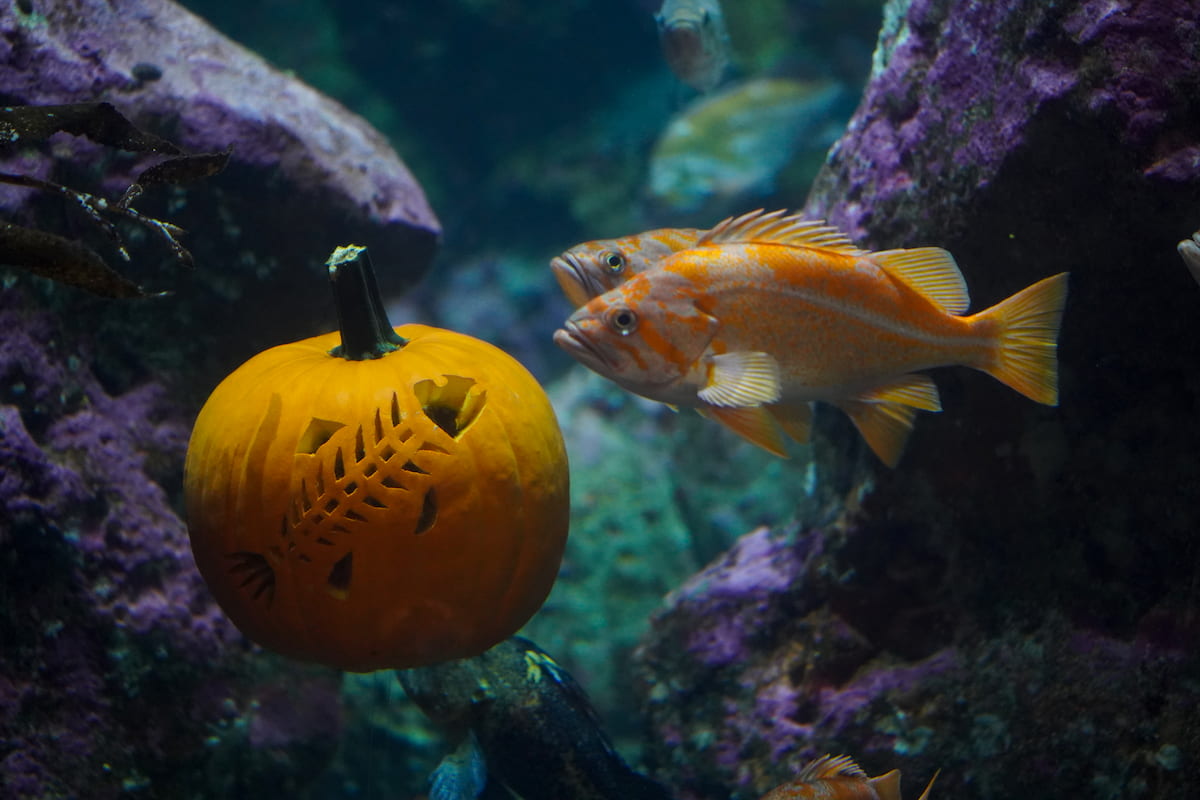
Quiz: Which marine species is your cozy season alter ego?
Posted on by Emma Leiser
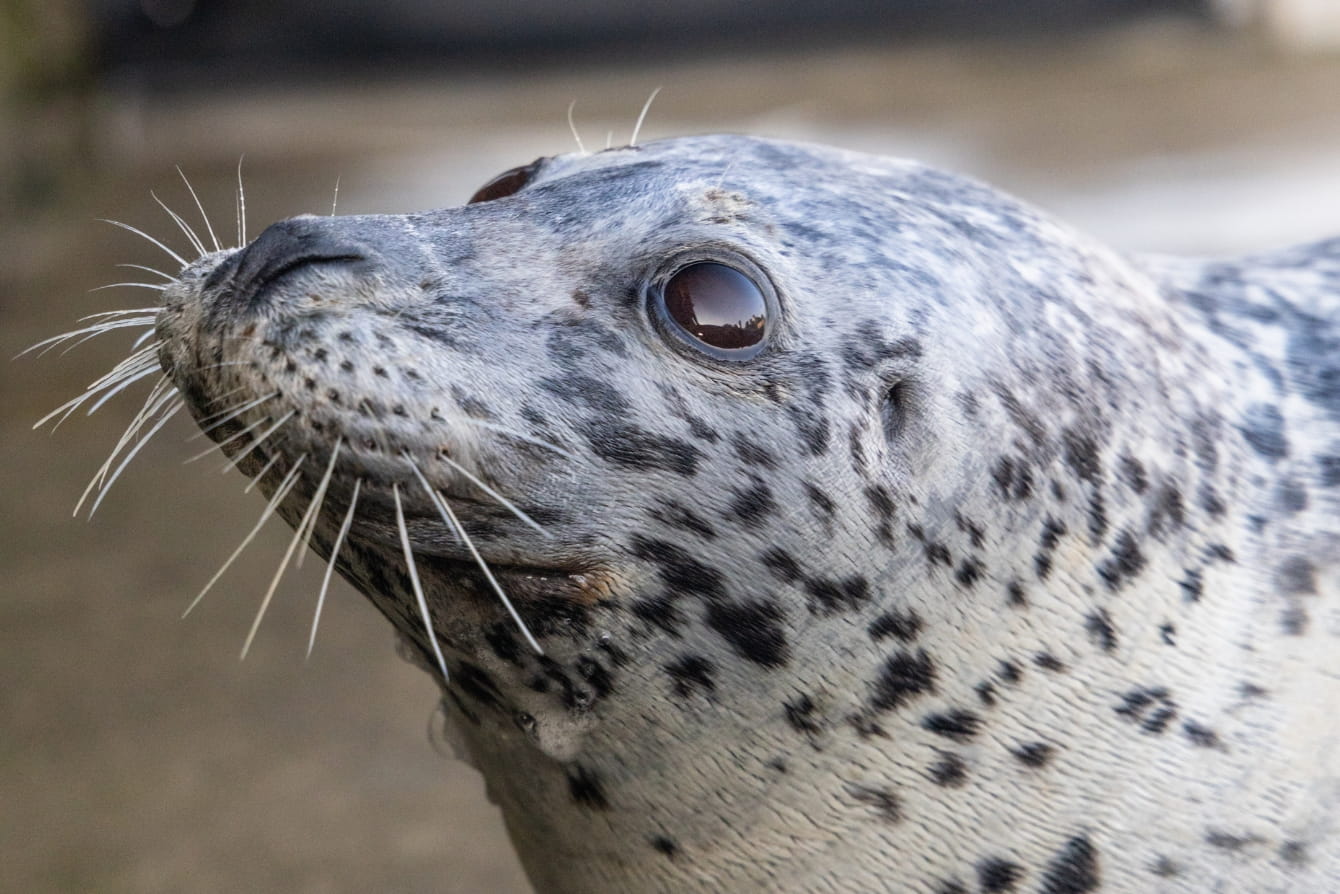
Quiz: Do you know the Spanish names of ocean animals?
Posted on by Emma Leiser
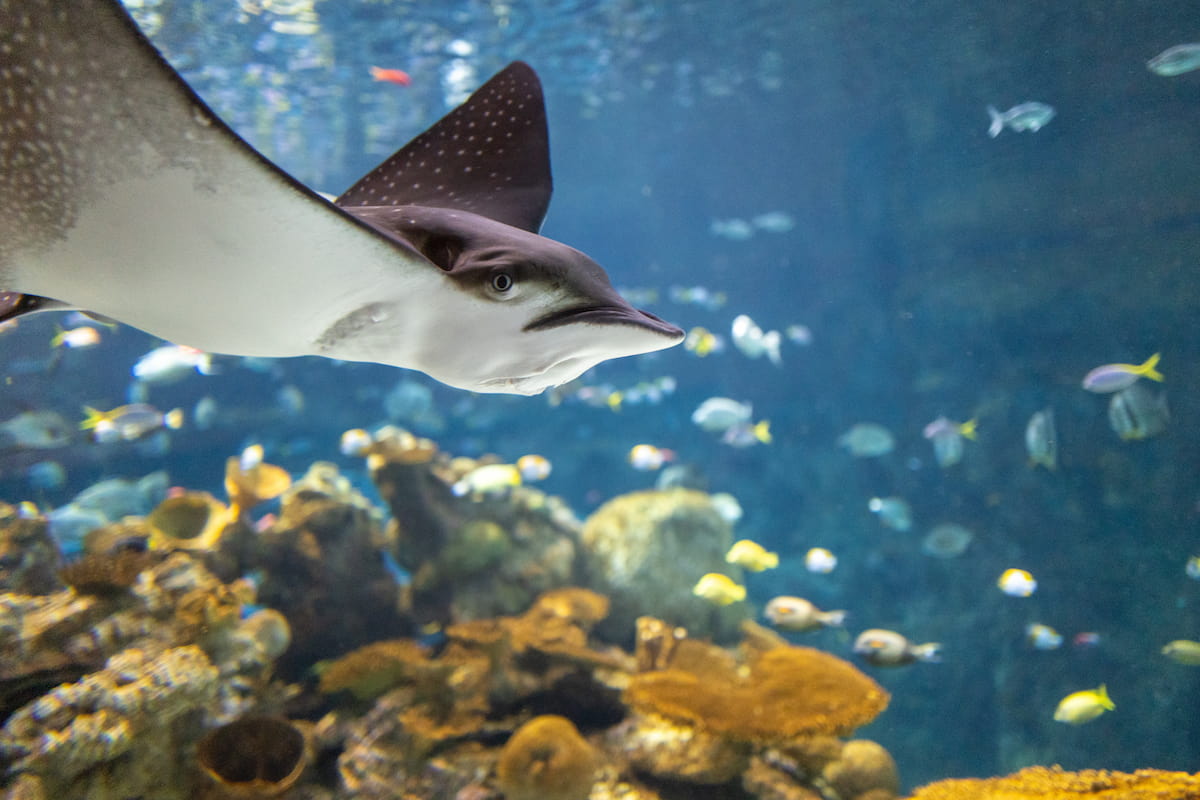
Dive down memory lane with us to celebrate Barney’s 40th birthday!
Posted on by Emma Leiser
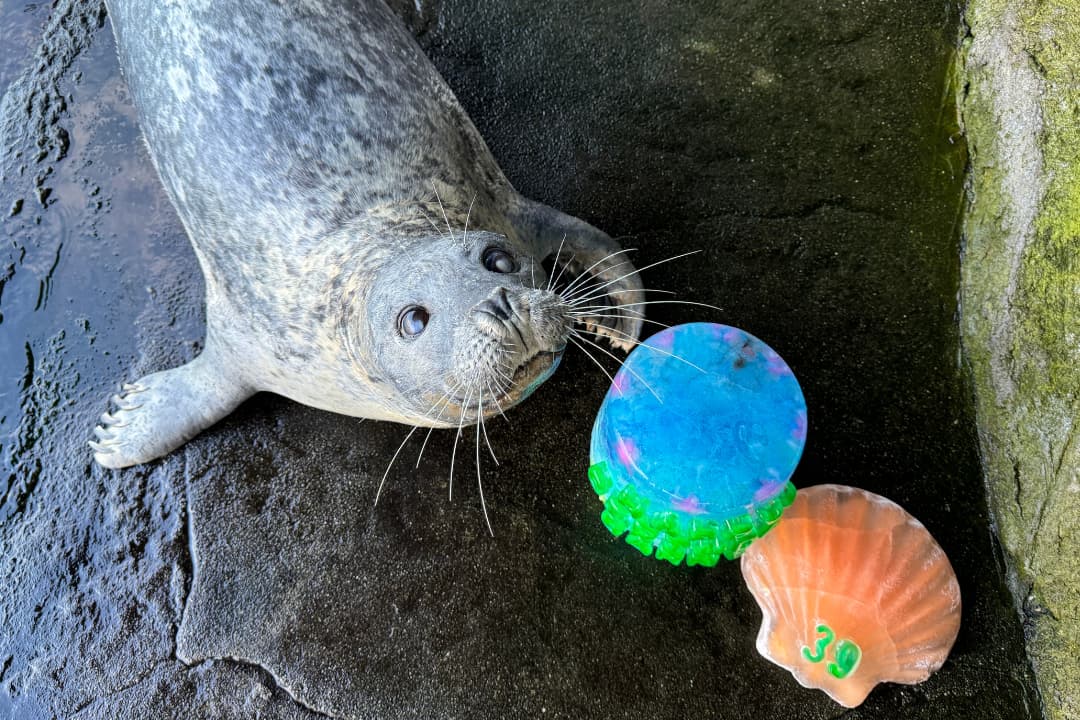
Editor’s note: This story was originally published in September 2024 for Barney’s 39th birthday, as he approached the human equivalent of 100 years old. Barney passed in March 2025. To celebrate his life and legacy, we’re republishing this story on what would have been his 40th birthday.
Barney the harbor seal was born right here at the Seattle Aquarium on September 14, 1985! And he’s been stealing the hearts of staff and guests alike ever since, while inspiring millions to help protect his beloved and charismatic species.
In his golden years, Barney enjoyed the simple things in life, like a nice nap in the sunshine, getting his teeth brushed daily and eating some of his favorite snacks, including all things fish. He was also a fan of his birthday celebrations, as you’ll see in the photos below. Dive down memory lane to revisit some of those celebrations with us as we commemorate Barney’s extraordinary life!
2024
Centennial celebration—happy 39th, Barney!
According to the Association of Zoos & Aquariums (AZA), of which we’re proud to be an accredited member, the median life expectancy for harbor seals in zoos and aquariums is about 25 years. At 39, Barney has lived well beyond that. In fact, his biological age is about the equivalent of a 100-year-old human!
Give him—and his caretakers—some love on our Facebook or Instagram to mark the occasion.
2023
38 years young!
Barney’s 38th birthday bash was complete with a “cake” made from ice and 38 frozen fish!
2022
37 looks good on you
We welcomed harbor seal Casey earlier in 2022, and all three “roomies”—Barney, Hogan and Casey— dug into a delicious, fish-filled ice treat together.
2021
Having his cake and eating it too
Barney rang in his 36th birthday by tucking into a towering ice treat “cake.”
2020
Pandemic party
While we couldn’t invite the public to celebrate with Barney because of our temporary, pandemic-related closure, our incredible animal care team made sure he felt the birthday love.
2015
Just another enriching birthday
Animals at the Aquarium receive enrichment every day (read more about it on our webpage). Special occasions, like Barney’s 30th, give our animal care team a fun reason to get creative with it.
2013
28 and looking great!
In 2013, Barney celebrated his birthday with cake in his habitat’s new haul-out space*! Generous support from people like you allowed us to renovate and expand the harbor seal habitat back then.
*What’s that? Space that the seals use to go onto dry land to nap, groom, cooperatively participate in their own health care and, in Barney’s case, eat a birthday treat.
Your gift today will make a difference too: Please consider a donation of $19.85, $39 or any amount on behalf of Barney’s birthday!
2012
Awww, you shouldn’t have
Shown here in the habitat’s previous haul-out space, Barney looks ready to devour the ice treat that our animal care team prepared for him.
2011
Stealth celebration
What’s better on your 26th birthday than a delicious ice treat, just waiting for you to notice it as you casually swim by?
2010
Blow out the candles!
Here’s a throwback to Barney’s 25th! Our animal care team went all out with an ice treat complete with “candles” for him to crunch and munch.
1985
Baby Barney’s birth day
Photo: Seattle Post-Intelligencer
How’s this for a sweet, vintage photo of newborn Barney alongside his mom, Clyde? For perspective on how long ago that was in terms of other Pacific Northwest icons, Barney was born the same year that downtown Seattle’s tallest skyscraper, Columbia Center, opened; two years before the band Nirvana was formed; and 15 years before the Kingdome was demolished. Just our humble opinion, of course, but we think he’s the best and most charming icon of the bunch. Happy, happy 39th to beloved Barney!