This site uses cookies. View our Cookie Policy to learn more about how and why.
On January 19, our Youth Ocean Advocates (also known as YOAs) teen volunteers traveled to Olympia to join the Seattle Aquarium and its partners in the Plastic Free Washington coalition for Lobby Day, advocating for policies that would reduce plastics in our environment. Nearly 70 Washingtonians joined to discuss with legislators how bills like the amended plastic bag ban (HB 2233/SB 5965) and the Recycling Refunds Act (HB 1607/SB 5502) will reduce waste and marine plastic pollution.
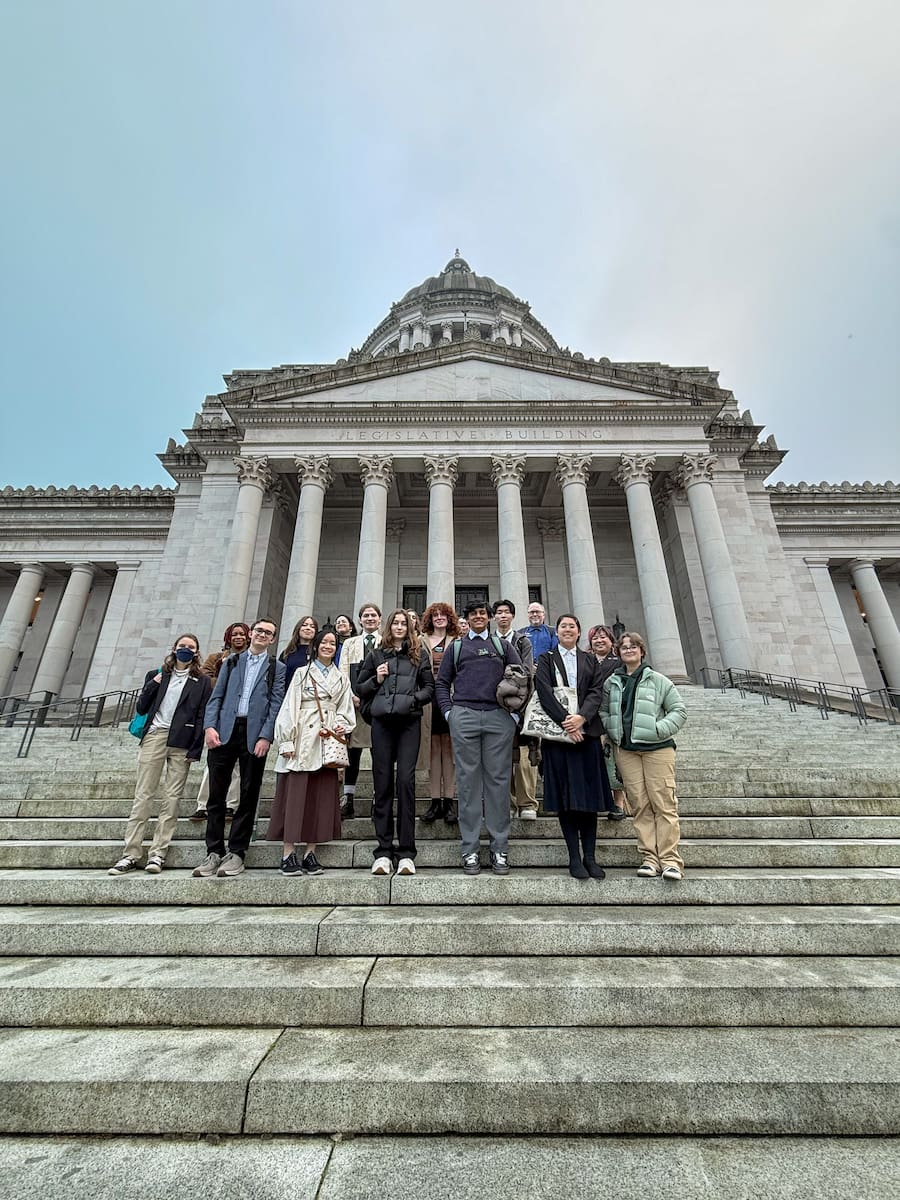
YOAs on the steps of the state Capitol Building.
Plastic bags are a major source of litter and pollution in our ocean. Washingtonians use nearly two billion plastic bags every year (yes, that’s billions, with a “b”)! In 2020, Washington passed a bill eliminating single-use, thin plastic bags. The amended plastic bag ban would close a loophole and ban all plastic bags, including the thicker “reusable” plastic bags often provided at grocery store checkouts or for restaurant to-go orders.
Like plastic bags, beverage containers are a major source of pollution along our highways and in our waterways. The Recycling Refunds Act (also known as the Bottle Bill) would improve recycling rates of beverage containers, with evidence from Oregon and British Columbia suggesting an 80–90% increase! Consumers would pay a 10-cent deposit on most beverage containers, which would be refunded when they bring their containers to convenient drop-off locations. Beverage brands would form a “producer responsibility organization” (PRO) to fund and implement the program. The PRO will cover 100% of the state’s costs, including oversight, administration, education and enforcement.
Volunteers organized over 30 meetings with state legislators to encourage support of the priority bills addressing plastic pollution, like the two mentioned above. Together, 12 YOAs attended 15 meetings. YOA Vasilisa said, “I learned a bit more about the process of advocacy, how laws are created and how constituents can communicate with their respective [state] representatives. I attended because I was curious about this process [policy advocacy] and wanted to help contribute to the Aquarium/Puget Sound and its animals as much as possible.”
YOAs got an opportunity to meet legislators and speak about their passion for the marine environment and their personal reasons for wanting to pass the Bottle Bill and the amended plastic bag ban. In one meeting with a state senator, YOA Alex was asked how her work impacted the world, a question she wasn’t expecting. After some thought, she replied, “I do not think there is a single visitor who leaves the Aquarium without loving the ocean a little more.” Later, further reflecting on the senator’s question, she realized that, while she can’t remove all the plastic pollution from the ocean or all the toxics in the Salish Sea, she can reach the hearts of visitors in her talks and interactions. She notices, “the eyes of a 6-year-old widen, an introspective tilt of the head, or a teenager look down to hide their wonder. This moment where, to them, the world gets a little bigger. The senator himself experienced this…leaning back in his chair, peering through his glasses, seeing not us, but the adoration and respect we have for the marine world. This is inspiring marine conservation.”
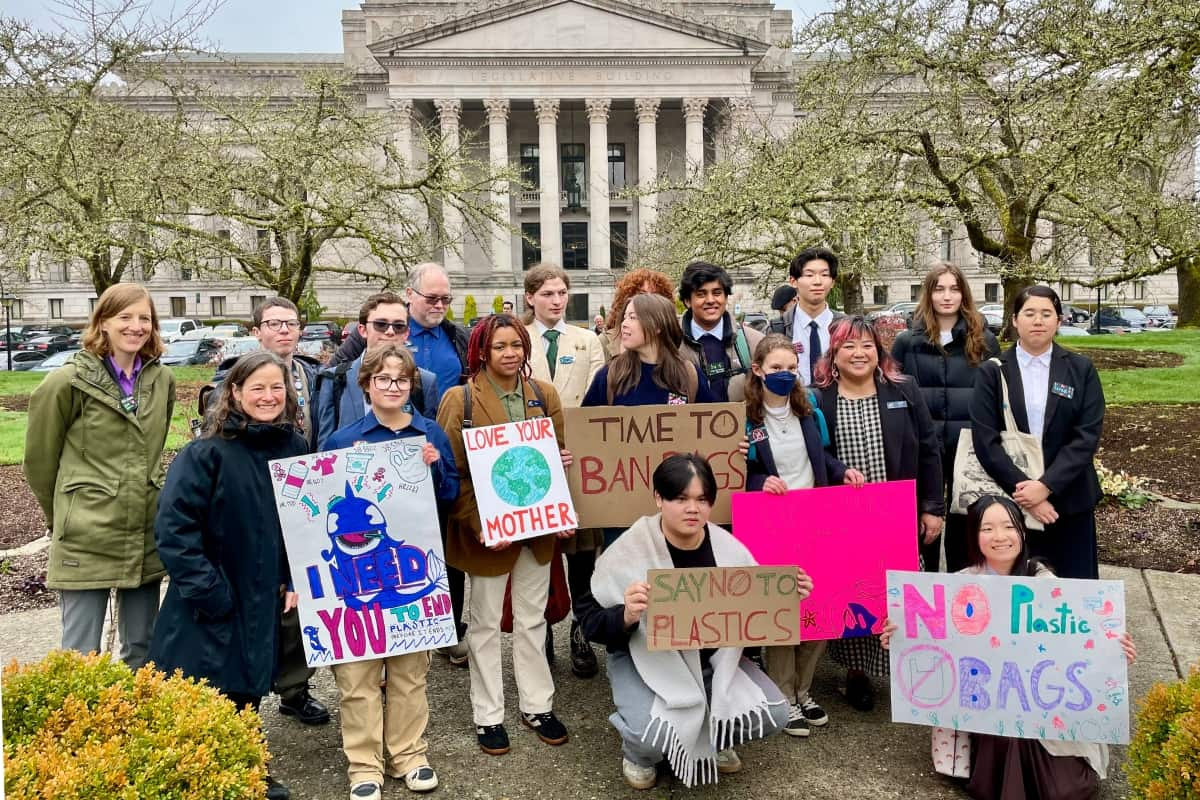
YOAs raising their voices at the rally at Lobby Day on January 19.
In addition to meetings with legislators, YOAs attended a public hearing in the House Environment & Energy committee. One of the bills in the hearing would ban 6PPD, a tire chemical that becomes 6PPD-Q, a chemical that’s highly toxic and lethal to salmon, particularly coho salmon. Four YOAs were brave enough to testify in support of the bill, signing up and preparing testimony on their own. Their testimonies were met with appreciation from the committee, and they met the bill sponsor, Representative Zach Hall (District 5). YOA Sid, reflecting on his decision to attend Lobby Day and his experience testifying said, “I attended because I care deeply about conservation and environmental policy. Healthy ecosystems support both people and wildlife, and I feel a responsibility to speak up when preventable pollution threatens that balance. Once I started speaking, my nerves settled, and I felt proud to share the science and the real risks to salmon and water quality. Overall, the experience strengthened my confidence and made me even more committed to conservation and policy work.”
The YOAs also attended a rally, where they heard from Representative Lisa Parshley (sponsor of the House version of the amended bag ban), who shared her passion for tackling plastic pollution and her appreciation for those who spent their day advocating for the bill. They also attended a tour of the Capitol Building, learning about the history and design, followed by a quick trip to the gift shop, where, so we’ve heard, some marine stuffed animals were purchased as mementos of the trip by a few of the YOAs.
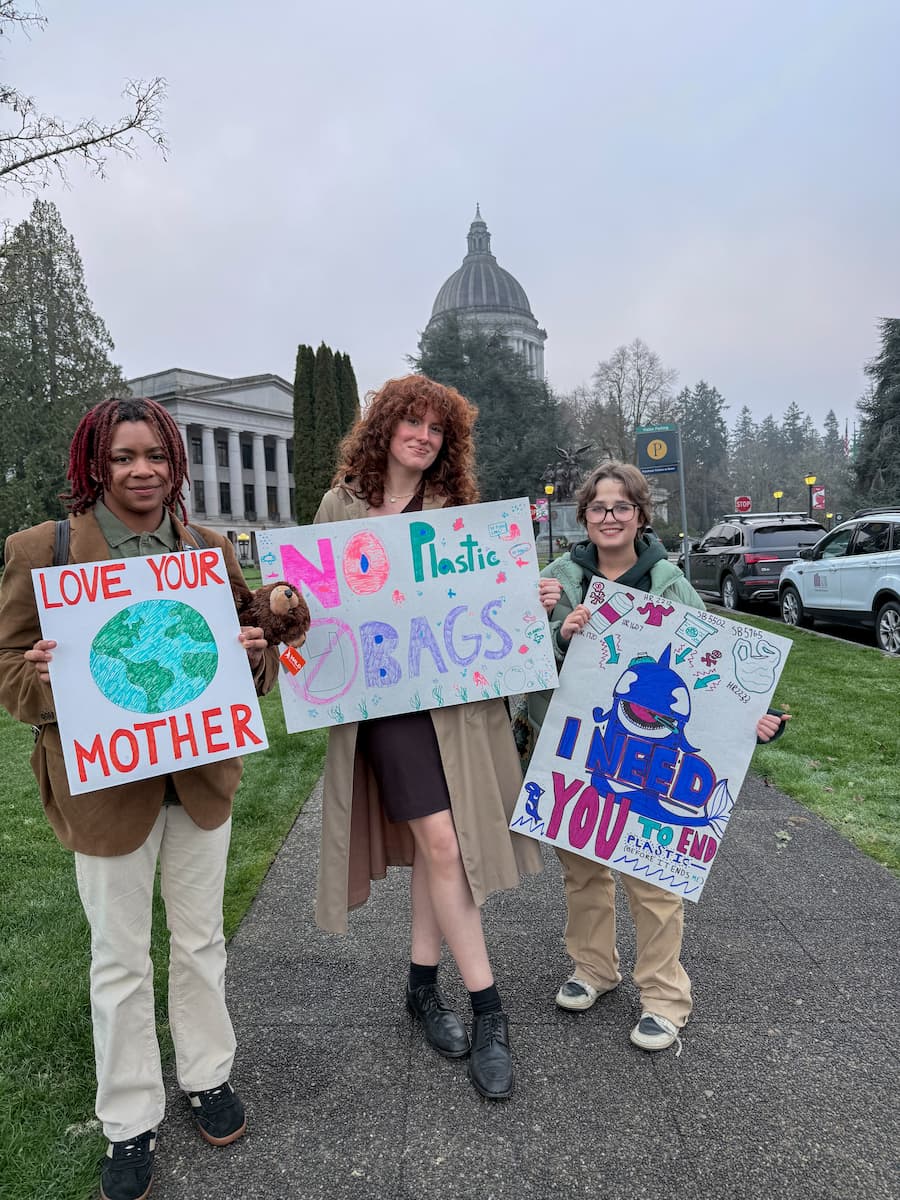
Handmade signs help amplify the message.
Learn more about our 2026 legislative priorities and how you can help advocate for our marine environment at the state and federal levels. You can also get notified about action opportunities by signing up for our policy action alerts.
If you or a high schooler you know wants to participate in advocacy opportunities like the ones described in this story, please go to the YOA webpage for more information. Recruitment for the new cohort of Seattle Aquarium Youth Ocean Advocates begins with orientation sessions in March.
From taking public transportation to taking shorter showers, the choices we make every day impact our one shared ocean. The Seattle Aquarium participates enthusiastically in that work. We’re committed to being a regenerative aquarium—one that gives back more to the environment than we take from it. We use our regenerative plan as a guide in this work.
This past year, the Aquarium made some exciting changes that allow us to operate our campus more sustainably—all while maintaining the highest quality of care for the animals here. From lowering our seawater usage to investments in renewable energy, read on to learn about this thrilling work.
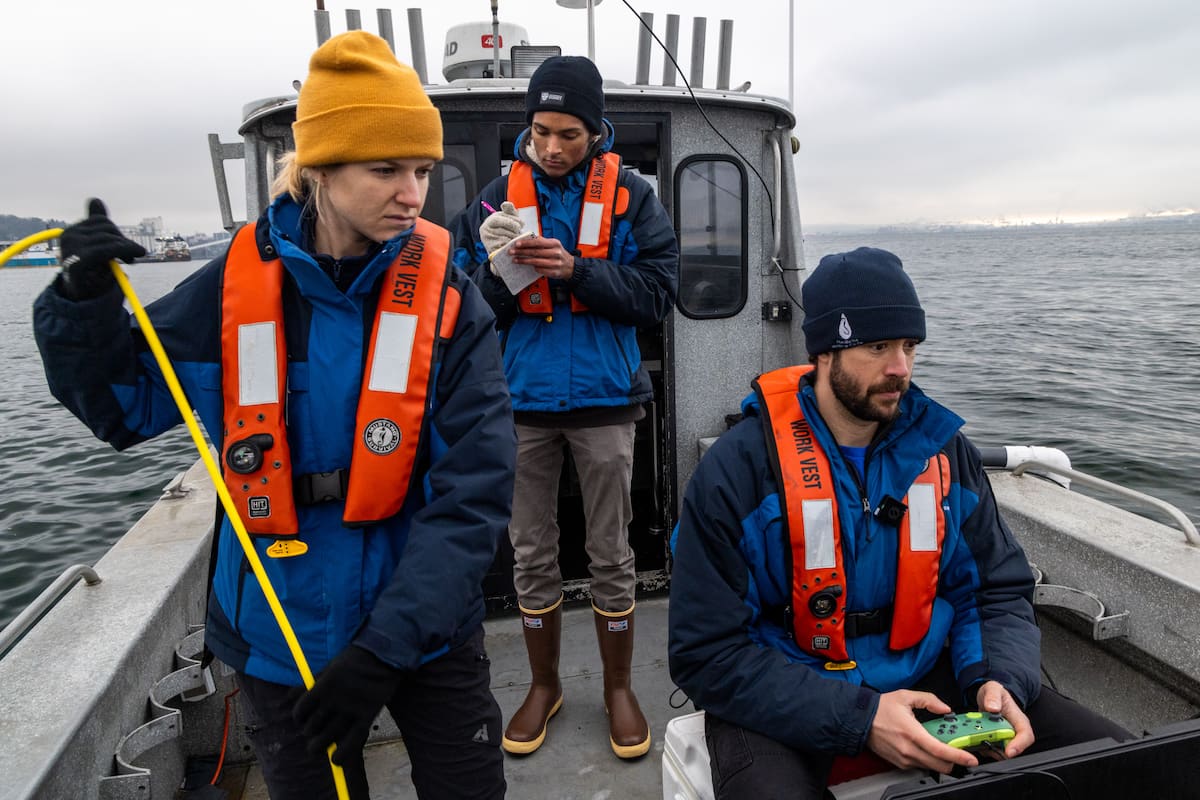
The Seattle Aquarium sources its seawater from Elliott Bay right below Piers 59 and 60.
Seawater may look abundant on our beautiful blue planet, but just like all other natural resources, it has to be handled with care.
The Seattle Aquarium has the unique ability to source the seawater for our habitats from Elliott Bay. For the habitats in Piers 59 and 60, which house animals native to the Salish Sea, water comes in from Elliott Bay, is treated, flows through the habitats and then back out to the bay.
This past year, our staff began gradually experimenting with reducing how much seawater enters our habitats. After every reduction, the water quality and animals in each habitat were carefully monitored for any changes in wellbeing. So far, we’ve managed to reduce seawater usage across the piers by about 24%.
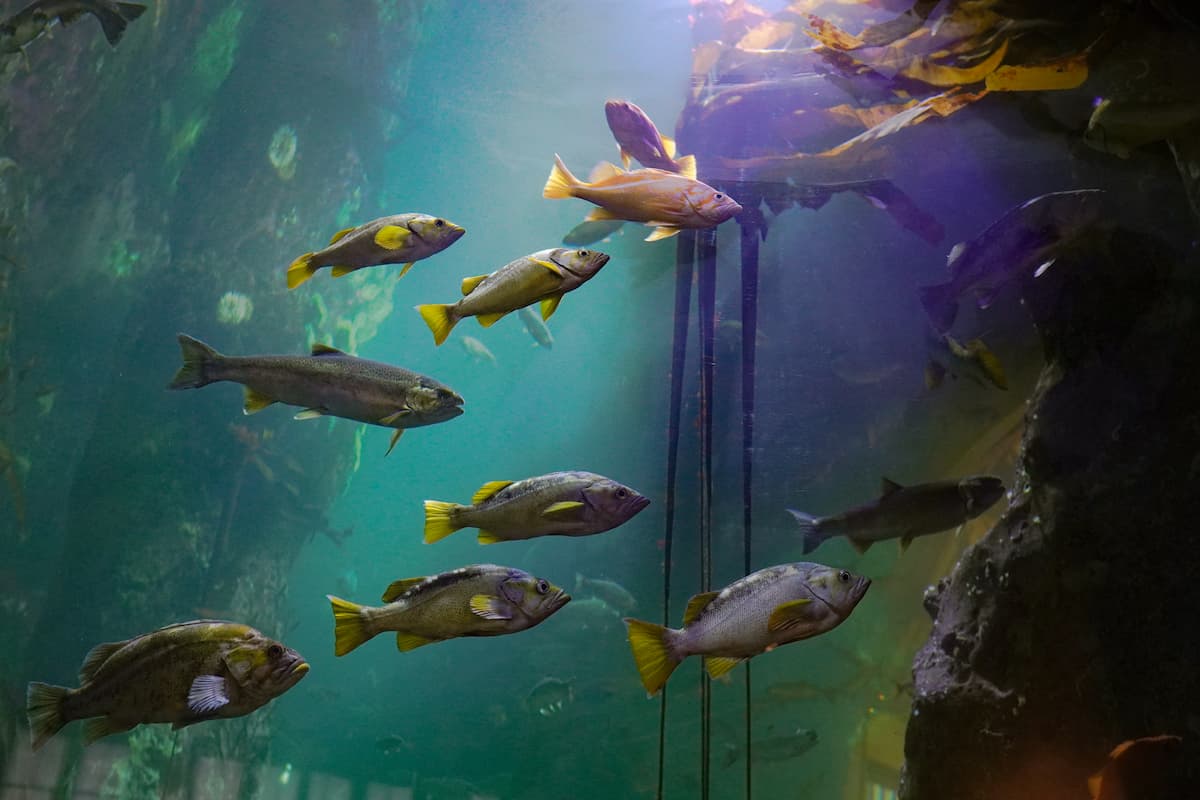
Flow improvements in Window on Washington Waters and other habitats contributed to strong reductions in seawater usage.
Less seawater pumping means less electricity usage—a serious regenerative win. And it also puts less stress on the pumping equipment, which means it will likely last longer.
And the project has allowed our teams to get a better understanding of the actual needs of our habitats, which means we can also be more accurate and resilient when planning for emergencies.
Did you know the amount of oxygen in seawater naturally fluctuates throughout the year? But the oxygen needs of our animal population remain the same. So, we often have to supplement the water with more oxygen.
For the past several years, the Aquarium has used large cylinders of liquid oxygen for this task. They work fine, but our team noticed some ways the system could use improvements. For one, the Aquarium empties oxygen tanks and receives replacements on a weekly basis, the transportation of which results in greenhouse gas emissions.
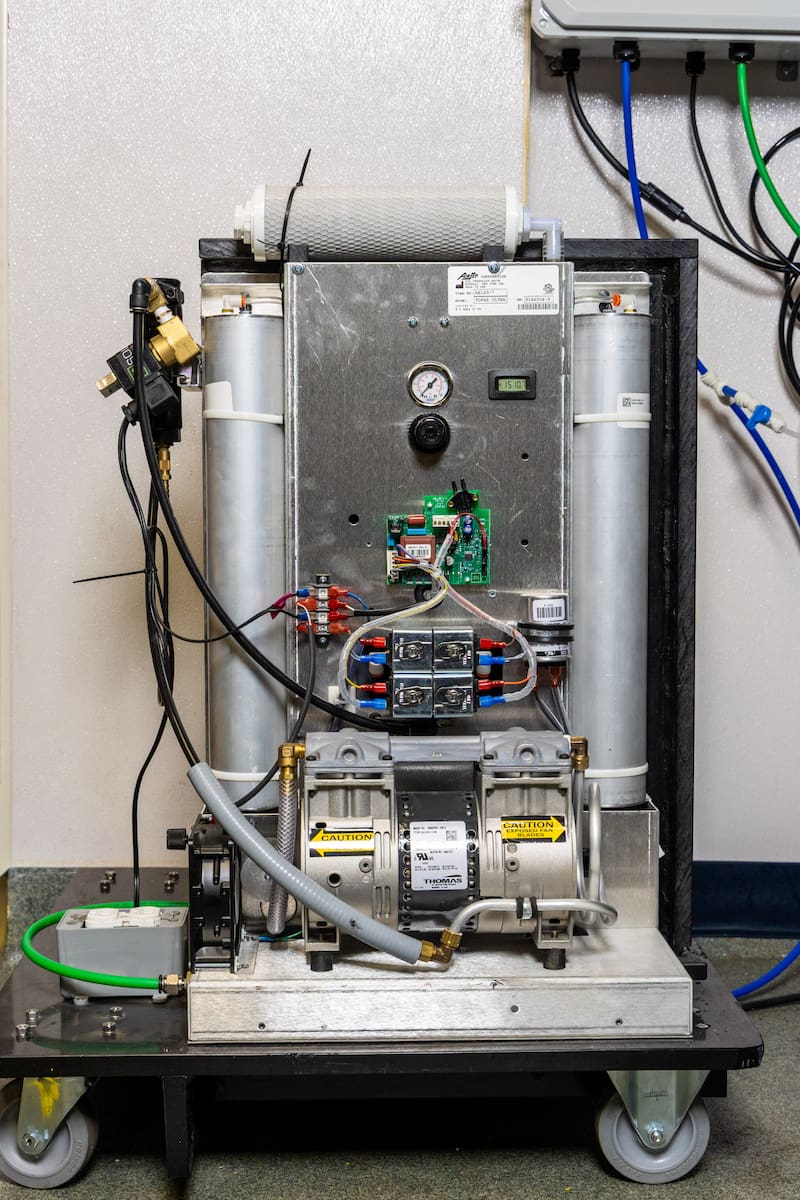
Enter, the oxygen concentrator. This machine works by taking in normal, everyday air and isolating the oxygen, filtering out nitrogen and other gases. That oxygen is then added into the Aquarium’s water and flows through our habitats.
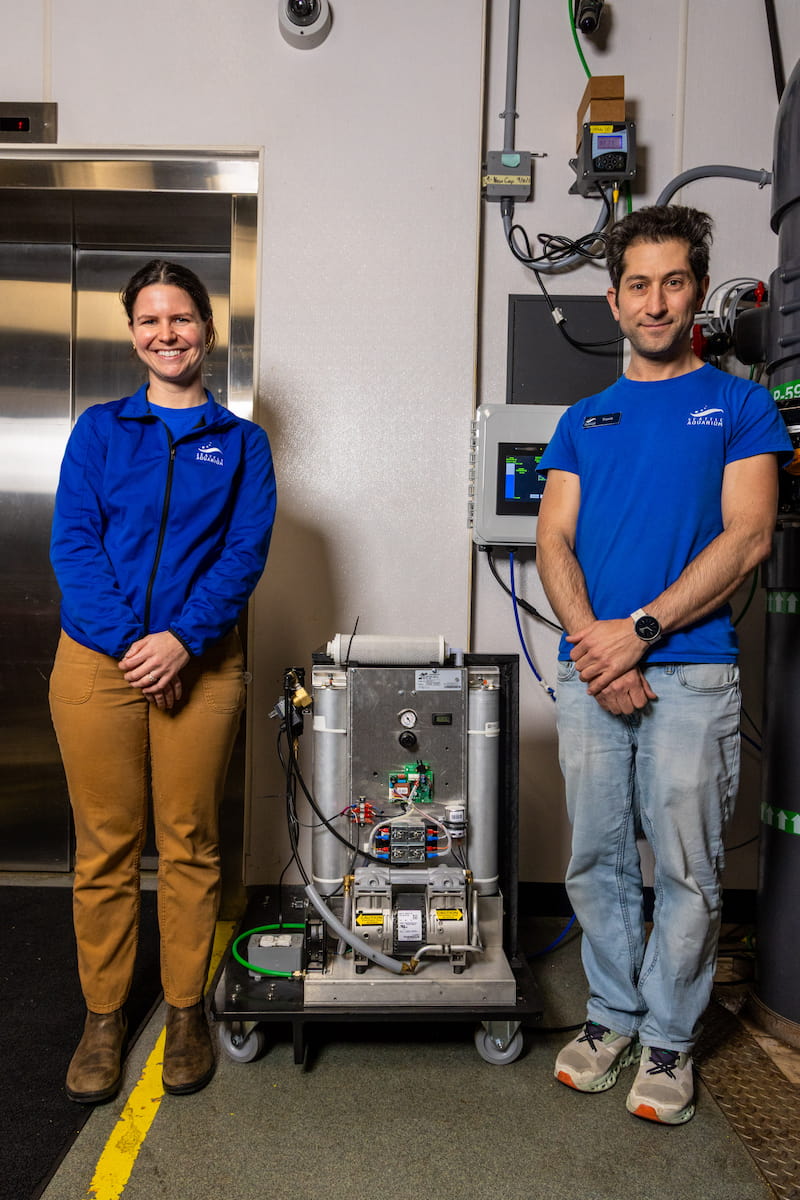
The oxygen concentrator installed in Pier 59 allows us to more efficiently and accurately adjust oxygen levels in the water of our habitats.
Unlike the liquid oxygen tanks, which require human monitoring and intervention, the oxygen concentrator has a sensor and can automatically adjust its output levels to meet the habitats’ needs in real time and to consistently maintain optimal oxygen levels 24/7.
The oxygen concentrator is currently in use for the water that goes to Pier 59’s Window on Washington Waters, Crashing Waves and most of Life on the Edge. The team facilitating the changes—led by Senior Water Quality Specialist Juliette Mason and Regenerative Manager and Life Support Technician II Travis Snyder—is looking forward to expanding the project in 2026 to reach the piers’ other habitats.
Senior Water Quality Specialist Juliette Mason (left) and Regenerative Manager and Life Support Technician II Travis Snyder lead the oxygen concentrator project.
Because the Ocean Pavilion is a closed-loop system, it operates with a water treatment system that maintains oxygen levels as the water recirculates, so an oxygen concentrator isn’t necessary there.
In 2025, the Seattle Aquarium signed a power purchase agreement with Seattle City Light. Essentially, this means we agree to purchase solar power from a newly built facility to replace our current electrical use, thus adding additional renewable energy capacity to the local electric grid. The agreement is scheduled to go into effect soon and last for 15 years.
This power purchase agreement represents one step in our regenerative journey. In past years, the Aquarium has done a lot of work to more sustainably run our campus, from designing the Ocean Pavilion to be fossil fuel free to making changes in Pier 59 that dramatically reduced our natural gas usage.
To engage in regenerative work is to live focused on the future. And with a team full of dedicated conservationists supported by our thoughtful community, the future of sustainability is looking bright at the Seattle Aquarium. Follow along with our progress on our Sustainability page!
There’s something new to discover on the Ocean Pavilion’s public rooftop—that is, in addition to the native plantings and sandblasted images designed by, respectively, traditional ecological knowledge-keeper Valerie Segrest (Muckleshoot) and Owen Oliver (Quinault/Isleta Pueblo).
A recently installed sign offers an overview of the types of canoes used by members of the Muckleshoot Tribe to traverse the waters of the Salish Sea—and beyond—for thousands of years, as well as a glimpse into the importance and tradition of canoe culture.
The newly installed sign anchors stunning views of the Salish Sea from the Ocean Pavilion’s rooftop.
The placement of the sign on the rooftop is intentional. As Muckleshoot Tribal Council Chair Jaison Elkins noted upon the announcement of our partnership with the Tribe in 2024, “This partnership reflects the Tribe’s deep connection to the Seattle waterfront where our ancestors celebrated the return of the salmon since time immemorial.”
To learn more about the history and significance of q̓il̕bid (“canoe” in the Muckleshoot language) culture, we recently spoke with several members of the Muckleshoot Tribe, who generously shared their thoughts with us.
Q: Can you tell us more about the Tribe’s history of traveling by water?
A: “Traveling by water was how we would get around, and I was told that’s why we have our paddle songs. When we would visit other tribes, we would sing so that they would hear us and the tribes would know who we were by which song we were singing.”
—Salena Jackson, Performance and Regalia Specialist
Eagle Spirit on the Canoe Journey leaving Lummi Island, headed for Samish Island. Photo courtesy of Adrian Markantonatos.
Q: The new sign features seven types of canoes, each with a specific purpose. What does that range say about the Tribe’s connection to water? How has that connection shifted over time?
A: “The variety of canoes speaks to the significant relationship we have, and historically have had, with water and the waterways. Just like how you’ll see different types of vehicles driving down the highway, each with a specific purpose—those waterways were our traditional highways, so in the same way, there would be a dynamic range of canoe styles.
We’ve lived in this area for thousands of years in such close proximity to the water, that it made sense to travel this way. It’s even reflected in our language—directions are given in relation to where the water is. As for the shift, we’ve seen a lot of changes but we’ve also held onto parts of our identity—one of those being our relationship with the water.”
—Sam Obrovac, Cultural Arts Coordinator, Muckleshoot Tribe
Muckleshoot carving team and Adult Work Training Program participants working on a cedar-strip canoe to give away at Canoe Journey 2023, Muckleshoot, Auburn, Washington. Photo courtesy of Sam Obrovac.
Q: The sign notes that the canoes are considered to be living beings. Can you tell us more about that?
A: “We treat the canoes like they’re living; we give them names that fit them because the canoes have a spirit. We introduce ourselves to them when we get on, and I’ve had a lot of conversations with those canoes. I talk to them just like a person. They’re like our babies; we take care of them and they care of us. Just like a newcomer in a family—the new canoes are our babies, and they go through cycles in their lives. Our new canoe, tubšedad, has a mind of his own.”
—Autumn MaGee, Canoe Family Manager
Napolean Ross blessing a shovel-nose canoe on the Green River.
Q: What else would you like people to know/understand about the Muckleshoot Tribe’s q̓il̕bid (canoe) traditions?
A: “This is how we hunted, this is how we fished, this is how we lived—reconnecting with that way of life is contagious and it keeps growing. Being out on the water and hearing those strokes, hearing the animals, hearing the water—that’s my peace.”
—Corey Ward-Jerry, Cultural Food Specialist
Canoe practice on Eagle Spirit at Gene Coulon Park, Renton, Washington. Photo courtesy of Corey Ward-Jerry.
Q: What opportunities do you see through the Tribe’s partnership with the Seattle Aquarium?
A: “I see a lot of learning opportunities for our youth to engage with this field of knowledge—having them potentially lead into careers in marine biology, or even just connecting with their natural environment. The idea that what we do affects the rest of the world and how we have to take care of the water.”
—Stephanie James, Culture Program Director
“Our ancestors tended to this land and defended this land. They have given us strength and wisdom, which empower us to continue inhabiting and caring for our lands while gathering resources, traveling the Salish Sea and fishing these waters. We are resilient; we are Muckleshoot.”
—Muckleshoot Tribe
We thank Salena, Sam, Autumn, Corey and Stephanie for contributing their wisdom and perspectives—as well as Sam, who closed with these beautiful words: “Witnessing this cultural resurgence, back to our Salish customs and identities, is a beautiful thing. It really is healing and powerful to see, and there are lots of additional people to thank who either held onto knowledge or went out and got it to share with the rest of us.”
To learn more, visit the Muckleshoot Tribe website and explore the collection of videos related to the annual Canoe Journey. Then, plan a visit to the Seattle Aquarium and make a stop on the rooftop to see the new sign. While you’re there, take a moment to gaze out at the waters of the Salish Sea and imagine the many generations of canoes that have crossed its waters.
Have you heard the news? The northern sea otters in our care, Mishka and Sekiu, have a new habitat-mate! Ten-year-old southern sea otter Ruby joined us on November 19, moving from her former home at the Monterey Bay Aquarium (MBA).
Welcome, Ruby!
Ruby was found, stranded, as a newborn pup in September of 2015. Weighing just 1.9 pounds, she was one of the smallest pups her rescuers had ever seen.
She was raised behind the scenes at MBA in their sea otter surrogacy program. After several attempts at having her live on her own in the wild, the team at MBA found that she had become dependent on humans for food. She was ultimately deemed non-releasable by the U.S. Fish and Wildlife Service and went on to join MBA’s sea otter habitat in 2022—where she charmed guests and became a beloved ambassador for her species.
Ruby getting to know her new habitat at the Seattle Aquarium.
For months, our care team worked closely with MBA’s, shadowing their care of Ruby, learning about her history, likes and dislikes, social needs and more. Collaboratively, the teams decided that our otter population would be a great fit for her.
As we mentioned above, Ruby is the first southern sea otter in our care. Southern sea otters are considered a distinct population. And, while southern and northern otters don’t share wild habitats, they do happily cohabitate in zoos and aquariums—their care needs are identical.
(What’s the difference between northern and southern sea otters? It basically comes down to two things: their range and their size. Northern sea otters have a range from Washington state to British Columbia and Alaska. Southern sea otters are found in California. And northern sea otters are larger, with males weighing up to 100 pounds and females up to 70—while southern males top out at about 65 pounds with females around 45 pounds. For context, Ruby’s current weight is 44 pounds; with Mishka at 50 and Sekiu at 54.)
Ruby relaxing with Sekiu.
After making the journey to the Seattle Aquarium on November 19, Ruby was quickly introduced to her new habitat—and then to Mishka and Sekiu. In short, things have been going swimmingly!
Comments Senior Animal Care Specialist Kelli Lee, “When introducing an animal into a new habitat, we expect them to be active and explore every inch. After they’ve had a chance to check out their space, we look for behaviors that show they’re comfortable, such as resting and eating. For sea otters specifically, we also look to see that they’re grooming, since that’s essential for staying warm.” (Learn more about how amazing sea otter fur is on our sea otter webpage!)
Kelli continues, “When introducing sea otters, we expect them to interact with each other by sniffing each other’s faces and heads. Then, after this typically brief interlude, we continue to make sure they’re all grooming, eating and resting.”
“They’ve been cohabitating well,” says Animal Care Specialist Michelle Munoz. “Ruby tends to follow Sekiu the most. You can see her resting with Sekiu in the main habitat, and at night, Mishka and Sekiu will haul out on deck by their mats, so Ruby will join them.”
Ruby, we’re so glad you’re here!
Ruby’s preferences quickly became clear to her caregivers. Notes Kelli, “Ruby enjoys interacting with enrichment, such as puzzle feeders, a lot. Her favorite food is shrimp and her least favorites are surf clam siphons and stomachs.” (Can you blame her?)
She adds, “When spending time outside of feeding sessions, she likes to rest in areas of the water that are shallow, such as the arch between the two habitats.” Want to see what she’s up to? Check out our live webcam!
In the weeks and months to come, we’ll continue working with MBA as we learn more about Ruby. “Getting her comfortable in the space is our priority so she can do all the things a sea otter does—like grooming and eating,” comments Michelle. “Building a relationship with Ruby will help us work with her in the long run and also allows us to start training new behaviors with her!”
For 30+ years, the Seattle Aquarium has led in the research of sea otters in Washington and contributed to recovery efforts with partners and collaborators around the world. We also have a long history of caring for individual northern sea otters who are unable to live in the wild.
Ruby’s arrival represents our continued commitment to sustaining and recovering sea otters, from California to Alaska and beyond. As a nonprofit, this work—both in the field and right here at the Aquarium—is only possible thanks to the support of our community. Every visit to the Aquarium supports this work and our conservation mission overall. We thank you!
We can’t wait for you to meet Ruby. Plan your visit today!
We recently introduced you to three amazing Seattle Aquarium volunteers who show their connection to the marine environment with meaningful tattoos. The story was so nice that we’re doing it twice—we’re back with three more fascinating folks who graciously agreed to share the stories behind their ink.
Without further ado, please meet Chelsea, Chris and Taylor! And if you haven’t already checked out earlier installments of this ongoing series, we invite you to explore part 1, part 2 and part 3.
“I feel like I'm in the right place at the right time, doing the best I can with what I have. That applies to being at the Aquarium, being in my work and being in the sea. It's like a Venn diagram of those.”
—Chelsea “Chelseal” Lee (she/her)
I got my seal of approval last year. He’s positioned so that when I give a thumbs up, he gives one too.
I’m an open-water swimmer—unassisted, which means no wetsuit, flippers or paddles. Just a swimsuit. I train at Alki Beach and seals swim along with me all the time. I always introduce myself and let them know I’m here to respect their space, not cross any boundaries between wild animals and something I want to hug.
I did my first marathon swim in 2021, in Sitka, Alaska. There’s a doctor at that event and she was amazed because it had taken me almost four hours but I wasn’t cold at the end. She said, ‘How are you not freezing? I think you might be a seal person.’ She started calling me Chelseal and it kinda stuck.
It’s been such a beautiful journey to build a relationship with the Salish Sea. I was born on the south coast of South Korea, adopted by white people and raised in Minnesota—just about as far from the ocean as you could be. But I always felt like it was calling me back. The first time I went in, I thought, ‘Ohh, this is what home feels like.’
I work for a nonprofit doing policy and systems change advocacy around affordable housing, community spaces and equitable access to public transportation. One thing that I talk about with people at the Aquarium, my conservation message, is the ability to coexist.
If you look at the animals in The Reef at the Ocean Pavilion, everybody’s able to coexist because they’re all getting their needs met. And when I talk about that with visitors, I bring in my work life and say, ‘Imagine if we did that for people.’ I hope that I’m planting a seed with that.
—Chelsea “Chelseal” Lee (she/her)
Tattoo by Berger, @wizardcitytattoo
“I realized that you don't have to work in this field to still be at the Aquarium and be a valued member of the community.”
—Chris Fitch (he/him)
I’ve lived in Seattle, close to the water, my whole life. When I was a kid, we’d go to a cabin that my grandpa built on the Oregon coast every summer. That’s where I learned about tide pooling, one of my favorite pastimes.
Going into college, I wanted to be a marine biologist. I started taking chemistry but it just doesn’t work for me. Then I learned about the pastry program at Seattle Central. I’d always been a fan of baking, so I went for it. Now I work at a bakery and I’ve been volunteering at the Aquarium for over a year.
I mainly volunteer at the touch pools. I love all the animals. It’s like tide pooling, but indoors and a bit more static. Working with kids is the best, especially the occasional 6-year-old who knows more than I do. It’s fun to talk with them as their parent tries to follow along while we’re both having a great time.
The people on my shift are always looking for nudibranchs, and it’s amazing when we find them together. It’s also cool for guests to see that there are animals here that surprise us—that it’s a living environment and we’re not controlling every single thing.
The lobster was my first unplanned tattoo. I went to L.A. to get a sandhill crane from an artist down there but she had to cancel. I was really bummed and went to Aquarium of the Pacific to make myself feel better. The lobsters made a big impression on me.
Later that day, an artist popped up on my feed who had done a spiny lobster* before. He was nearby and could get me in right away. It went from not working out to me having this great tattoo inspired by the lobsters at Aquarium of the Pacific. Lucky.
—Chris Fitch (he/him)
Tattoo by Noah Fox, Boartooth Tattoo, Culver City, CA, @noahfoxtattoo
*Editor’s note: Curious about what a Pacific spiny lobster looks like in real life? Visit our Ocean Pavilion!
“I stopped eating king and Chinook salmon when I learned about the low population of the southern resident orcas. I’ll still eat other kinds but not those. I want to save them for our residents.”
—Taylor Welch (she/her)
I’ve always been a huge animal person. I love orcas—just love how pretty they are. My grandma has a vacation home on Whidbey Island and every time there’s an orca sighting, she texts to tell me. It’s always the day after I leave. But I was actually here at the Aquarium for an orca sighting in Elliott Bay last spring. It was my first time seeing them in the wild after living in Seattle for 33 years.
I’ve been volunteering here for seven years and I’m still learning new things about some of the animals. I’m trying to do all the habitats, but I mostly like to be near the touch pools.
I love interacting with the guests. My favorite part is telling them about the sea cucumbers because they’re the vacuum cleaners of the ocean floor and they poop out clean sand, which kids love learning. I say, ‘Thank the sea cucumbers because this is their ecosystem and they’re doing us all a favor.’
I also assist with the volunteer program, doing interviews with potential new volunteers. I look for people with great energy. We talk about why they want to volunteer—some want to share their knowledge, others want to give back to the community, some just want to do something fun. We have a very unique ecosystem here and it’s cool when people want to get involved, help other people learn about it.
I graduated from UW two years ago, in environmental studies. I’ve been working part-time in the Gift Shop since then and I’m hoping to find a full-time job at the Aquarium. I’d love to do an outreach education program or be a marine interpreter supervisor here someday.
—Taylor Welch (she/her)
Tattoo by @dannychantattooseattle
We thank Chelsea, Chris and Taylor for sharing their stories with us—and all the volunteers who generously give their time in support of our conservation mission.
Seattle Aquarium volunteers share their knowledge and enthusiasm with our guests, help prepare meals of sustainable seafood for the animals in our care, dive in our habitats, meet members of the public on local shorelines and much more. Interested in learning about the program and potentially becoming a volunteer yourself? Check out our website!
It is with great sadness that we announce the death of river otter Ahanu. He passed away unexpectedly during a routine sedated exam on the morning of November 5.
Ahanu, who came into our care in 2019, was beloved by Aquarium staff and volunteers—as well as the many thousands of Aquarium guests who loved watching him at play. Photo courtesy of Senior Animal Care Specialist Kelli.
Throughout his life, Ahanu had undergone numerous exams just like this one. Before the exam, he had been eating and playing normally. The sedation and exam itself went well, and he was stable throughout.
Sadly, sedation for any animal carries inherent risks and after the anesthetics were reversed, Ahanu did not rouse. Our full Veterinary team, along with several members of our Bird & Mammal team who were assisting with the exam, immediately began life-saving measures. After 50 minutes of CPR and multiple rounds of medications and assessments, the team made the difficult call that Ahanu had passed.
He hadn’t previously shown any respiratory symptoms—such as trouble breathing—but, during the X-rays and ultrasound that were part of the exam, our team discovered that one of Ahanu’s lungs showed abnormalities. We don’t yet know whether this affected his passing; it’s one of several questions our care team will be looking into as they perform his necropsy.
Ahanu’s name means “he laughs” in the Algonquian language—and it’s no surprise that he captured so many hearts: He was born on Valentine’s Day in 2011 at the Oakland Zoo. He was transferred to the Denver Zoo at age 2 before coming into our care in 2019.
Ahanu joined us as a habitat-mate for Molalla, who had been living solo after his companion, a geriatric river otter named Skagway, passed away several months before.
Ahanu (at right) cozying up with his habitat-mate, Molalla—affectionately known as Mo by his caregivers—in their habitat’s den. Photo courtesy of Senior Animal Care Specialist Kelli.
In zoos and aquariums and in the wild, the social structures of male river otters vary— they may live with their litter mates, alone, in bachelor groups (like the one formed by Ahanu and Molalla)—or even, temporarily, in family groups for breeding purposes. North American river otters are managed under an Association of Zoos and Aquariums (AZA) species survival plan—through this program, animals are transferred to AZA-accredited zoos and aquariums around the country to mimic species-specific social movements and enhance population sustainability and genetic diversity.
River otters have life spans of eight to 15 years in the wild; in human care (thanks to consistent veterinary care, readily available food and protection from predators), they may live for 15 to 20 years. At nearly 15 years old, Ahanu was entering his senior years—but he was still known for his playful antics, not to mention a voracious appetite.
Remembers Veterinary Technician Erika Russ Paz, “I always enjoyed going up for a training session with Ahanu and watching him chow down. River otters are extremely cute when they eat but have no manners. They just toss their heads back and chomp down on their food with mouths fully open, then stare at you insistently for their next piece.”


Ahanu devouring a special ice treat, stuffed with some of his favorite foods. Photos courtesy of Senior Animal Care Specialist Taylor.
Ahanu not only delighted the hundreds of thousands of Aquarium guests who watched him at play—he also helped people learn more about the importance of his species in the broader scope of ocean health.
“With grace, agility, and enthusiasm Ahanu introduced millions of people to the charismatic nature of North American river otters. He moved people to care about his species, and the aquatic environments we share,” says Seattle Aquarium President & CEO Peggy Sloan.
She continues, “North American river otters represent a conservation success story. Nearly wiped out by the fur trade, they recovered due to successful reintroductions and habitat protection. Today these otters thrive in Washington. Ahanu’s story is one of environmental optimism and conservation success. His loss is felt by his care team and his large fan base—and these emotions mix with gratitude for the joy, empathy and action he inspired over many years in our care.”
When Vice President of Animal Care Lisa Hartman announced Ahanu’s passing to our staff, she noted, “Losing an animal is one of the hardest parts of our work, and it can be especially hard to navigate when the loss is unforeseen. Our teams provided Ahanu with the utmost care before, during and after the exam. Just as in our own lives, sometimes loss happens quickly and without warning.”
Ahanu’s loss is deeply felt by the devoted caretakers who knew and loved him over his years with us. Remembers Animal Care Specialist Ana Ibarra, “Ahanu was always up for a treat. Whenever we called the boys to feed them, Ahanu would be the first one to head up—but oftentimes he had to come back to their den and wake up Mo so they could go together.”
Former Supervisor of Birds & Mammals Aubrey Theiss shared some thoughts too. “Ahanu, I hope you’re blowing tons of raspberries, scratching everything you see, peeping at salmon, climbing trees and scaring hummingbirds, chewing rib bones, chasing minnows and digging all the holes. RIP, you crazy little guy.” And, from former Senior Animal Care Specialist Cheryl Becker, “Rest in peace, sweet boy. He always used to make me laugh at how he would partially sit on tubs—it looked like he was a lounging mermaid.”
Ahanu and Mo enjoying a cold plunge together. In the wild, river otters make their homes in a variety of habitats, near both marine and fresh water. Video courtesy of Animal Care Specialist I Anthony.
Ahanu’s current caretakers are now working to ensure that Molalla, Ahanu’s habitat-mate, receives extra support during this change. As noted earlier, it can be natural for males of this species to live alone—and we’ll be sure to provide updates in the future with any news of a new companion for Molalla.
In the meantime, we invite you to check our social media channels for more photos and to share your own memories of Ahanu. Thank you for joining us in our grief. Ahanu will be deeply missed.
Join us for After Hours: Going Green to explore the Aquarium at night and celebrate our beautiful blue and green planet!
Today only, your gift will be matched dollar-for-dollar up to $25,000 thanks to the generosity of donors Betsy Cadwallader, J & Tim, and Jess & Andy Peet. Help us reach our $50,000 goal!