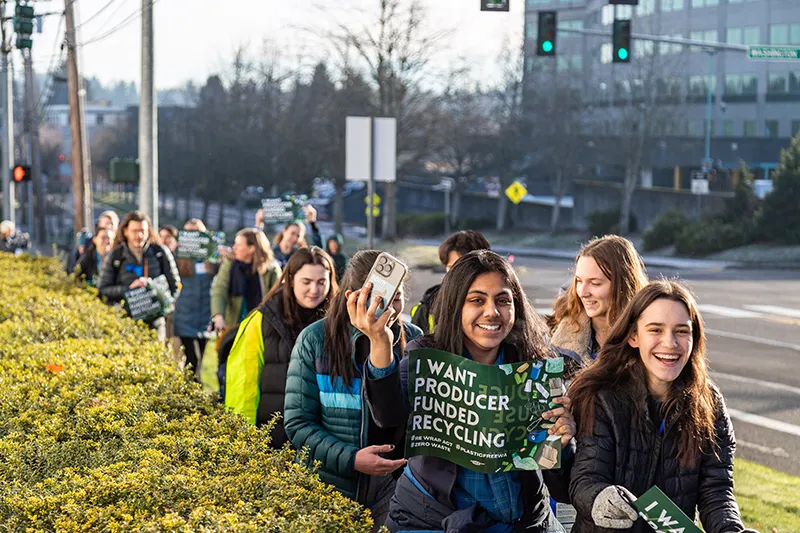
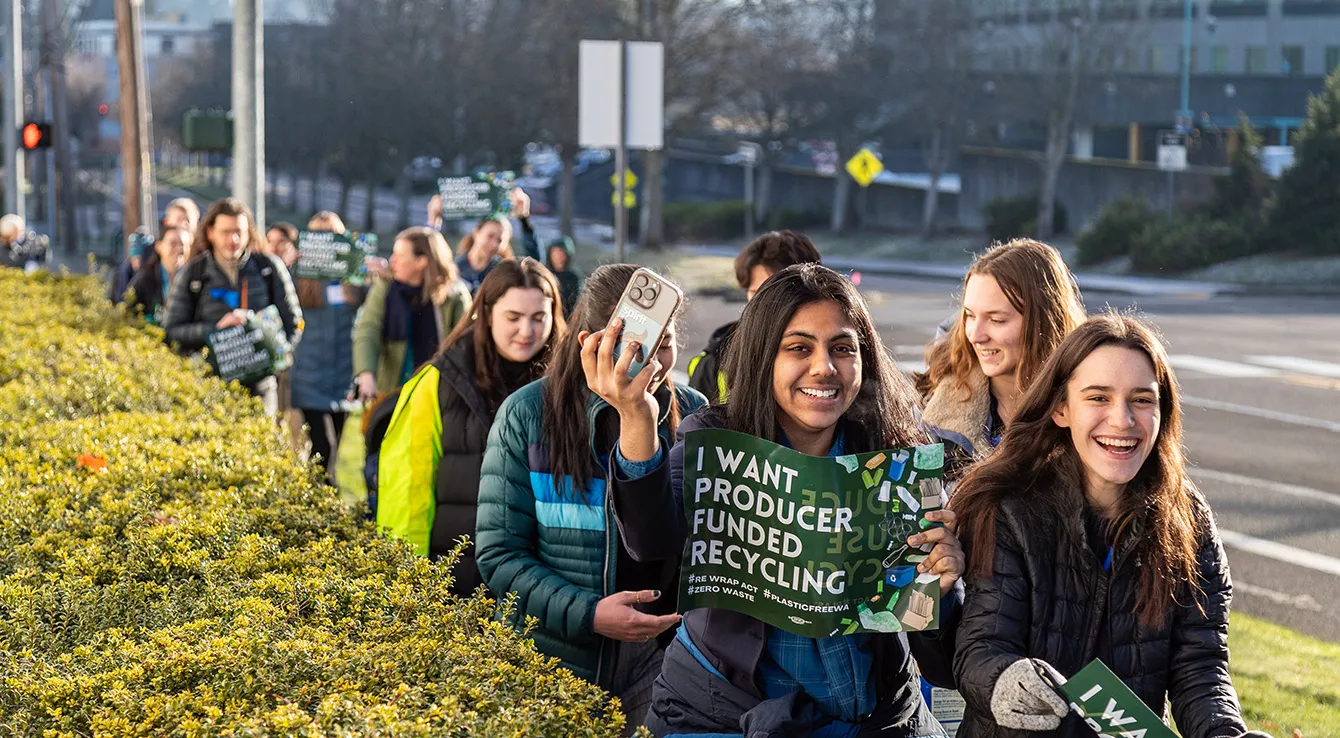
Youth Ocean Advocates march with other Washingtonians in support of the ReWRAP Act, a producer responsibility bill for recycling. Credit: Ricky Osborne.
On January 15, our Youth Ocean Advocates (YOA) traveled to Olympia to show their support for the ReWRAP Act by participating in a constituent lobby day. The Seattle Aquarium collaborated with our Plastic Free Washington Coalition partners to gather nearly 100 Washingtonians to discuss with legislators how this bill will reduce waste and marine plastic pollution by transforming our state’s recycling system.
The ReWRAP Act (HB 2049/SB 6005), sponsored by Rep. Liz Berry and Sen. Liz Lovelett, will comprehensively increase recycling rates, incentivize more sustainable packaging design and ensure that all Washingtonians have access to free curbside recycling. Packaging producers will be financially responsible for the end-of-life costs of their packaging, a policy that other states like Maine, Colorado, Oregon and California have already passed.
Having learned about the intricacies of the bill to prepare to speak with legislators, Ellen, a 17-year-old from West Seattle, believes the bill will “revolutionize recycling in Washington.” For her, “It seems like it will kind of restore hope in the whole initiative of recycling and ideally shift the burden of protecting the environment more to the corporations who are responsible for manufacturing those materials in the first place.”
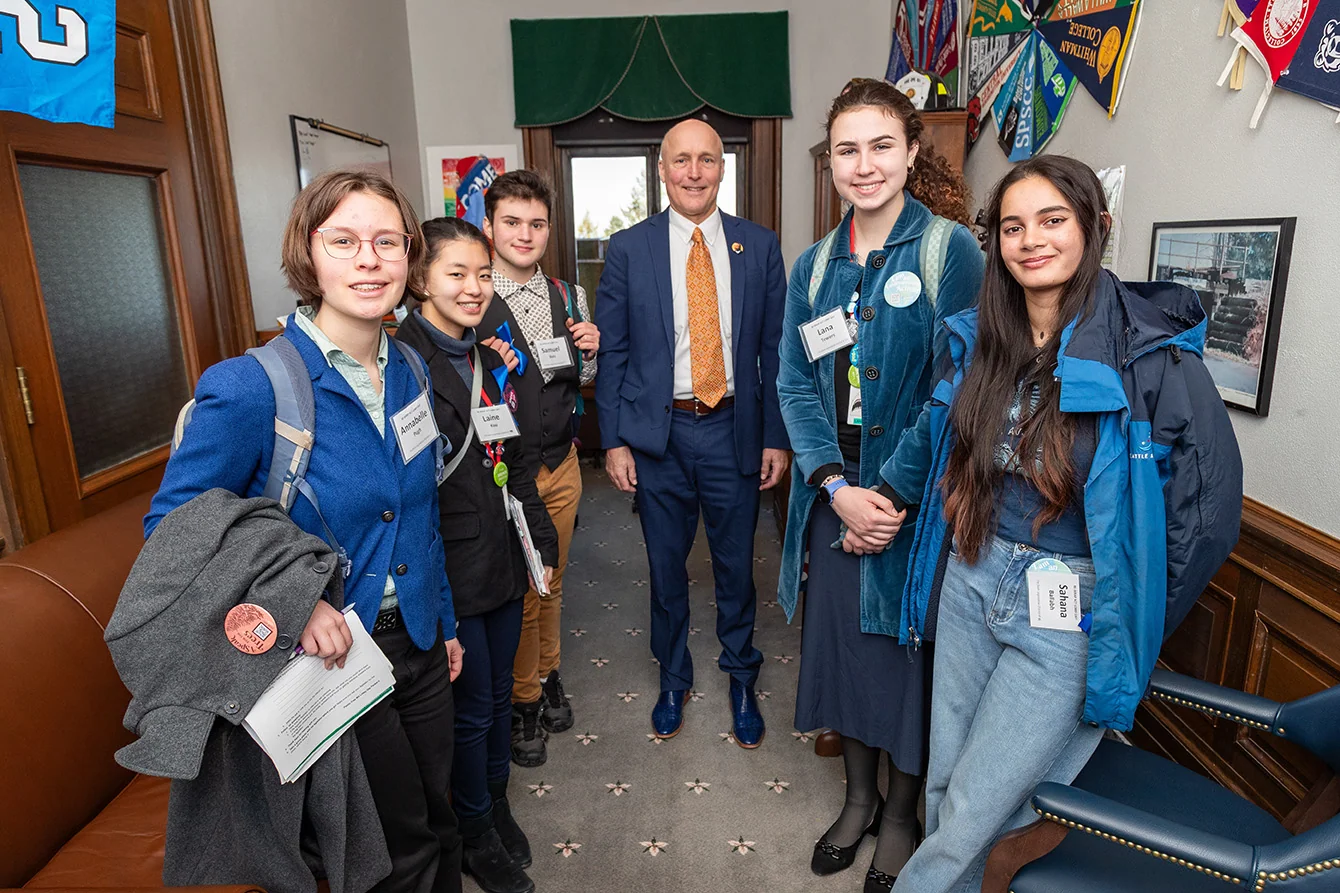
Youth Ocean Advocates meet with Syd Locke, Rep. Steve Bergquist’s Legislative Assistant, to discuss the ReWRAP Act. Credit: Ricky Osborne.
The lobby day volunteers organized over 70 meetings with state senators and representatives to encourage support for the ReWRAP Act. Together, 16 YOAs attended 12 meetings! Samuel, a 16-year-old from Redmond, found it “really empowering to be able to interact with the people who are helping put this legislation forward within our state and therefore be part of that process as well.”
In meetings with their legislators, YOAs spoke about their personal reasons for wanting ReWRAP to pass. Ellen went to Olympia to share with her legislators that she is “really passionate about ocean conservation and advocacy,” to contextualize how important this bill is to her. In her meetings, Cristina, a 17-year-old from Auburn, spoke about how this bill will make sure everyone has access to recycling services. She said, “A lot of the times in environmental policy, the focus can be put on the consumers when so much of pollution is coming from large corporations, so this really is taking pressure off the consumer or small businesses.”
Though meeting with a representative can seem intimidating, Annabelle, a junior who attends a high school in Seattle, found that “legislators want to hear from you.” She wanted to encourage others to “just be confident in yourself and use your power as a Washington resident.”
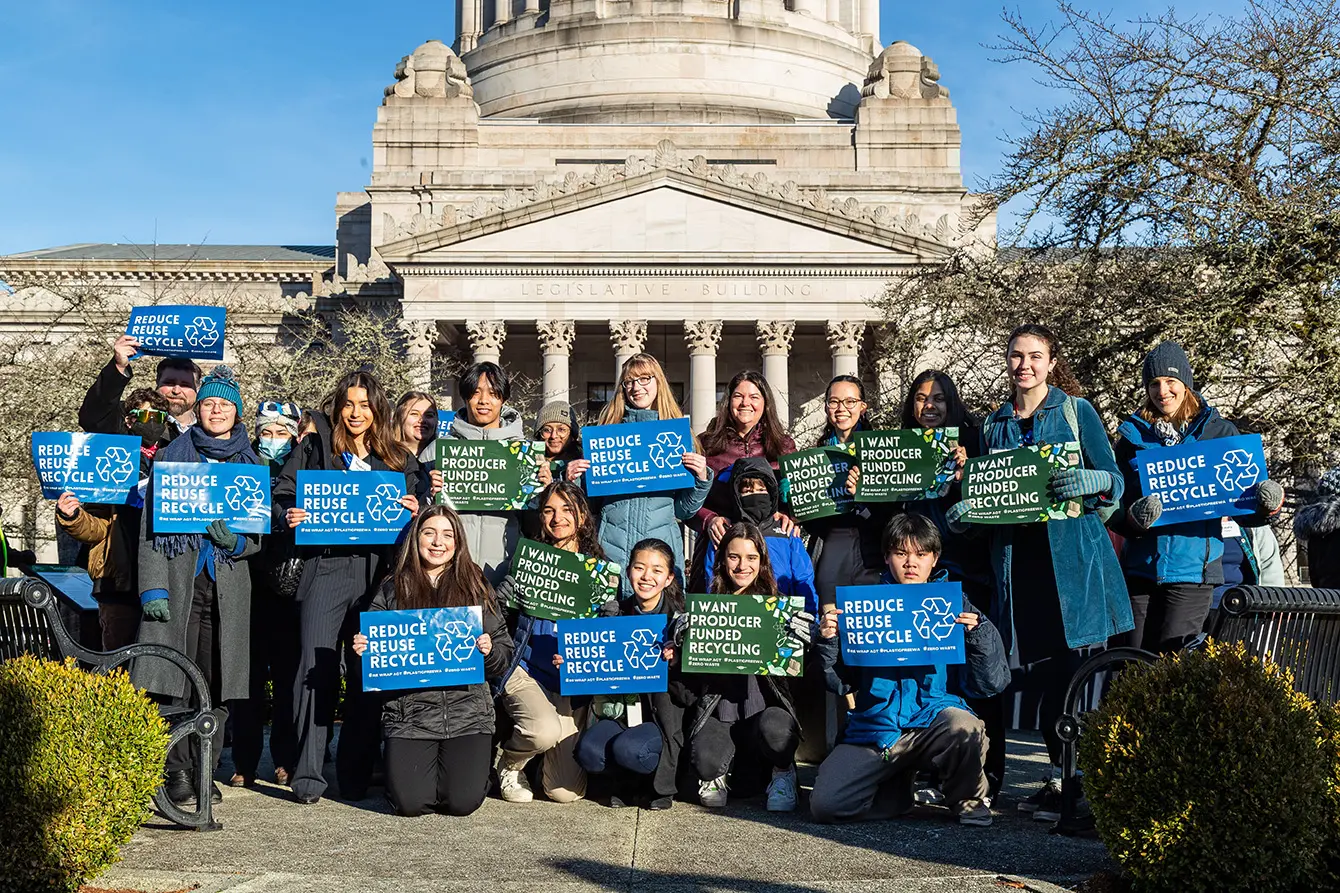
Youth Ocean Advocates and Seattle Aquarium staff pose with Rep. Liz Berry in front of the Legislative Building. Credit: Ricky Osborne.
After marching across the Washington State Capitol Campus in nearly freezing temperatures, our YOAs and other lobby day participants got to hear from Rep. Berry, an environmental champion who has worked closely with many stakeholders, including the Aquarium, to advance this bill in the House. Representative Berry underscored the importance of youth engagement in policy. Lac, age 15, came away from the day feeling that “what you do does matter in terms of ocean pollution and (young people) are the future of our society.”
The YOAs also attended a House Education Committee hearing, where they got to listen to other young advocates testify on bills related to middle and high school curricula. Claire, a high school senior from Seattle, found it inspiring to hear other kids testify in that hearing “getting to see younger generations involved in this sort of thing is really important and just very exciting to see.”
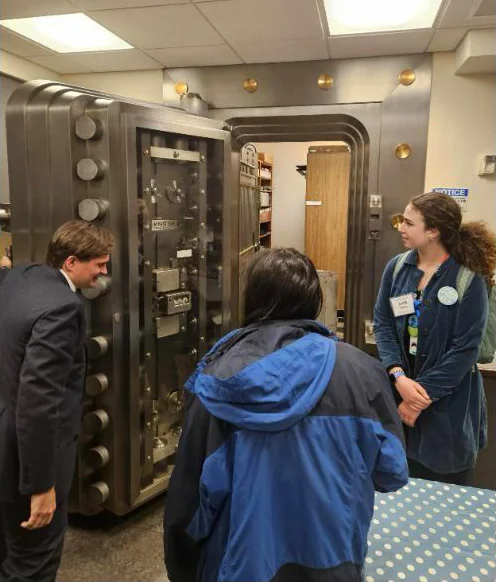
Youth Ocean Advocates on a tour of the state vault with Washington State Treasurer Mike Pellicciotti. Credit: Nora Nickum.
The YOAs also met with Washington State Treasurer Mike Pellicciotti and had a chance to check out the state vault. Sonia, a 17-year-old from Seattle, learned that “there are many different ways to become involved in politics, whether that’s being a treasurer or being a legislator or attending hearings…there are different ways to advocate your message.”
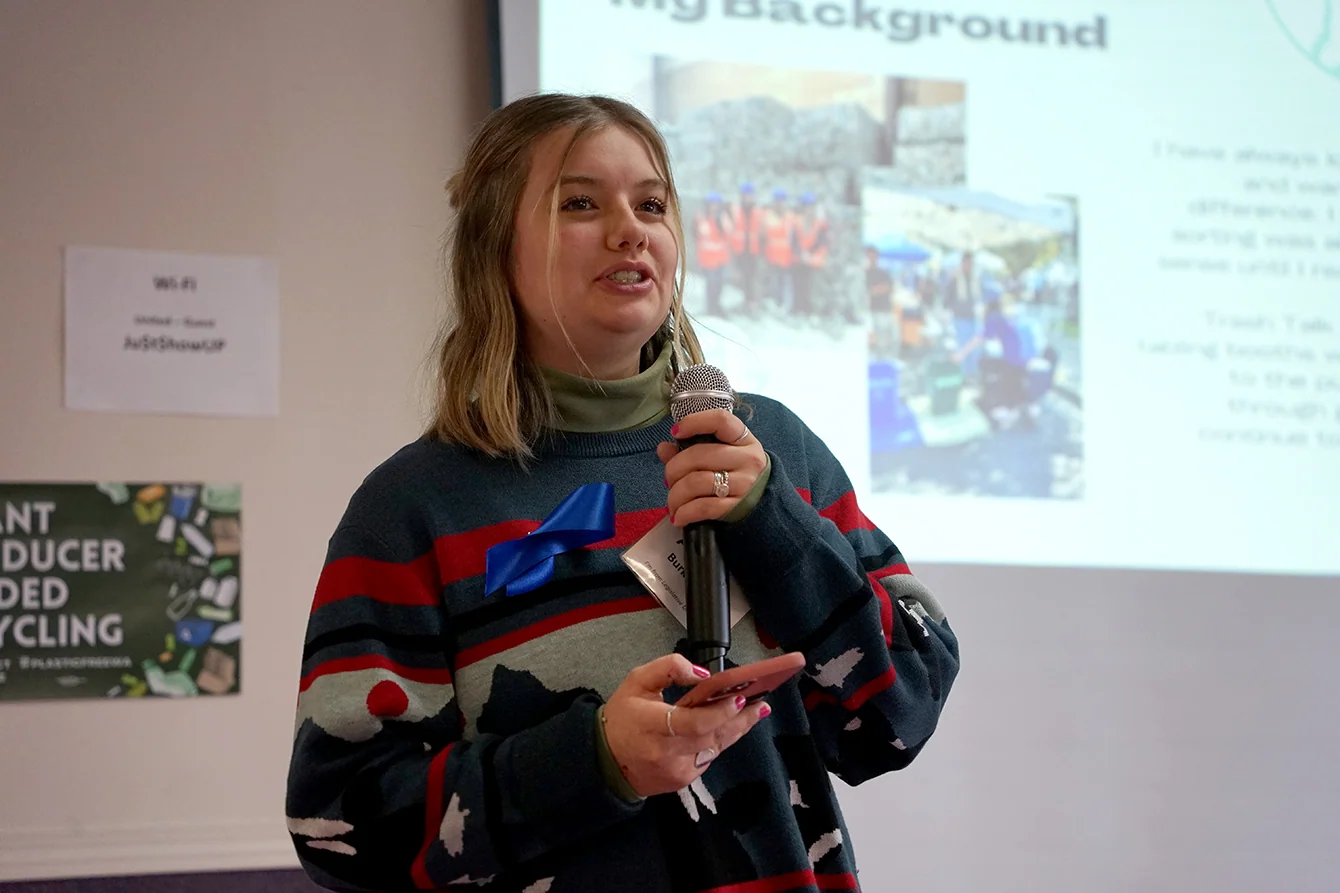
During the Lobby Day lunch speaker series, Athena Burk Bravo, a former Seattle Aquarium YOA, exemplified the different ways young people can reduce plastic pollution. Athena spoke to all the lobby day participants about her work founding a nonprofit called Trash Talk, which educates King County residents about the impact of recycling and pollution.
Athena Burk Bravo, a former Youth Ocean Advocate, speaking to the group about her work as founder and president of Trash Talk. Credit: Pamela Clough.
At the end of the day, Nikki, a 16-year-old YOA from Sammamish, said, “It was just so inspiring being in a big group of people, all really passionate about the same cause. And that really gets me excited to maybe attend more events like this and keep looking into what goes on with the ReWRAP Act.”
Recruitment for the new cohort of Seattle Aquarium Youth Ocean Advocates begins with orientation sessions in March. If you or a high schooler you know wants to participate in advocacy opportunities like this, you can go to the YOA webpage for more information. In the meantime, check out the rest of our 2024 State Legislative Priorities and stay up to date on the ReWRAP Act and other action opportunities by signing up for our policy action alerts!
Why is the Seattle Aquarium bringing tropical ecosystems to people in Seattle? After all, the Pacific Northwest, our own backyard, is home to vibrant and diverse marine life.
That’s certainly true. What’s also true is that ocean health is part of a bigger picture. Actions by people in other parts of the world impact our local waters and the animals who live there. And what we do here affects animals and waters far away.
Regenerating a healthy ocean begins with understanding how one ocean connects us all.
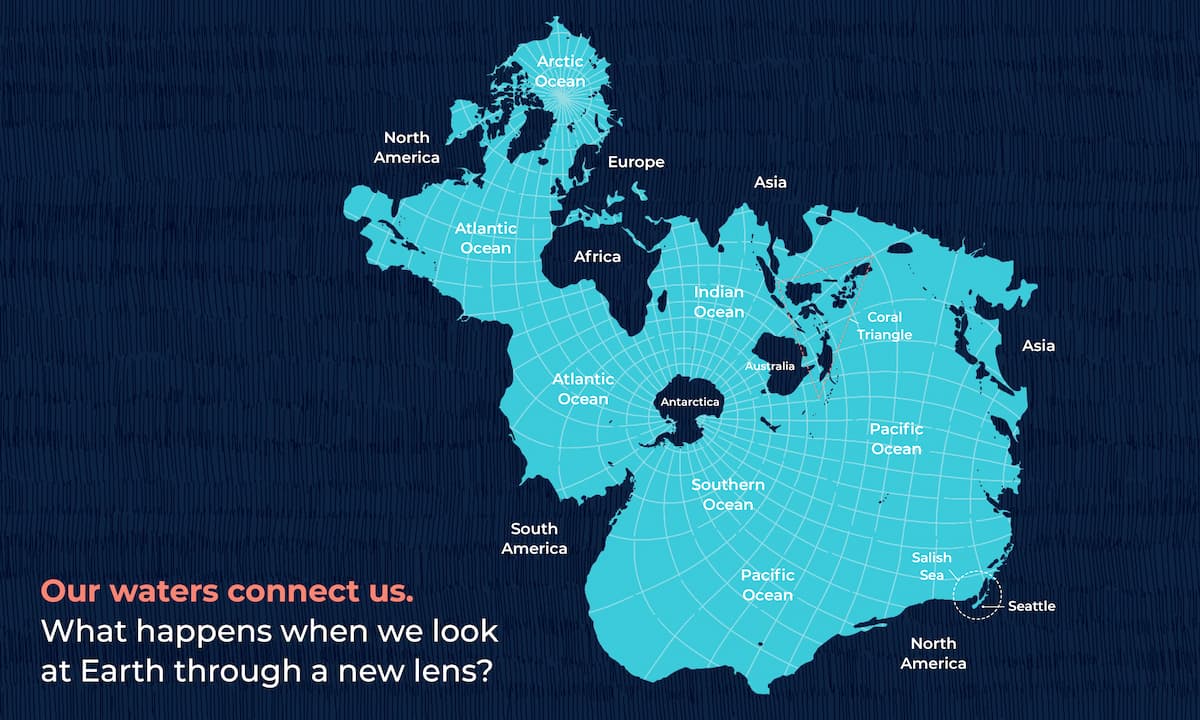
In school, many of us learned about five oceans or seven seas. Amind-bending image called the Spilhaus Projection shows us another way of looking at the blue planet. It focuses our gaze on one connected ocean, a place where animals move freely across vast, borderless waters.Can you spot home on this map?
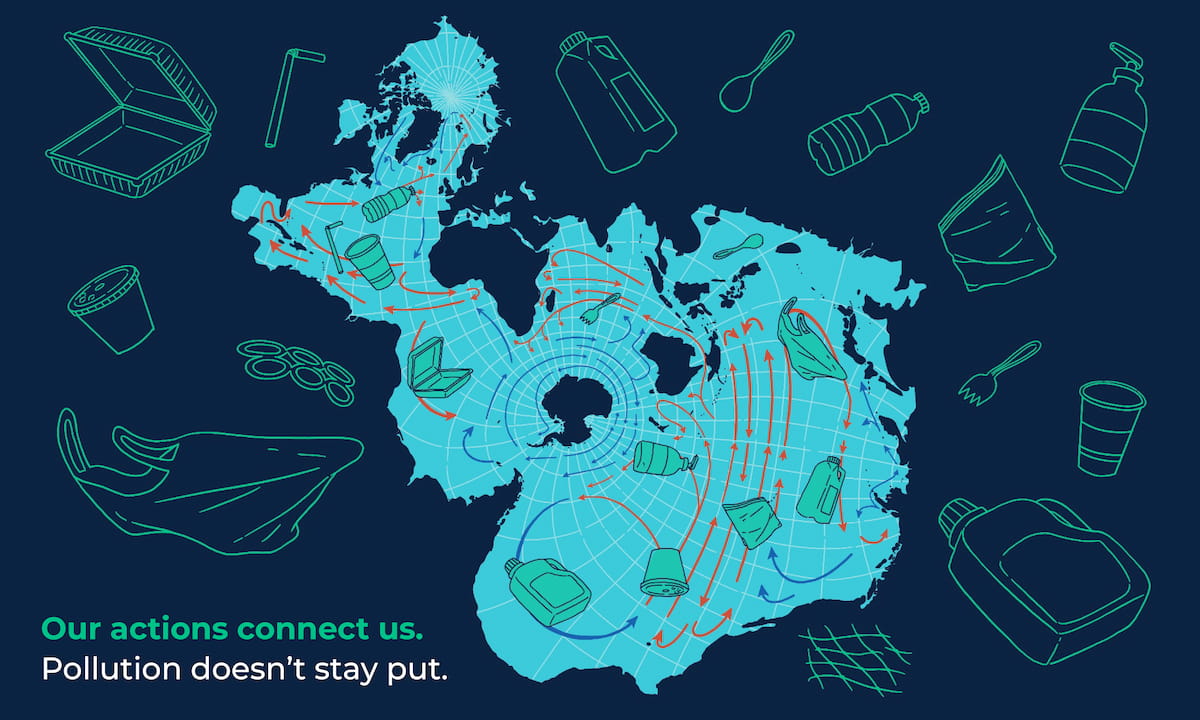
Scientists have identifiedhuman-made chemicals and plastic debris in the deepest, most inaccessible parts of the ocean, ferried there bya complex system of currents.What’s more, the carbon we emit into the atmosphere makes the ocean warmer and more acidic everywhere.How we live andthe actions of our businesses and governmentsaffect the health of our entire planet.
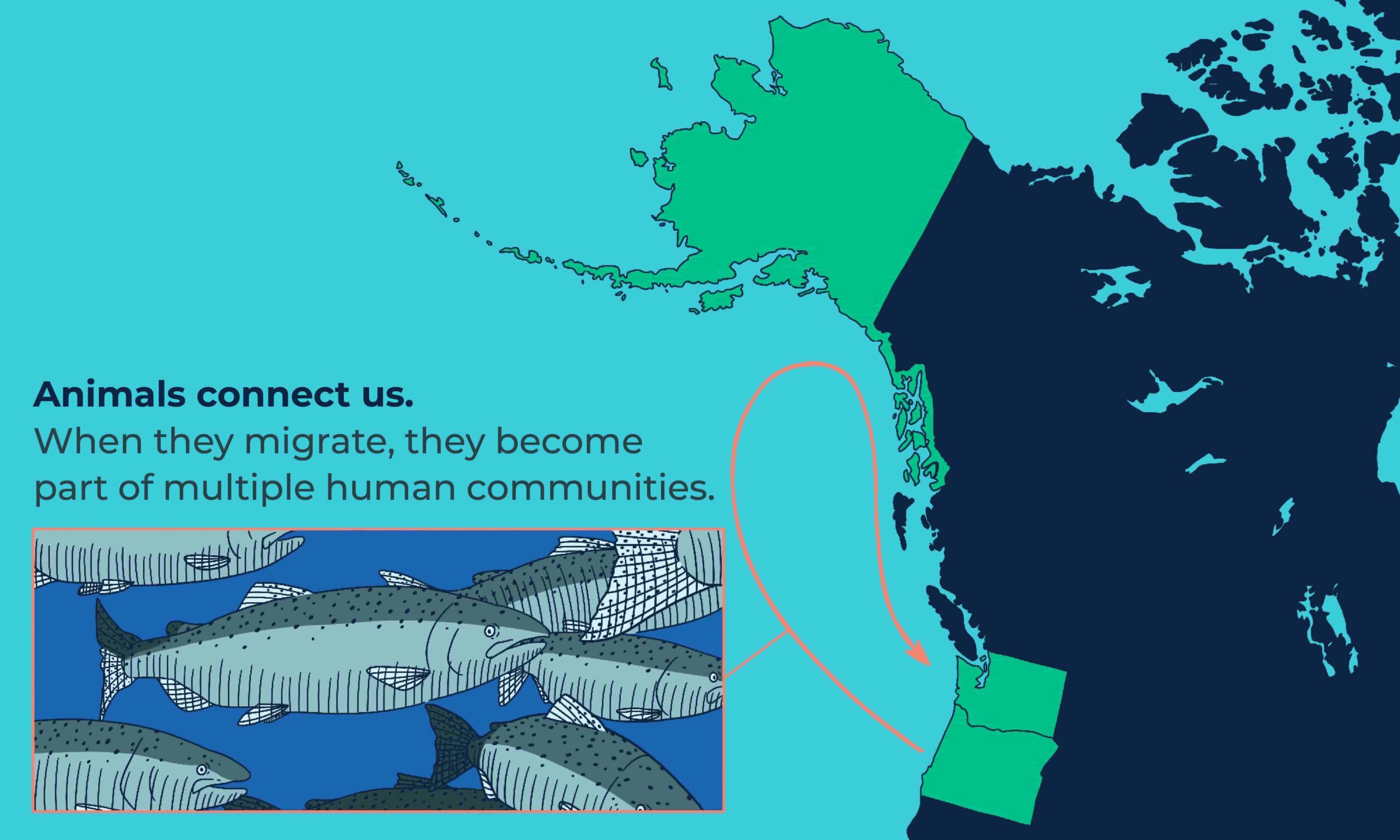
Marine animalshold cultural and economic importance to people in multiple regions. For example, some “Alaskan wild-caught”salmon spawned in Washington streams(or hatcheries)just a few years earlier. Policies to protect salmon here also protect the livelihoods of people in Alaska.And likewise, how fishing is managed in Alaska affects salmon populations here and local animals that feed on them, including critically endangered southern resident orcas. As climate change drives some animals into unfamiliarwaters, new communities will join their network of stewards. Now consider how these ideas apply to an animal with a huge migratory range, like a humpback whale! Some humpback whales can migrate 3,000 miles, from the waters off Alaska to the waters of Hawaiߵi. Imagine all the other ecosystems and communities they touch!
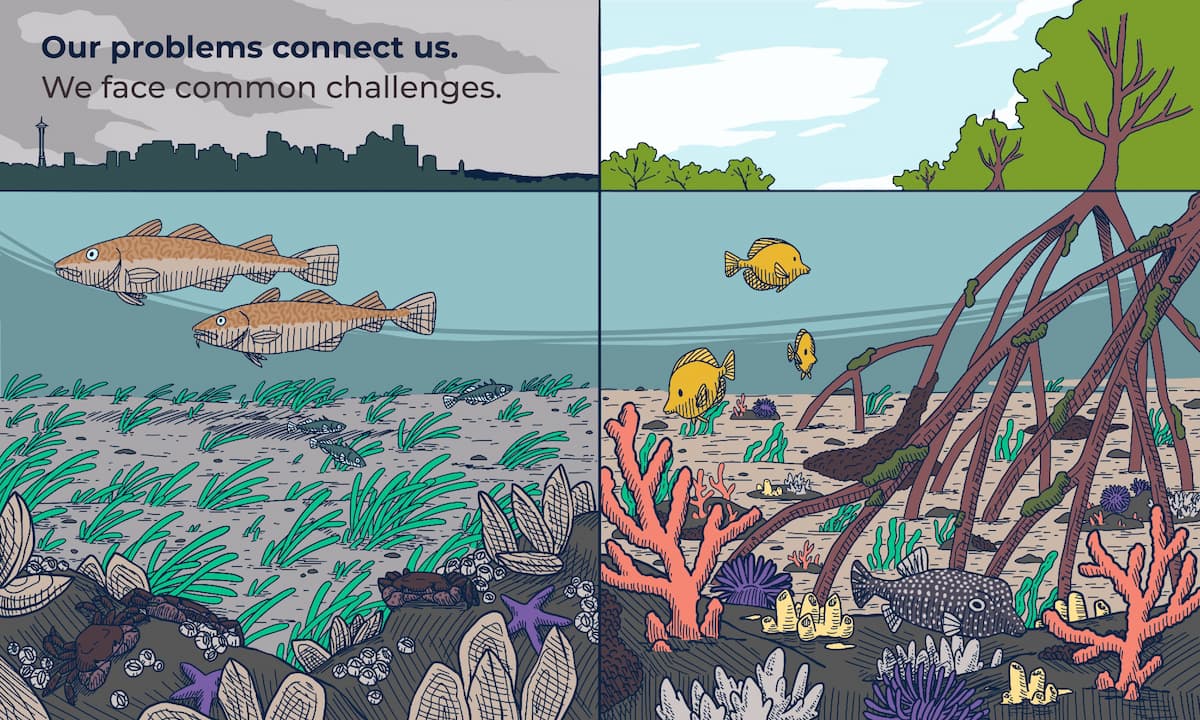
Like the Salish Sea, the Coral Triangleis a place of beauty and biodiversity. Because of the number and variety of species in the Coral Triangle, some people call it the “Amazon rainforest” of the ocean. Sadly, in both the Salish Sea and Coral Triangle,overfishing, pollution, development and climate change are taking a heavy toll.We’re losing iconic animals (like orcas and whale sharks), habitats that serve as fish nurseries (like eelgrassand mangrove forests) and important species that are sensitive to changes in ocean acidity (like oystersand coral reefs).We have much more in common than it might seem.
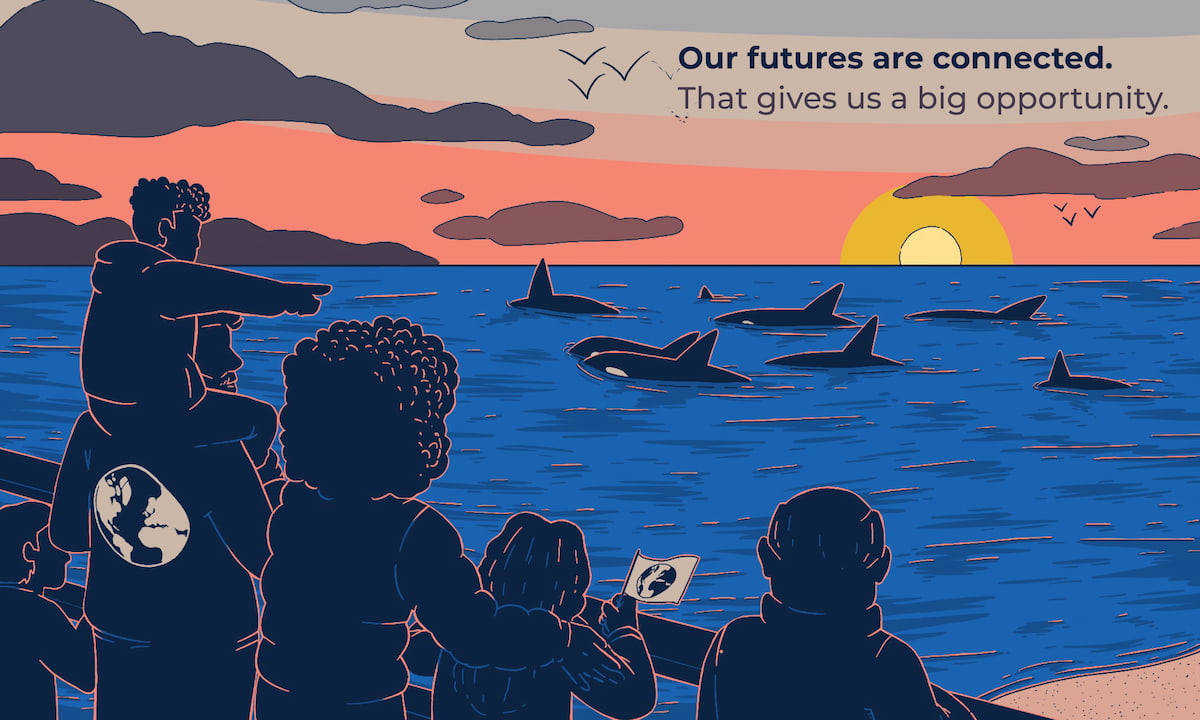
Shared problems can meanshared solutions—and hope. Did you know that governments in all six Coral Triangle countries—Indonesia, Malaysia, the Philippines, Papua New Guinea, Timor Leste and the Solomon Islands—have establishedmarineprotected areas that strictly manage human activities? Similarly, the Olympic Coast National Marine Sanctuaryhelpsanimals off the coast of Washington thrive. Bans on lightweight plastic bags, a major contributor to ocean pollution, have flourished in recent years. In addition to states likeWashington, countries including Botswana, Haiti, Morocco, New Zealand and dozens of others have banned them.Rewilding initiatives—like ReShark, which was cofounded by the Seattle Aquarium and has 90+ global partners—are breeding and restoring wild populations of threatened species.Young people, including the Seattle Aquarium’s Youth Ocean Advocates, are making their voices heard worldwide.Indigenous communities around the world are playing leading roles in the climate justice movement. Looking for a way into this work? There are many. Find an effort that excites youand get involved.
Make new connections
When the Aquarium’s new Ocean Pavilionopens in 2024, you’ll be able to explore habitats that reflect the exquisite biodiversity of the Coral Triangleand the precious animals there. You’ll hear stories about leaders who are making a difference in ocean health. And get ready to join them!
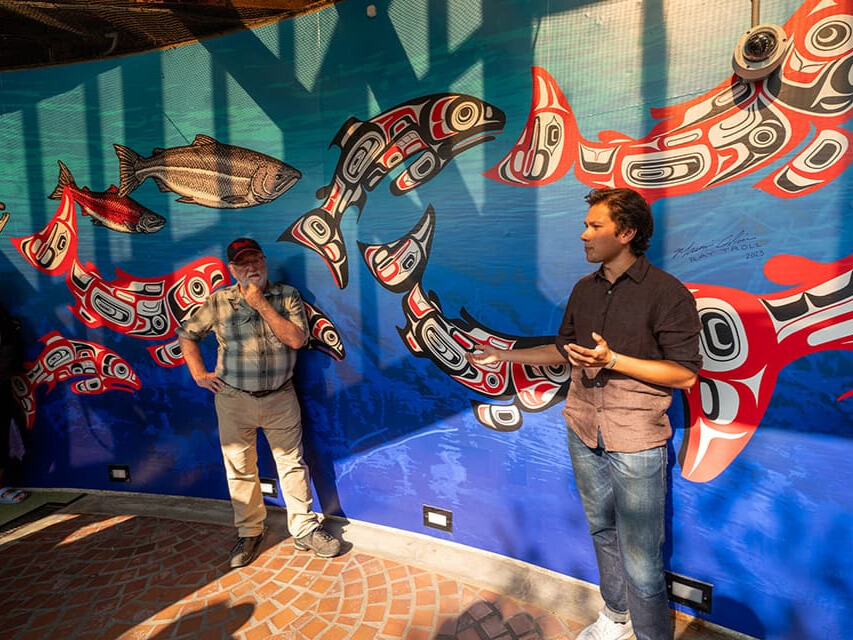
The Seattle Aquarium is proud to display two new murals from celebrated artists Ray Troll, Grace Freeman and the late Marvin E. Oliver (Quinault/Isleta Pueblo). “Salish Seascape” and “Ocean Travelers” now adorn the walls of the Aquarium’s Marine Mammals habitat.
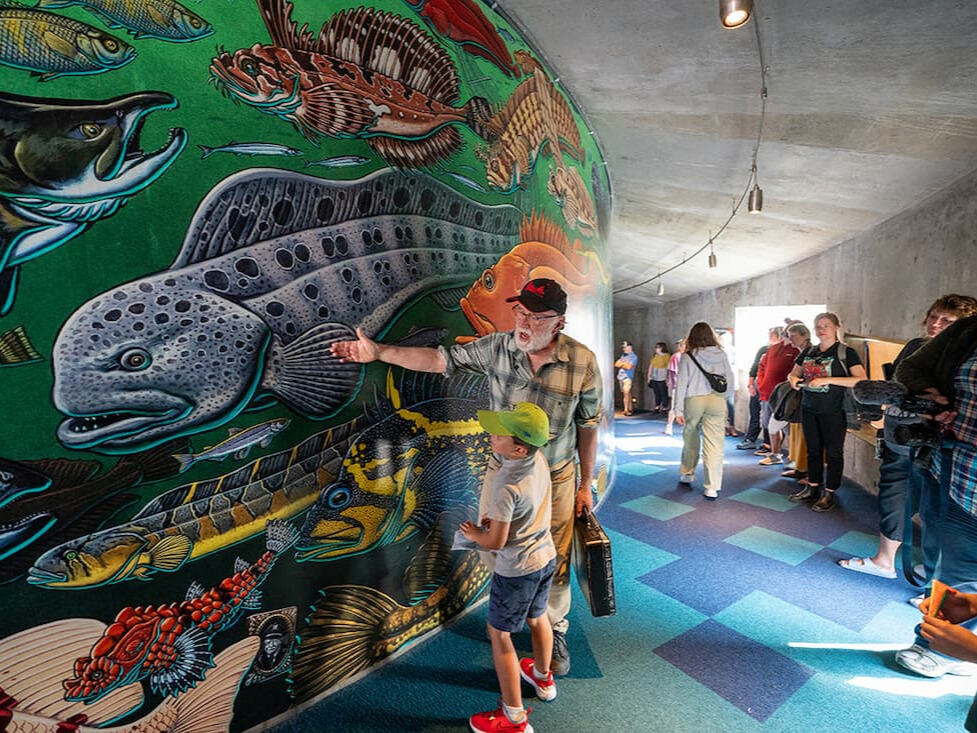
“Salish Seascape” celebrates the diverse array of life that make their homes in and along the Salish Sea, which is a coastal extension of the Pacific Ocean that includes Puget Sound. The fish are drawn in Ray’s signature style, which has been dubbed “scientific surrealism.” For this piece, Ray dug deep into the catalog of drawings he’s created over his decades-long career. Many of the fish featured in this mural are ones Ray originally created for the University of Washington in 2010.
“This mural is a combination of a career’s worth of work with all my fish stuff from the Pacific Northwest,” Ray says.
The mural came to life when artist Grace Freeman digitized Ray’s designs and added her own touches, like the mermaid swimming around in the upper right section. The artists added other hidden gems to the seascape, including a pencil, paintbrush and portrait of Ivar Haglund, founder of the seafood restaurant chain Ivar’s.
Artist Ray Troll at the Aquarium's September 2023 dedication of his new mural “Salish Seascape.”
Artists Ray Troll and Owen Oliver (Quinault/Isleta Pueblo), son of the late Marvin E. Oliver (Quinault/Isleta Pueblo), discuss “Ocean Travelers,” which combines Ray and Marvin’s work into a single image.
“Ocean Travelers” features a run of salmon in the styles of Ray and the late Coast Salish artist Marvin E. Oliver. Ray and Marvin ran adjacent art studios in Ketchikan, Alaska before Marvin passed in 2019. Throughout their long friendship, they discussed doing a collaborative piece. This mural fulfills that wish.
“A friend of mine once said that art stands in the river of time,” Ray says. “And I’ve always liked that phrase. Marvin is no longer with us. But Marvin is still with us through his art.”
Marvin’s son, artist Owen Oliver (Quinault/Isleta Pueblo), said the work is a testament to the friendship between his father and Ray. It also pays homage to Indigenous values, as Coast Salish people have looked after these waters since time immemorial and continue to do so today.
A CHANCE TO GIVE BACK THROUGH ART
Ray has lived in Ketchikan for the past 40 years, but Seattle holds a special place in his heart. He moved to the city in 1977—the same year the Aquarium opened—and sold his prints at Pike Place Market. Since then, he’s spent a lot of time at the Aquarium because he considers it one of the best places to see fish in action without having to take a dive.
Ray has long been fascinated with underwater creatures, a feeling he hopes to share through his art. He’s proud to have his work displayed in the Aquarium that helped feed his curiosity and continues to inspire that same feeling in others.
“If you get people to stop for a second and marvel at something as tiny as a Pacific spiny lumpsucker, you have fostered a sense of wonder and awe and fascination,” Ray says. “And if you become fascinated by something, you begin to care for it.”
The Aquarium would like to thank Marvin’s family, Ray and Grace for allowing us to display their art. We are proud to showcase art from such talented, passionate people who care deeply about nature. These murals reflect our S.A.L.I.S.H. values, which include inspiring a sense of excited curiosity in our guests and honoring the Indigenous peoples who were the original stewards of this area and currently play a valuable role in guiding its conservation.
Editor’s note: As of spring 2024, the Seattle Aquarium is targeting Zero Carbon Certification, a different certification offered by the International Future Living Institute (ILFI). Though our target certification has changed, the building sustainability features detailed in this story remain the same. We’re proud to be the first aquarium building in the world seeking certification from the ILFI, and we hope to be the first of many. Learn more about Zero Carbon Certification here.
Aquariums are complex buildings. They need to be, to keep aquatic animals safe and healthy.
But can a building as complex as an aquarium also meet some of the world’s toughest green building standards? We think so—and we’re designing our new Ocean Pavilion to do just that.
The Seattle Aquarium already offsets more carbon than we emit and has ambitious goals for energy, water, materials use and zero waste. Building the Ocean Pavilion gave us the chance to go even further.
Challenge Accepted!
With the Ocean Pavilion, we’re taking part in a global sustainability certification program called the Living Building Challenge. Created in 2006, the Challenge guides participants to dramatically raise the bar from “doing less harm” to serving as stewards of our environment and co-creators of a future in which all living beings thrive.
Today, many green building experts consider the Living Building Challenge to be the most advanced measure of sustainability—beyond the more widely known Leadership in Energy and Environmental Design (LEED) certification. Quick note: The Ocean Pavilion will also be LEED Gold-certified, as required for new City of Seattle-owned buildings.
Why are Living Building Challenge certifications so highly regarded?
Performance over plans: Living Building Challenge certifications are based on a building’s actual performance data. To earn the certification we’re seeking, we’ll need to show measurable proof of how the Ocean Pavilion operates and uses energy and water for 12 consecutive months. That’s a step beyond LEED certifications, which are based on building plans.
A holistic view: Living Building Challenge certifications look at the usual technical performance areas, like energy and water use. But they also depend on demonstrating whether a project’s design helps people and communities thrive.
Petals, as in ... flower petals?
In the language of the Challenge, performance areas are called petals. That’s because the creators of the Challenge believe that the ideal building functions as efficiently and is as beautiful as a flower.
We’re working toward Living Building Challenge Petal Certification. To earn it, we’ll need to meet requirements in key performance areas (or petals, in Challenge-speak). The petals we’re currently targeting are energy, water, beauty, equity and place.
As we continue to revitalize our full Aquarium campus, we’re planning to pursue the remaining petals (materials, health and happiness) on the path to full Living Building Challenge certification. Dive deeper into the intent and requirements for each petal.
Why this matters
We all impact the ocean through our actions. The Aquarium is no different!
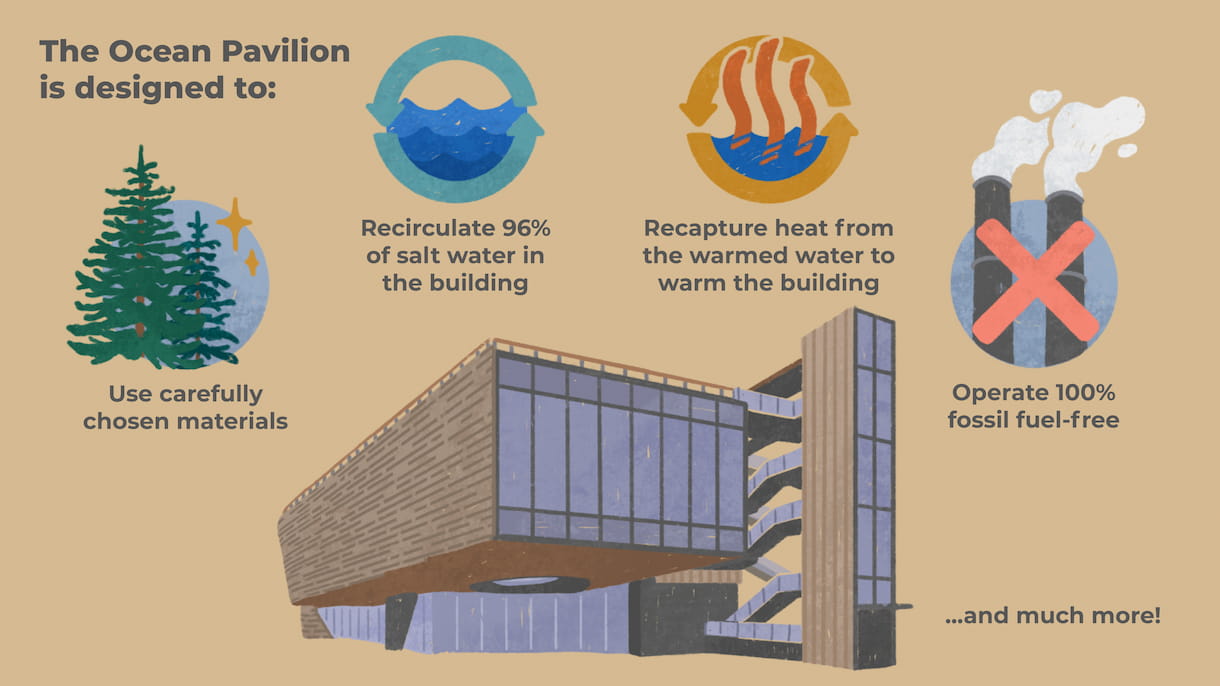
We’ve designed the Ocean Pavilion to:
Operate 100% fossil fuel free.
Recirculate 96% of the salt water in the building.
Recapture heat from the warmed water to warm the building, a 91% energy savings.
Use carefully chosen materials, like the Alaskan yellow cedar exterior panels, which will be Forest Stewardship Council-certified and procured from an Indigenous-led company.
And much more!
Watch the video to explore how salt water works in the Ocean Pavilion!
As we revitalize our other buildings, we envision contributing to Seattle’s renewable energy grid and building a mechanism to filter and clean water before returning it to Puget Sound.
The Living Building Challenge was created by The International Future Living Institute—a global nonprofit that certifies advanced sustainable and regenerative buildings.
As we push the boundaries for sustainable aquariums, we’re building on the momentum of other leaders:
PCC Community Markets is the first grocery store in the world to pursue Petal Certification.
Global companies Google and Etsy both have office buildings that are Petal-certified.
Climate Pledge Arena is pursuing Zero-Carbon Certification, also offered by the International Future Living Institute.
The Bullitt Building, one of the world’s greenest commercial buildings, is a local example of a fully Living Building Challenge-certified project.
We look forward to sharing our progress as we work toward Living Building Challenge Petal Certification! To learn more about this exciting project, visit our Ocean Pavilion webpages.
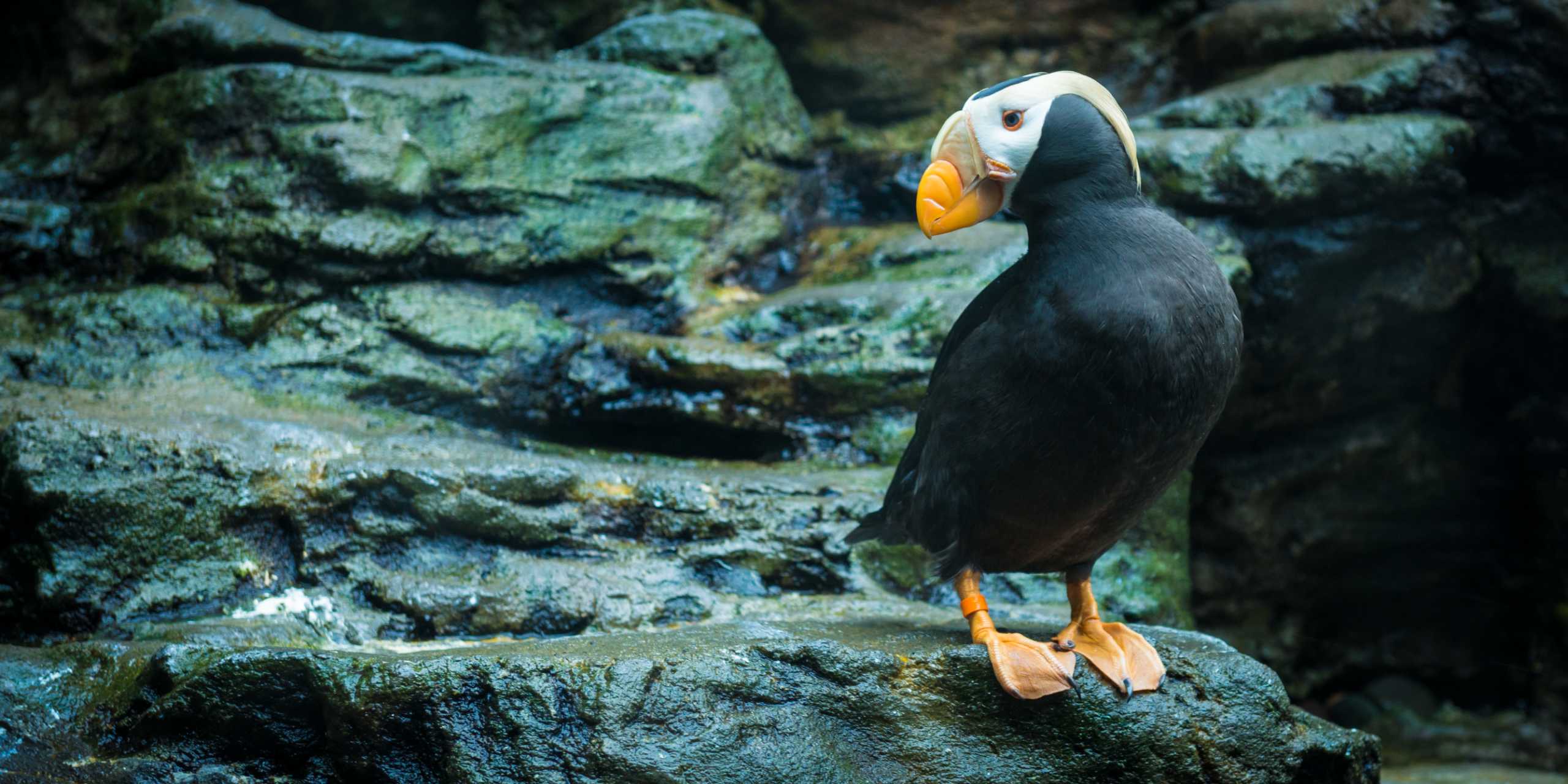
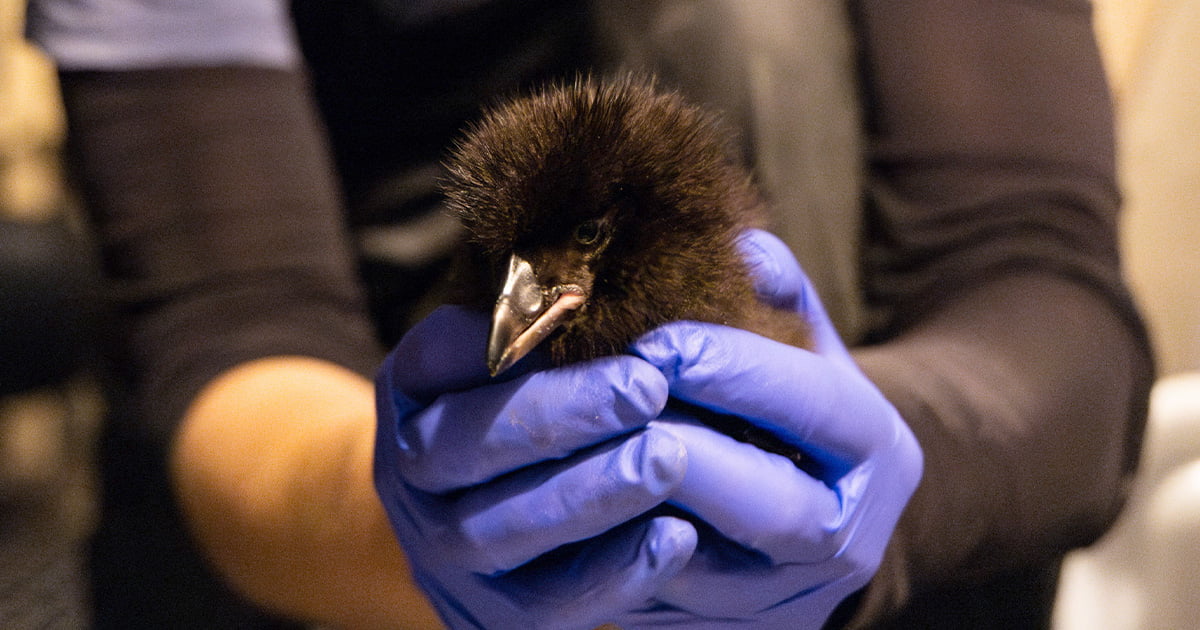
The Seattle Aquarium got a little (or a lot) cuter on August 3 when we welcomed a new tufted puffin chick, aka a “puffling!” This fluffball is the first puffling chick to hatch at the Aquarium since 2019.
The doting parents are longtime bonded pair Dora (who wears a yellow band on her left leg) and Boots (who sports red and blue bands). Tufted puffins generally mate for life and raise one chick at a time. Couples share parenting duties, like nest building, egg incubation and feeding their chick.
Like most animals, birds are vulnerable when they are young. Sadly, in the wild, many tufted pufflings don’t survive to adulthood. At the Aquarium, this chick is benefiting from a protected space and top-notch care from both animal and human caretakers. Dora and Boots, along with our dedicated Birds & Mammals team, have been keeping a close watch on the little one.
So far, the chick has a healthy appetite and is doing well. Talk about a tough little puff!
Privacy for the puffling
Dora, Boots and their little one have a nest in a secluded burrow in the upper section of their habitat. The chick will stay out of sight for a while, taking time to grow. Our team expects the puffling to fledge, or leave the burrow and join other members of the habitat, this fall.
In the meantime, Aquarium guests can check out other seabirds—including SEAlebrity tufted puffin Phelps—in the Birds & Shores habitat. You might even catch Dora or Boots gathering fish to bring to the chick or just taking a rest. Parents need breaks too!
To learn more about tufted puffins, aka the “parrots of the sea,” check out their fact page.
P.S. Our Birds and Mammals team is still deciding on a name for the little fuzzball. Keep an eye out on the Aquarium’s social media channels for the name reveal!
This story is part of our Nerdy Science Series—how we’re using research and technology in service of a healthy ocean.
Sharks have roamed the ocean since before dinosaurs walked the earth. But today, around a third of the world’s 500+ shark species are threatened with extinction. New research co-authored by Riley Pollom of the Seattle Aquarium offers a way forward.
Why are sharks going extinct?
In a word: overfishing. Fishing—legal and illegal—kills around 100 million sharks every year. Sharks are targeted as sources of food and products; they’re also caught as bycatch in the hunt for other species. Because sharks take longer on average than other ocean animals to mature and reproduce, their populations often don’t recover quickly. Sometimes they don’t come back at all.
When shark species go extinct, the loss has a ripple effect. Ocean food webs are delicate, and the disappearance of a major predator can wreak havoc, sometimes causing the populations of other animals in the system to swell or shrink in unpredictable ways. The impact of these big changes often falls on coastal communities who rely on small-scale fishing for food and income. But as we lose species at an unprecedented rate, all of us will be affected.
Aquariums have the knowledge and capacity to play an important role in population management when things get dire. There’s a point of no return, and we need to avoid it.
A clue on how to turn the tide
A team of researchers that included Riley analyzed shark populations throughout the Western Atlantic Ocean over decades.
But—as the research team found—sharks in the Northwest and Western Central Atlantic are now making a comeback. In fact, some species that were on the verge of collapse in the 1980s and 1990s are now at stable or even growing populations.
Meanwhile, the situation is very different in the Southwest Atlantic. There, almost all populations of shark species—including many of the same species that are recovering in other regions—are still in trouble.
What’s fueled the difference? The answer, researchers found, is strong fisheries management.
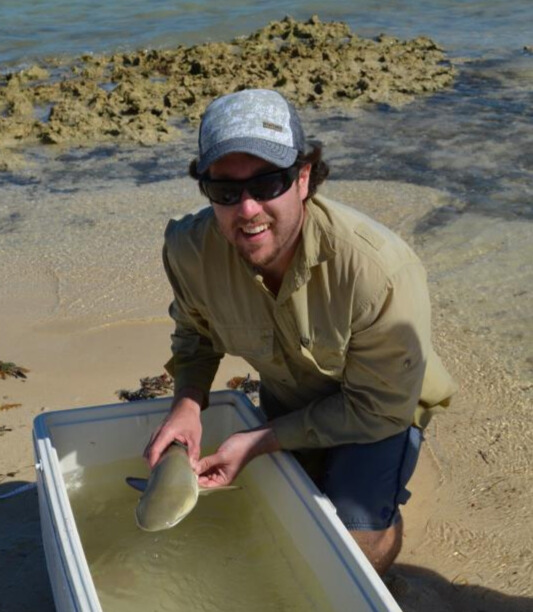
Riley doing field work on lemon shark populations in the Bahamas.
Fisheries management refers to setting, enforcing and monitoring strict limits on how many animals can be caught, where and when they can be caught, and other important rules. Where these practices are robust, like the Northwest and Western Central Atlantic, shark and ray populations are rebounding. Where they are weak or nonexistent, many species are on the verge of extinction or heading that way.
“If strong fisheries management measures are implemented elsewhere, we would expect to see similar recovery,” Riley says.
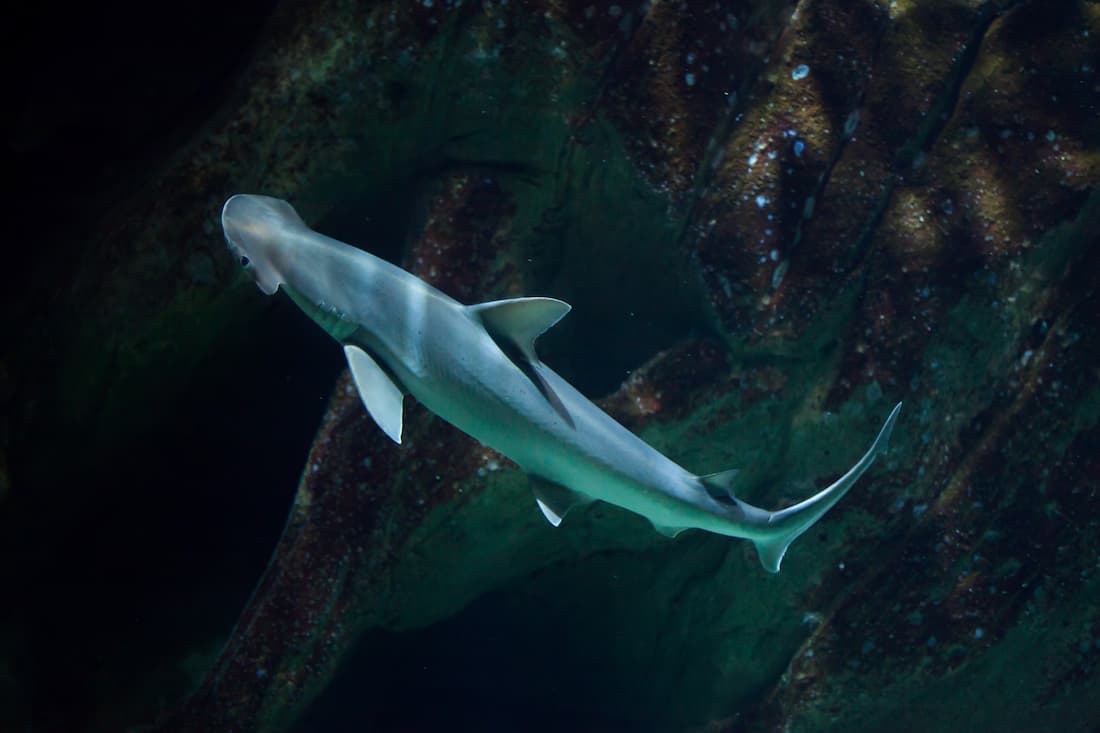
The Bonnethead shark (Sphyrna tiburo), pictured here, is now making a comeback in the Northwest Atlantic.
Avoiding the extinction vortex
As the new research shows, protective measures work. But in some cases, those measures aren’t enough.
In a situation that conservationists call the “extinction vortex,” the population of an endangered species drops so low that even if other threats are removed, the species will not recover and may still go extinct. That’s because when populations are small enough, males and females have trouble finding each other. Those that do risk inbreeding, introducing genetic defects and weakening fitness.
In some cases, direct intervention by people might be the only way to avoid the extinction vortex. Increasingly, aquariums are getting involved in this work.
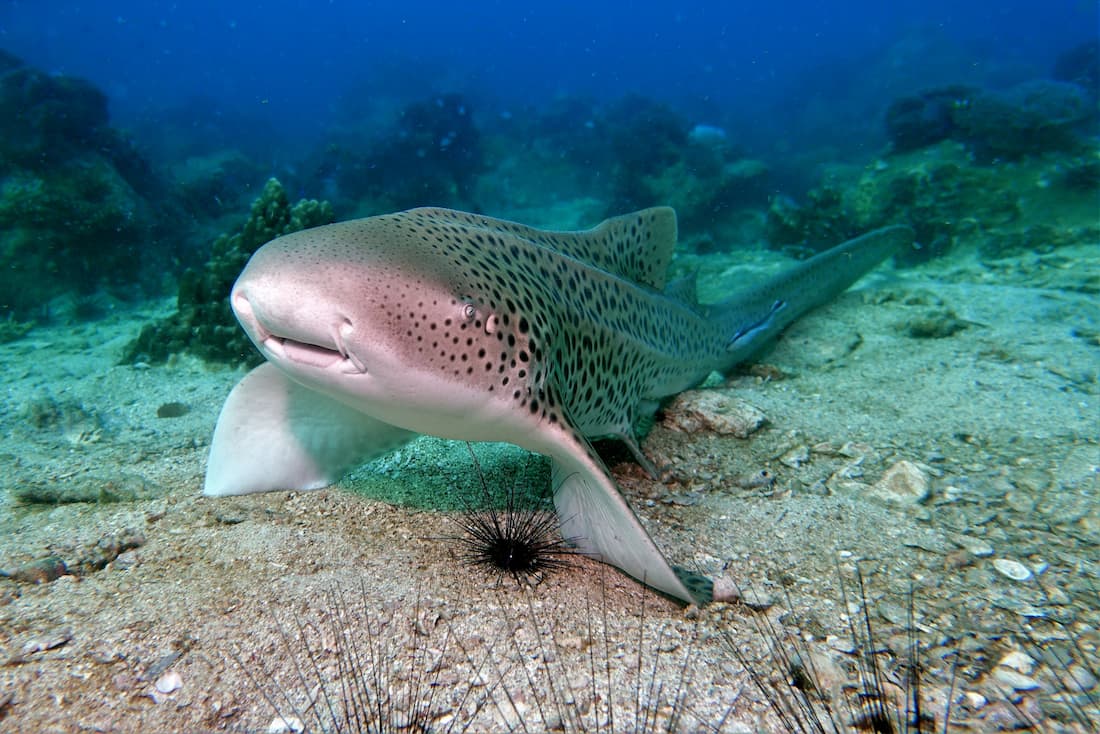
In 2020, the Seattle Aquarium helped launch ReShark—a global collective to recover threatened shark and ray species. ReShark’s first project is to breed and release Indo-Pacific leopard sharks, which have all but vanished from their home waters off the coast of Raja Ampat, Indonesia. Projects like this are still novel for aquariums—but so far, ReShark has had early success rearing shark eggs born in aquariums for release into their marine-protected home waters. (Read National Geographic’s coverage.)
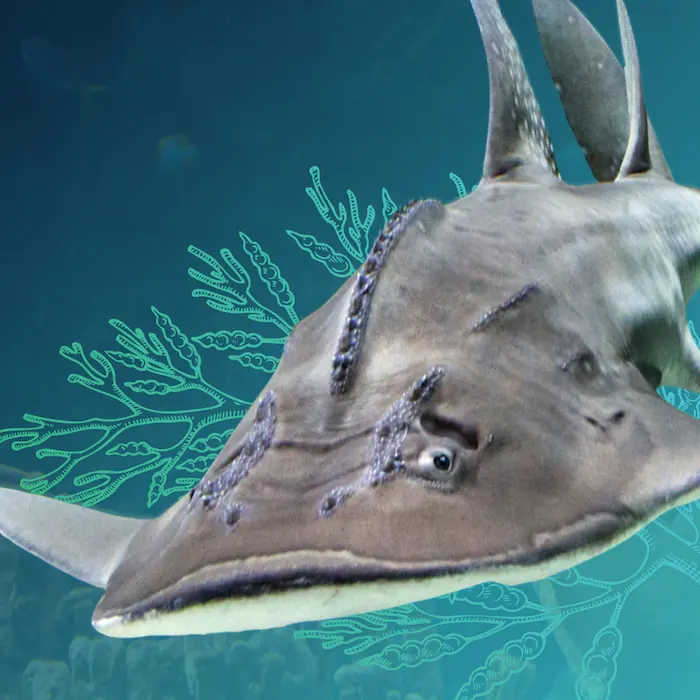
The Seattle Aquarium helped launch a global partnership to recover endangered sharks, beginning with Indo-Pacific leopard sharks (Stegostoma tigrinum) like this one.
As species recovery program manager, Riley is helping to lead the Aquarium’s growing programs and partnerships to bring back threatened species in Washington State and internationally.
What can individuals do?
Wherever you live, “Vote with the ocean in mind,” Riley says. “Learn and understand politicians’ stances on ocean policies and fisheries management policies.” When we’re informed, we can advocate for setting and enforcing strong fisheries management. Join the Aquarium’s email list to receive alerts on how you can support our state and federal advocacy on behalf of the ocean.
This story is part of our Nerdy Science Series—how we’re using research and technology in service of a healthy ocean.
During 2014, a mass of warm water nicknamed “the blob” simmered and spread in the Pacific Ocean. It lingered until early 2016, wreaking havoc on marine ecosystems and causing a mass coral bleaching event in Hawaiʻi’. Then in 2019, another marine heat wave struck Hawaiʻi, reminiscent of the blob. Smaller heatwaves have followed.
Seattle Aquarium research technician Amy Olsen was born and raised on Hawaiʻi’s Big Island. Rising ocean temperatures, which most scientists attribute to climate change, are transforming her home. Today, as a marine scientist for the Aquarium, Amy is leading scientific papers that analyze how those changes are affecting fish populations off the Big Island’s coast.
"By 2025, marine heatwaves are likely to occur every year. There is an urgent need to see what’s happening now and how we can anticipate and mitigate those changes."
Seattle Aquarium researcher Amy Olsen in action.
Working Far Beyond our Walls
For nearly 40 years, Hawaiʻi ecosystems have been part of the Seattle Aquarium experience. If you’ve visited the Aquarium, you’ve likely marveled at Pacific Coral Reef, a lush community of corals, puffers, tangs, wrasses and other members of tropical reefs.
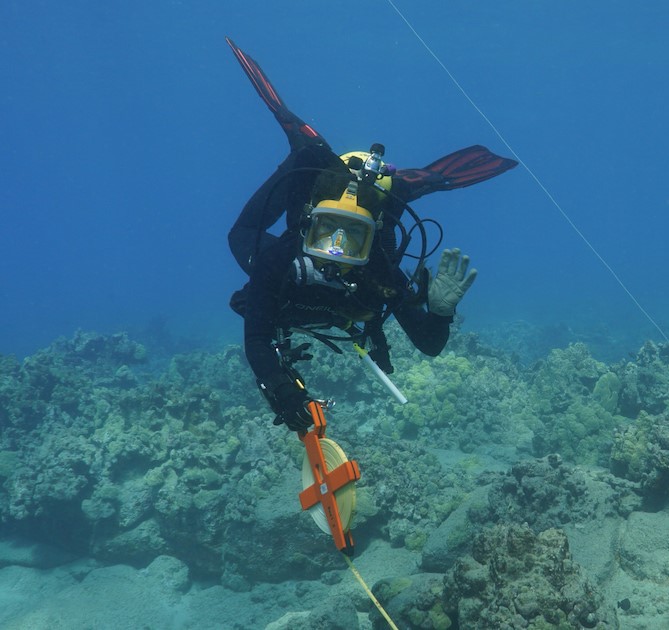
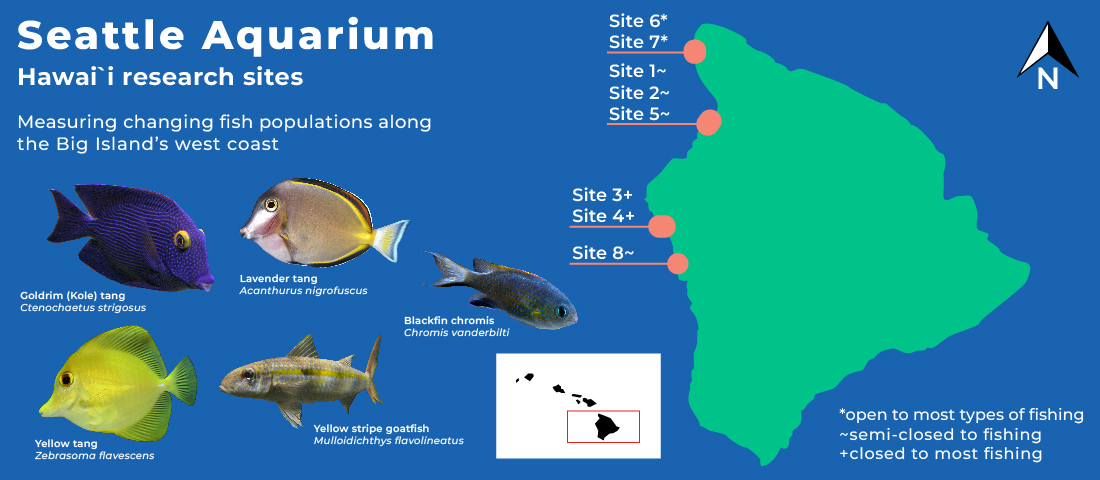
But what isn’t visible to Aquarium visitors is the scientific research that takes place outside its walls. Since 2009, Aquarium researchers have traveled to Hawaiʻi and donned scuba gear to track fish populations in eight locations off the west coast of the Big Island.
Their goal: to provide long-term data on the health of fish populations.
Connecting Research and Home
“This research is a way to give back to the place where I was raised,” Amy says.
She joined the Aquarium’s Hawaiʻi research team in 2014, the same year the blob struck. She later decided to focus her master’s thesis on how marine heat waves affected groups of fish, using Aquarium data gathered between 2009 and 2019.
Amy works closely with Dr. Shawn Larson, senior conservation research manager—who launched the Aquarium’s Hawaiʻi research—and a multidisciplinary Aquarium team that includes conservation researchers, dive experts and scientists who specialize in fish and invertebrates.
The team uses a unique method to measure fish populations each year. It’s the same method we’ve used to monitor local Salish Sea fish populations for decades. Researchers dive along defined 100-meter sections (transects) of the ocean while wearing underwater cameras. As they swim along a transect, they speak into a microphone, narrating the species and number of fish in their line of sight and creating a recording that can be analyzed later. The team uses GPS coordinates and visual notes to return to the same spots year after year without leaving behind physical markers that could impact marine life.
This method proved so efficient in the Aquarium’s Hawaiʻi research—where divers often had more than 100 species in sight—that the team published a special methods paper to share it with other researchers.
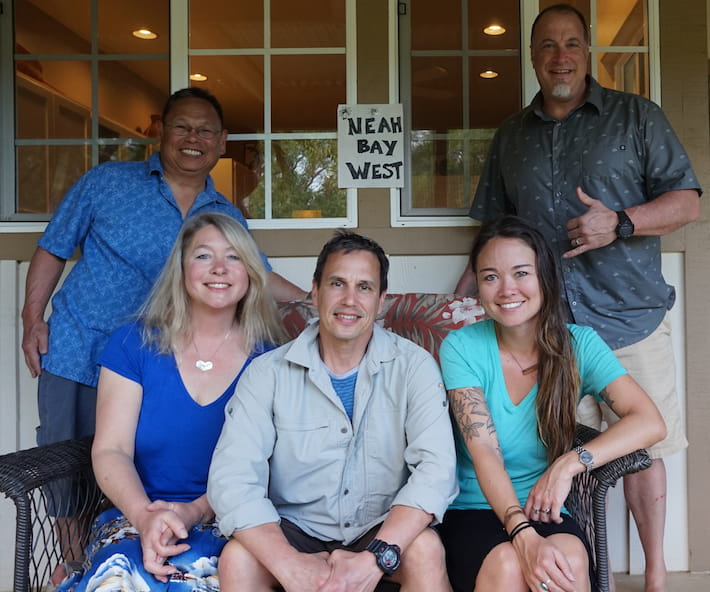
Seattle Aquarium researchers from a past Hawaiʻi project (left to right: Alan Tomita, Dr. Shawn Larson, Chris Van Damme, Amy Olsen and Joel Hollander).
The groups included predators, “secondary consumers” (typically small fish that eat other fish or plants), planktivores (animals that eat plankton), corallivores (animals that eat coral), browsers (which eat algae), grazers (which eat short, fibrous turf algae) and scrapers (which effectively clear algae from corals). Why so many groups? Each plays a unique role in their delicate food web.
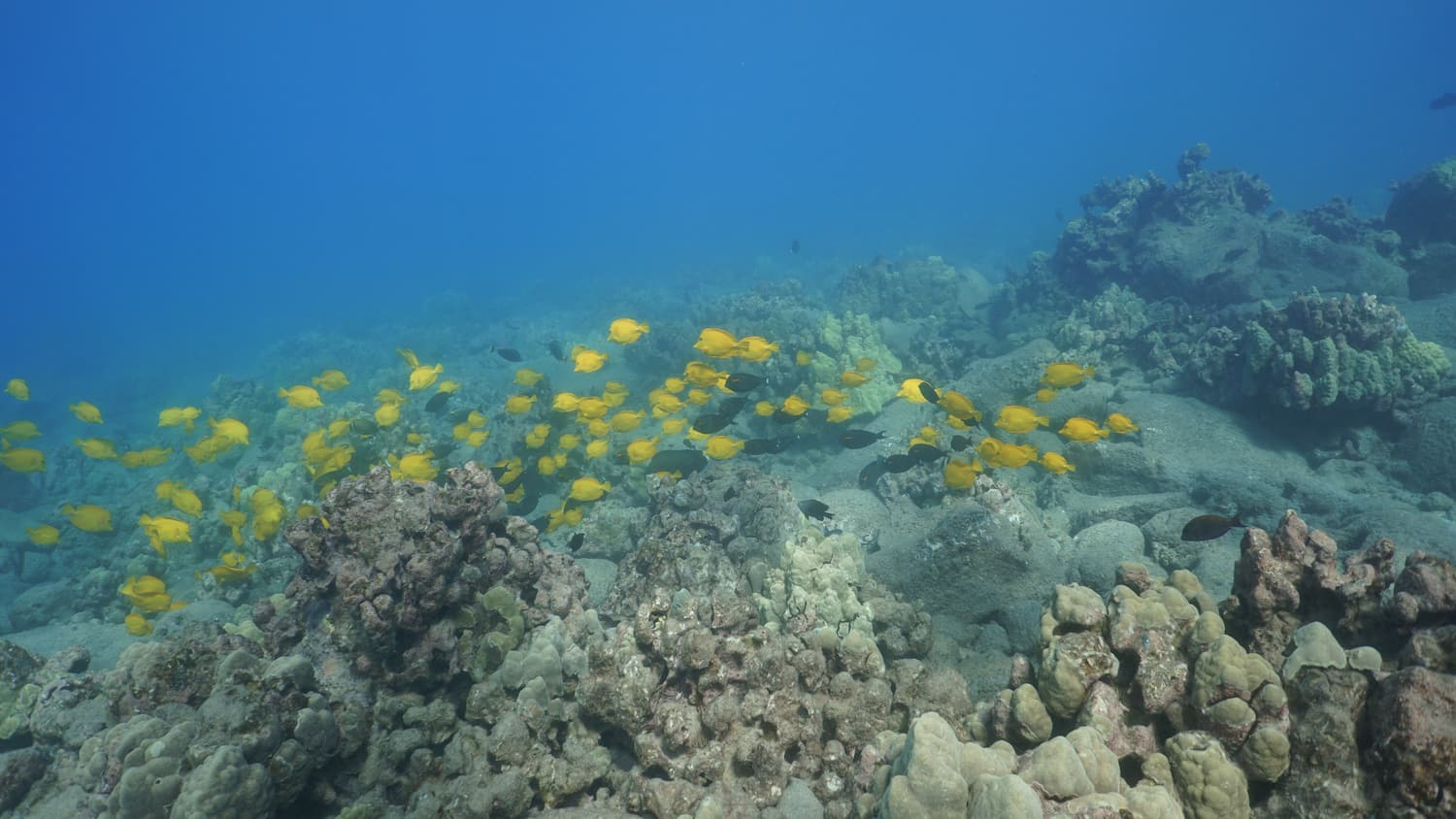
We’re researching how warming waters are affecting populations of fish, like these yellow tangs and kole tangs, in Hawaiʻi.
The research showed that after the 2014–2015 heat wave, fish populations in all groups increased. The group that grew the most were the grazers, tiny fish that eat turf algae.
“One hypothesis is that the heat wave encouraged more algae to grow,” Amy explains. “Fish that graze on it did well because they had more food.”
But any change to ocean food webs is complex. The same warming events that benefitted fish are devastating coral. The breakdown of coral will mean less food for the creatures that eat coral and fewer hiding spots for larger fish. The bottom line: Pulling a thread in ocean food webs can unravel the entire sweater.
My goal is that our scientific partners use this research to inform decision-making and policy. For individuals, I hope it encourages curiosity, behavior change and hope—because our actions do make a difference.
What can individuals do to help slow marine heatwaves and protect reefs?
A lot, Amy says. One simple action is to use reef-safe sunscreen, whether we’re swimming in Pacific Northwest or tropical waters. Coral reefs exist in both. With this small step, we can do less harm to wild populations of coral, which are already stressed.
Climate change remains one of the biggest challenges we and the ocean face. Shifting our day-to-day habits—from how much we drive to what we eat—matters. So does large-scale policy change. The Aquarium advocates for policies that address climate change and protect our ocean. Get involved by learning more and signing up for Seattle Aquarium action alerts.
Today only, your gift will be matched dollar-for-dollar up to $25,000 thanks to the generosity of donors Betsy Cadwallader, J & Tim, and Jess & Andy Peet. Help us reach our $50,000 goal!